
Some ideas just catch on like viruses. You know the kind – tunes playing in our heads from the Oscars, Super Bowl ads, storylines and bumper sticker slogans attacking teacher union selfishness and campaign-like talking points (‘public employees need to start making some "shared sacrifice’). The idea of mind viruses, aka "Memes" was developed by Richard Dawkins in his book The Selfish Gene. Dawkins came to this construct by analogy to how genes propagate themselves. Genes use the physical bodies they are housed in, as Dawkins said, selfishly. That is they have evolved to act only for their reproduction without knowing about or caring about their host’s quality of life. Genes succeed just as long as they are passed on. A side effect is that they help construct hosts that survive their environments.
Looked at this way genes are reproducing and infective specialists with side effects for hosts who need to survive environments to reproduce. Dawkins generalized this idea to propose that our mental life includes entities, which he called memes, that are similar to genes but
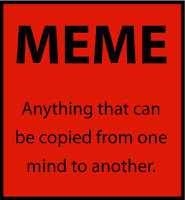
a unit of cultural transmission. They are ideas that play in a mental host and "seek" to replicate themselves in one mind after another. Having a host with advanced skills (think of early humans making tools) and communicative abilities allows better reproduction of ideas, especially if they are selfish in spreading themselves. So without conscious intent (let along divine ones) our memes infect host-minds, copying themselves not for host interests but for their own reproductive ability. The idea is more of a framework than a well worked out theory but people like Daniel Dennett think that considering the meme focus on “who profits” answers some key evolutionary and cultural ideas, such as chain reaction of one innovation leading to and affording another. A simple example is the idea of a belonging meme for human gregariousness. The concept of staying with others is reproduced, since there was safety in numbers for our ancestor’s tribes.
Dennett and Dawkins along with others have applied the idea vigorously to discuss various memes that they hypothesize are involved in propagating religious ideas. In this formulation ideas giving people a feeling of belonging to a group (say a religious group) have an advantage. There is also the idea of distinguishing oneself by doing something new, innovative, or significant. An individual with memes about how to find food, shelter, and stands out from the crowd is more likely to find a potential mate. Religious leaders stand above others and so a religious story meme is likely to be reproduced as they are voiced by what a tribe recognizes as favored mates.
But other non-religious cultural advances and economies of scale efficiencies may also be propagated by a concentrated population. One group economy of scale comes with such innovations such as farming which requires stable groups. Population concentration also then works to increase mate choices and possibilities, who in turn can pass on innovations.
I was reminded of the meme model by 2 recent things. The first was a light BBC article called 'How did the word "OK" conquer the world' which illustrates why some ideas spread and take over. The article was based on Allan Metcalf’s book
OK: The Improbable Story of America’s Greatest Word in which he traces the word’s journey from “joke to business tool and then to staple of everyday conversation and an attitude toward life.” "OK" like "you know" or "I mean" crops up in daily speech dozens of times every day, although it seems habitual and carries little real meaning. My personal knowledge of OK’s origin was limited to what was declared in a Pete Seager song - "
All Mixed Up". This asserted that OK came from Native American Choctaw - Okeh. But as Allan Metcalf explained the sound is also similar to Scottish German, Finnish and Greek affirmative words. Some idea-thing like OK is a good viral candidate in part because it sounds distinct but has simple acoustic components that are familiar to a multitude of languages. Thus its sound travels well and its graphic balance of the round /O/ and a /K/ made of straight lines makes it stand out clearly, easily distinguished from other words. These are good distinctions for a “Virus of the Mind” as Richard Brodie notes in his book of the same name. They help a meme virus get into the system and be communicated to others via a diffusion network. You can see some diffusion networks for recent memes that are afforded by the internet and social media
online.
But as Dawkins noted early on, we are now aware of memes and so are at a new stage where people can intentionally design mind viruses. Those of us aware of the danger or having an interest can track some forms using a tool like
Truthy .
Viral marketing is now a well known phenomena, which brings me to the 2nd phenomena that reminds me of memes – the attack on organized labor and the various memes of conservatives echoed my a mostly passive and tame media. It starts with simple sounding quotes as recorded in a NY Times article on dueling protests in Madison WI.
“‘You don’t care about this country! Shame on you, you’re selfish,’ one supporter of Gov. Scott Walker’s proposal told union supporters, wagging his finger as he spoke.”

Eric Alterman, for one, believes the issue of selfishness implied here isn’t merely rhetorical, but something we need to understand. It is dangerous. Alterman asks how did our country become a culture where “poor and middle-class folks willingly engage in internecine class warfare against one another, with one side essentially acting as a cat’s paw for mega-wealthy conservatives intent on undermining every worker protection in existence.” See http://www.thenation.com/blog/158844/whats-matter-wisconsin for the full article and the analogy to crabs fighting to escape a steaming pot. Altermann thinks that Thomas Frank framed an understanding of deceptive efforts by conservatives in his 2004 book,
What’s the Matter with Kansas? The problem is that many of us have fallen for well designed memes disguised as populist, conservative messages that are in fact in conflict with the middle and working classes best interests. These have been called truthy memes since they rely on deceptive tactics to represent misinformation and half truths as fact. In a phrase we are infected with some bad ideas, which we are also in danger of passing on. They are spreading through the culture in part because they are driven by some basic fear of decline and by being packaged in a simple, relatively message about who to blame. Easy targets make for simple messages, which move along more easily than cognitively complex ones.
One thing that makes these messages difficult to resist is that the mainstream media has adopted conventional storylines as their hot button topics. This is done while crowding out competing and less sexy memes that provide the larger context digging into the real causes of the accelerating budget deficits seen in Wisconsin and elsewhere around the country. The real story might be to understanding the confluence of the failed housing market, high unemployment and Wall Street speculating and wild leveraging. These, rather than meme stories about public-employee union activity, are much better predictors of which state’s revenues are now in the red. But they are not simple, “OK” stories. They appeal to higher understanding and not the sexy, fear-based, scapegoating message being pushed.
Nor do you get much hard to resist messages about how the new cohort of Conservative governors have (or are) enabling state budget deficits by slashing corporate tax rates. Ron Brownstein had a column on a new war front role that Republican governors are playing in Washington's conflicts now –“American politics increasingly resembles a kind of total war in which each party mobilizes every conceivable asset at its disposal against the other. Most governors were once conscientious objectors in that struggle.” Instead of these ideas being widely discussed we hear echoes of misinformation dressed up as good statistical analytics. One cited example is the talking-point meme-statistic used by GOP politicians around the country. It appeared in USA Today in this form in August during the campaign:
“At a time when workers' pay and benefits have stagnated, federal employees' average compensation has grown to more than double what private sector workers earn.” USA Today, August 10, 2010
This notion of public union employees milking excess benefits from local government while the rest of the middle-class is simultaneously struggling sparks much of the public’s resentment. But it is a designer meme that is easily refuted by grounded realists like Ezra Klein of the Post who pops meme bubbles like Organized labor is in the hands of the teacher's unions. Klein points out that, "Wisconsin public-sector workers face an annual compensation penalty of 11%. Adjusting for the slightly fewer hours worked per week on average, these public workers still face a compensation penalty of 5% for choosing to work in the public sector."
(see http://www.politicalruminations.com/2011/02/truth-about-wisconsin-public-sector-employees-compensation.html)

That’s a meme we need to hear more about. Like conservative stories it needs to be made ubiquitous and give some organic growth time to put down hardy roots into the public’s mind. This is what Conservative memes echoes over their media and do it religiously. When they are wrong on an issue, based on a hard look at the facts, they ignore the facts and keep repeating their meme story. Dangerous designer memes...Beware.
.
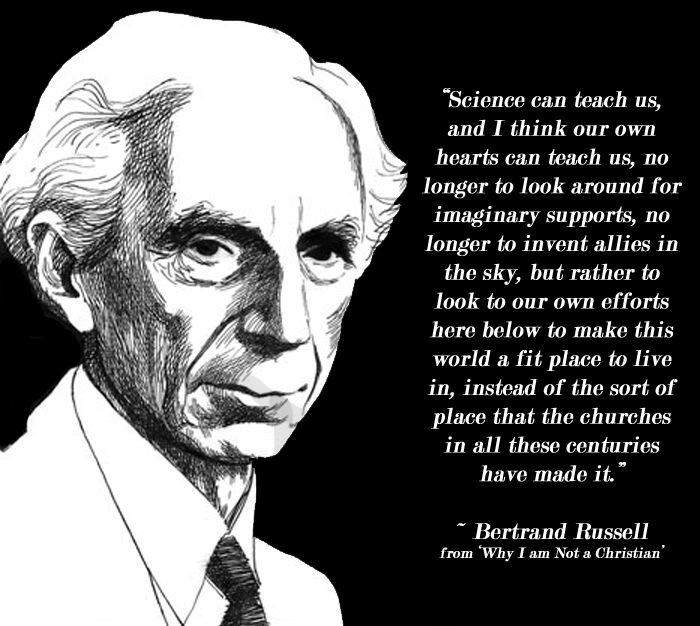
 godfather was John Stuart Mill), was justifiably famous as a mathematician & logician with a three-volume work Principia Mathematica, on the foundations of mathematics, written with Alfred North Whitehead on 1910. Logic has moved on from the atomism of that work but Russell’s generally writing earned him a nobel prize for literature in 1950 "in recognition of his varied and significant writings in which he champions humanitarian ideals and freedom of thought". It is a bit wonderful to hear humanitarian ideals being praised so freely. Bertie is remembered broadly as a campaigner for intellectual, social and sexual freedom, as well as peace and disarmament. It's a voice that heard in my mind as I read his wrtitings in paperback as a youth. For me and for many Russell’s image combined a rational, skeptical, humanist, and philosophical voice with an atheist one. Russell was probably the most prominent atheist voice of the era and well known for this from the 1920s on. His broad knowledge and clear philosophical argument provide a standard that only people like Dan Dennett attain:


