Showing posts with label Islam. Show all posts

Sunday, May 17, 2015

Historical credit vs. Ready Made Explanations

by Gary Berg-Cross

 penned a WaPo article called The violent narrative of religious rivalry (aka Love Thy Neighbor)

Gerson, "the guy who is credited with penning the "smoking gun/mushroom cloud" lie line that helped enable the Iraq war", wanders around the topic of the narrative of the West vs. Islam and ideological containment. He uses a very broad brush with a bit of historical interpretation for the reason that our favored "Westernized" religions are better than the more recent creation  - Islam:

When monotheism is tied to dualism — the belief that history is a cosmic conflict between the children of light and the children of darkness — it becomes “the most dangerous doctrine ever invented,” allowing people to “commit evil with a clean conscience.”
Both Judaism and Christianity have made progress over the centuries in weeding out dualism — reinterpreting their violent scriptural texts and finding resources of “respect for the other.” For Christianity, this transition wasn’t easy, involving the Reformation and the Thirty Years’ War. But this bloody, chaotic process eventually produced a flowering of powerful ideas in the 17th century: the social contract, human rights and liberty of conscience."
There are any number of arguments in here that one may dispute, but a central one is, "what caused this flowering in the 17th century that we are so proud of?"
An insightful view on this, I think, was penned in a letter response in the Post by Elliot Wilner of Bethesda, who wrote:
"In his May 12 op-ed column, “Love thy neighbor,” Michael Gerson provided an intelligent argument for preserving the American tenet of religious tolerance. Curiously, however, he credited the Reformation and the Thirty Years’ War with having eventually created the “flowering of powerful ideas in the 17th century: the social contract, human rights and liberty of conscience.” Those ideas should be credited mainly to a succession of secular humanists, opponents of organized religion, such as Baruch Spinoza, Jean-Jacques Rousseau, Thomas Paine and John Stuart Mill. “Love thy neighbor” was preached and practiced as much, if not more, by these secular humanists as by religious sectarians."
Right on as an additional step to understanding what it takes to move a culture.  The follies of war and the ideologies that birth them and give them sustenance provides teachable moments when we may move ahead, if we listen to the best among us.


Monday, January 19, 2015

Blasphemy and Issues around Free Speech

by Gary Berg-Cross


The recent Charlie Hebdo shootings have stirred a range of discussion, some reasoned and some emotion driven about persistent topical ingredients such as;
·         How do we and should we define the border between freedom of expression and hate speech?
·         Does religion or associated ethnic groups with their values have special status to consider?
·         What is the role of history, including facts and law in deciding these things?
·         How does this debate relate to extremists and to establishment power structures?

People, cultures and groups will differ as to what “facts” and assumptions are to be used in the debate, some of which we see embedded in the above questions. Some very liberal people’s preference is to defend freedom of all kinds of expression, including mockery and
incitement without any limitations. That's really free and there are no real borders to worry about.  There is no hate speech. It’s a mature & proper view and perhaps take maturity, tolerance and polite reflection all around to work.  Maybe it is the goal, but we have various types of hate speech or its equivalent enshrined in law. So we have to deal with gray areas that may vary from country and culture. there is also the idea of civilized discourse. I'm in favor or that too and the idea of this can also vary from place to place.  There may be practical issues to get to the idea of free speech and civilized discourse on the way to enlightenment without conflict or giving in to bullies and crazies. Every culture has some small percentage of unstables and events often afford them opportunities to make an impact and get into the spotlight.


Then there is the emotional vs. rational aspect of our behavior. We are not always reflective or tolerant and some things get the emotions fired up, even among rational, secular folks. Take something as simple as the proposition to respect a person’s right to believe whatever they want – so long as that belief does no harm to others. Of course harm is a judgemental thing -hurting a believer's mothers feelings may not be harmful to me, but it may be the way a belief culture wants things to be and mutual politeness may allow this if all other things are equal.  Alas, they are rarely so.  It is this unevenness that makes finding a useful position difficult.  Indeed certain groups are protected by laws and others by convention which builds in some unevenness. 

Non-believers might think a "no harm respect-all" standard is an improvement over what we have now– believers should respect nonbelievers as people and not disrespect them as people.  We are human too and recent events might offer a teachable moment for respecting people.  Whether we should respect the belief itself is quite another matter that eventually leads to argument. When can we speak up about the silliness of other's belief?  

In a simple respect position non-believers would leave faith-based believers to their own thoughts.  And indeed this seems to me what many of us on the nonbelief side do - new atheists and anti-theists aside. This might be a nice peaceful world, if that was all there was to it. But there is history and custom to consider  and these conflict respect for people with having to respect certain beliefs - the religious ones for example.


For a long time, well maybe for as long as we know, believers don’t leave non-believers alone.  Believers have their hooks into the power structure and get laws, such as Blasphemy statutes, passed, which do beyond disagreeing with the belief and take action on non-believing people, such as not allowing them to hold office. 

For evidence let’s look at the International Humanist and Ethical Union. They have released their annual global report Freedom of Thought Report 2014, on discrimination against humanists, atheists, and the non-religious, and their human rights and legal status. As input to the report, a group  called Atheist Ireland contributed information about religious discrimination in Ireland as part of the overall process of developing the Report.

Here are some of the General systemic issues noted on how nonbelievers are affected in Ireland: 

§  There is systematic religious privilege
§  Preferential treatment is given to a religion or religion in general
§  Religious groups control some public or social services
§  State-funding of religious institutions or salaries, or discriminatory tax exemptions
Freedom of thought, conscience, religion or belief; Establishment of religion
§  Official symbolic deference to religion

Much of this is due to article 44.1 of the Constitution of Ireland in which

 “the State acknowledges that the homage of public worship is due to Almighty God. It shall hold His Name in reverence, and shall respect and honour religion”.

This clause, smells of the concept of blasphemy - the act of insulting or showing a lack of reverence for God, religious or holy persons or things, or toward something considered sacred or inviolable.

This Irish thing is surprisingly close to a foundational tenet of Islam, namely, submission to Allah (the Arabic word for a universal “God”). There may be thankfully fewer acts of violence seen in Ireland than the Middle East for a variety of reasons. These things happen when people are stressed and conflicts are ongoing. There are sometimes sparks from a real war with people being killed and tortured that lead to violent response.

Coming back to what we saw for Ireland, a contextual question might be “Is it legal to draw and publish caricatures like these in Europe?”

Well we think clearly yes, but it turns out with reservations, legal ones at times.

There are still laws in Europe criminalizing blasphemy, although there has been a trend to decriminalize it over the last 40 years. In the Netherlands, it was only abolished completely in 2014
In the US prosecution for blasphemy is in theory "unconstitutional” after the 1952 Supreme Court case of Joseph Burstyn, Inc. v. Wilson. But there are still laws on the books.  So although we aren't whipping people anymore we aren't pure on this issue of free expression that we hug to our breast.  We can do better.

The extremist claiming the attack in Paris declared that it was revenge for the publication of caricatures in the Charlie Hebdo symbolically depicting the Prophet Muhammad, as a terrorist, but also as revenge for torture they cited in Iraq.  The equating of a proclaimed prophet as a terrorist is certainly provoking.  As some have noted characterizing killers of abortion clinics as Christians, perhaps with a picture of Jesus doing the bombing would not be a fair, mocking characterization.  We don't blame world wide Jewry of depict Moses as a bomber of Palestinians in Gaza. A few fringe zealots and defenders of belief turf may take react violently, but we don't blame or satirize an entire religion.  They are often few, such as our US Koran burners or government building bombers, but allow broadly the scapegoating of the other side and may use religious cover for this. But then the caricature of the Prophet is also broad in seemly condemning an entire religion using its prophet symbolically.  It would seem that civilized cartooning as part of debate could be smart enough not to smear an entire religion in anger.  But maybe that is the point and one that can be debated in a civilized fashion.

There is another practical side to this too.  Some defend a more limited conception of freedom of expression to avoid the downsides.  The idea here is that some speech may incite violence and cause hate speech. Certainly we recognize this is some aspects of social media.  Ever been banned from a web site for heated argument?  What about police who crack down on targets that talk back.  Their speech seems quite limited, but perhaps if they used satire it would go better.  Well maybe not.  We read how French police are rounding people up because of the stuff they "said", including a drunk driver who was arrested for apparently feeling his freedom expression too much, and talked tough.  As troubling as well, is a know French comedian who made a joke in poor taste on Facebook. He was arrested.  There seem to be practical limits, especially if you are talking to the power structure in your society as opposed to one that your power structure is in conflict with. And that is another point people have made about Charlie Hebdo. Their criticism has been characterized as more of punching down to a minority group and its religion in the country but at odds with the power Charlie H rarely punched up against that power structure it is claimed. As one letter to WaPo put it:

It is easy to claim to promote and stand for freedom of expression and to wrap oneself in the mantle of righteousness at the expense of those who are already beleaguered, downtrodden, marginalized and oppressed. But it is a gross abuse of a worthy principle, and there is nothing admirable or praiseworthy about it.

 Freedom to speak is not nearly absolute especially when it makes groups in power uncomfortable. Secularists have understood and experienced this for a long time. You might have a right to say what you feel to the law yet you might get arrested or charged with disrespecting a law officer. Some have been killed.

As advice here, consider this practical, civilized point of  view from the David Ignatius posting , “Sorry, but this war-on-terror mobilization is the wrong response to the Charlie Hebdo tragedy.” It would repeat mistakes the United States made in its reaction to Sept. 11, 2001.

“The role of religion in all of this is dangerously exaggerated,” says a former State Department official who now organizes private-sector efforts to counter extremism. “When we get stuck in a religious debate we are never going to win, we miss the point, which is that extremists are offering young people a sense of belonging, an outlet for adventure, and some kind of enhanced status. To combat this, we have to appeal to them as young people more than we have to appeal to them as Muslims...
Cracking a joke or publishing satire has its place in this discourse, but so does delicacy and civility. If we want to rise above barbarity, sometimes our humor needs to rise above as well. It doesn't mean we need remain silent in the face of fraud, atrocity or illiberality or discard our fundamental right to free expression. It just means instead of a sledgehammer, sometimes the knife of subtlety is a much better tool..”


Sunday, July 27, 2014

The Negative Consequences of Believing in Superstition - Part III

This is Part III of a three part series.  (Go read Part II if you've not seen it yet!)

Politics/Law

America is in the middle of a severely dysfunctional period of political and social change.

Over the last hundred years, technology has rocketed us from the horse and buggy days to jet aircraft and rockets to the moon.  From simple telephone tech to cell phones and computers in our pockets.

A hundred years ago, information was limited to those who could read, which for the population of the US as a whole was about 90%.  In 1979, that rate was 0.6%.  The ability of people to distribute information was limited.  For a regional audience, newspapers were the norm, and was limited to what the editors would print.  A wider audience could be reached in book publication, but that was limited to what the major publishing house editors thought would sell.

Accordingly, the public picture of what was normal was limited to what people could read, and that was tightly controlled, even with what was then a fairly free press.  The abnormal was easily ignored and any contradicting speech or dissension was often swept under the rug.

Until women got angry, and began working to change things.  By 1920, the 19th amendment allowed women the right to vote after a long and contentious public debate, including protests outside the White House, often resulting in arrests.

Today, information is everywhere.  The Internet allows instant connection to just about any repository of information that has an online presence.  Many traditional repositories of information, including the Library of Congress, are rapidly digitizing their collections.

The Internet has changed communication as well.  In the early 20th century, overseas telephone calls were expensive and rare, requiring coordination by letter so both parties were available at a coordinated time.  While this got easier with time, even as late as the 1960's, calling overseas often required advance reservations of a time slot, and were still not cheap.

By the 1970-'s, with modern satellite communications systems well under construction, such calls became both cheap and easy compared to just a decade earlier.

The Internet changed all that.  Today, there are multiple methods for connecting to people, even across the globe.  Email, texting, land line calls and even cell phones can be used to connect to people instantaneously.  While the online bulletin boards of the early 90's allowed communications by text, today, with such Internet giants as Facebook and Google, communication with huge numbers of people across wide swaths of the globe are as easy as sending an email, posting to a Facebook page or setting up a web site.  Skype and FaceTime allow instant face to face communication across the globe.

Any of this can be done on a cell phone.

This communication explosion has greatly changed the character of our political discourse.  While Americans slowly and quietly moved away from devout religious observance during the course of the late 20th century, the 21st, with the advent of instant internet communication, has resulted in an explosion of secular movements and groups.  The demographic of "None" as related to religious affiliation is the fastest growing category world-wide, not merely in the US.

Many in the movement attribute this to the Internet and the ability of people of a secular point of view to see - for the first time - that they are not alone and are part of a growing and dynamic community.

The growth of secularism, from the 60's on, resulted in a backlash of religiosity, starting with the Moral Majority, and Ronald Reagan's Presidency.  This backlash has grown in political influence, spurred on by the Republican Party allying itself with the religious right in a bid for increased political influence.  Successfully, I might add.

The Religious Right (RR) has gained influence on a regional and local basis through intense local organizing and political activism.  The resulting political power thus gained has allowed the Republicans control of a substantial majority of State Houses, allowing the RR to bend the political discourse far to the right of center.

A movement known as Dominionism (of which I've written here extensively) has orchestrated much of the successful passage of laws undermining education and science, causing much social controversy and political division, especially in the area of abortion and women's reproductive health.  In many States, there is a virtual dearth of any legal means of abortion, and now the fight is being directed towards a subject everybody thought was won decades ago - contraceptives.

So, today, after decades of successful advancement of women's rights, including the right to vote, the right to divorce, including no fault provisions, the right to contraceptives and abortion, and the right own property (largely won in the 19th century), women's groups are now having to gear up and spend vast amounts of money fighting for the continued existence of rights once thought secure.

Most of this is due to religion.  Patriarchy, biblical proscriptions against women (whether real or not) and a Dominionist movement intent on converting the US from a democracy to a theocracy have all brought the American political scene to a complete and utter standstill.

RR's efforts haven't stopped there.  There is a litany of things they are working on.

abstinence-only education - Instead of medically accurate information and thoughtful conversation about intimacy and childbearing, teens get promise rings and slut shame. 
Opposing protections and rights for children.  Thanks to the influence of biblical Christianity, the U.S. stands alone with Somalia in failing to ratify the United Nations Convention on the Rights of the Child.  
Undermining science - The scientific method has also become an existential threat to Bible belief. We know now that the Genesis creation story is myth, neurotransmitters rather than demons cause mental illness, mandrake roots and dove blood don’t improve female fertility or cure skin diseases, and the cognitive structures of the human mind predispose us to certain kinds of religious belief.
Promoting war - George Bush didn’t need to seek input from his earthly father about the invasion, because he asked his Heavenly Father.  Besides, Jesus is coming soon and war in the Middle East is predicted in the Bible.  That makes it not only inevitable, but—in a manner of speaking—desirable.
Abuse of LGBT persons and refusal of equal rights - They've fought equal rights for these folks for decades, and still are, and it would be bad enough if we were simply talking about history. But homophobic American Christians, thwarted at home, have turned to inciting oppression in Uganda and Nigeria where their hatred still finds fertile ground.
Destroying Earth’s web of life and endangering future generations - Climate change denial and refusal of reasonable methods of keeping our air and water clean and unpolluted is based on biblical scripture giving man "Dominion" (there that word is again) over the earth and all its animals, as well as the believed inevitability of the Second Coming, where God will simply create a new and better Earth guarantees that the RR will refuse to assist in doing anything to protect the environment or protect future generations from the consequences of our irresponsibility today.  Add Republicans' devotion to Corporate welfare, and the die is cast.
(Thanks to Valerie Tarico at Salon.com for her ideas and some of her language.)

I guess the greatest harm in general that religion (right wing fundamentalism in particular) does to this country is through its insistence that we support Israel.  The most vile technique they use is to accuse detractors of being anti-Semitic.  Even people who have reasoned and logical arguments against that support are branded with that epithet.

I am not, in principle, opposed to Israel.  I am not even against some form of support for it.

But our foreign policy regarding Israel is held hostage by the RR for religious reasons (because of the Second Coming) and tolerates no deviation from complete and total support.  Regardless of whether American interests are harmed or even devastated by that support, they insist that we continue to support Israel, blindly and without digression.

This has resulted in anger towards the US and much hatred of us by the Muslim world, and has resulted directly in the attacks on the World Trade Center (both of them), and a continued campaign of terrorist activity against American interests.

Our responses to that have been goaded by the RR to the point that our constitutional rights are now under attack at home and US Intelligence has eroded America's reputation for even handedness and high standards of morality to the point of almost nonexistence.  The RR's toleration and indeed, insistence on, classifying water boarding and "advanced interrogation techniques" as acceptable has completely destroyed the ability of this country to hold other countries accountable for similar actions against our own citizens, resulting in the inability of the government to protect American Citizens overseas.

Even if the Progressive movement (such as it is) managed to gain political ascendancy in the next election by some miracle, it would take decades for us to regain our good reputation for being a humane and law abiding nation.  As it is, forget it.

Obviously, this examination of the negative affects of having the population of this country believe in superstitious Bronze Age beliefs is incomplete.  If I tried to classify it all, I'd have to write a series of books.  One wouldn't be enough.

But the short story is a beginning.  If the only negative affects of religious belief were what I have touched upon here, it would be bad enough to justify organizing the secularists of this country to incite political influence and action to combat it.

But it is far, far worse than this.  The struggle to overcome religiosity and its negative affects on this country will continue into the future, and may never be fully complete.  Christianity, Judaism and Islam have been here, collectively, for over three thousand or more years.  That kind of influence doesn't go away overnight; we've been fighting it since the beginning of the Renaissance in the 12th century.

Let's not allow it to make a comeback.

Robert W. Ahrens
The Cybernetic Atheist

Saturday, July 26, 2014

The Negative Consequences of Believing in Superstition - Part II

This is Part II of a three part series.  (Go read Part I if you've not seen it yet!)

Sex

The subject of sex in the US is so screwed up, and it is mainly because of religion.  The system of patriarchy discussed above forces men and women into gender based roles.  While the social aspects of patriarchy are bad enough, the affects on sex and human sexuality are even worse.

As noted above, men are forced into a false and totally artificial image of "manhood", that is as false and artificial as the image of "womanhood" the ladies are forced into.  This produces mental and psychological stress and often damage that hurts the individuals, their families and their friends - often their employers as well.

Why?  Why is it damaging?

Several reasons.  (Stick with me - I'll get to LGBT issues in a bit.)

I think the most obvious is in personal confidence.  Body image, and how a person portrays him or herself sexually is extremely important in this country.  Heck, for that matter, in much of the world.  It affects our social standing, our family and how it is viewed by the larger society, and eventually, how and whether we are accepted as marriage potential.

Accordingly, we are obsessed by sex, we are obsessed with youth and the sexual aspects of it.  The secular commercial realm tells us that sex is good, it is natural and wholesome and, well, whoopee!

But...

In American society, sexual beauty and attractiveness is so skewed from the norm that millions of Americans, both men and women, suffer from severe lack of self confidence because they perceive themselves as unattractive, through failing to live up to an artificial and false vision of beauty.  No, this isn't because of religion, it is because of rampant and unregulated capitalism.

Religion, or the so-called "Judeo-Christian" or "Abrahamic" religions, especially in this country, as mentioned above, enforce a patriarchy.  A large part of that system is the second class status of women, and therefore, control over their public behavior.

Christianity especially, enforces a view of sex that restricts sex to the role of procreation within a family context.  This comes, probably, from the role of the family, or the clan, as the center of Roman life.  The individual wasn't important, the family or family group, was.  Loyalty to that group was paramount, and for women, that meant only having sex with their husband, to preserve the purity of the bloodline.  Hence the religious obsession with sex as procreation, looking down on both abortion and contraception.  One because it is an "illegal" rejection of the man's seed, and the other as rejection of a man's control over his woman.

So, religion forces us into this weird, twisted image of sex - the patriarchal picture of gender roles, mixed with the god-smacked rejection of women as full humans, subservient to men, and under their full control.

This results in our social culture allowing this culture of rape.  Men are supposed to be virile, strong and manly, which is supposed to drive women into raptures of sexual frenzy.  Women are supposed to belong to men, which means they owe us sex, and they owe us their love and devotion.  Women who reject this and refuse to go along are subjected to campaigns of hate and vitriol, threats of rape and violence.

If a guy doesn't fit that manly, virile picture, he is a failure, and is ridiculed as such.

So.

For women, you have to fit this image of womanhood that reflects the stay at home mother, homemaker, sexy wife and willing brood cow, while the larger social milieu tells you that you've got to be beautiful, sexy, and available to any guy that pinches your ass.  If you don't, you're a prude, and you'll never find a husband, especially if you are ugly.

In the meantime, religion tells you that if you DO, you are a slut, a sinner and you'll go to hell.

Guys, largely, get a pass on the religion thing because, you know, patriarchy.  Unless, of course, they aren't manly, so they're failures.  Or if they allow their wives to "hen-peck" them, they aren't following the bible, so they'll go to hell then, too.

Double-failures.

Especially if they are rejected by the ladies.  Since this isn't anticipated by the traditional patriarchal framework, guys that see themselves as manly and virile who get rejected by the ladies anyway can't comprehend that rejection.  They get mad and blame their failure on the ladies, who, of course, OWE them sex.  Severe mental pain and emotional confusion are common resulting from this condition, and has been known to generate violent reactions.

Is it any wonder that Americans are so screwed up about sex?  The true wonder is how any of us manage to grow up with normal pictures of reasonable and responsible relationships in time to have families.

But wait, I'm not finished.  Not everybody is a cis-gendered, heterosexual human being.  Some folks are homosexual.  Some folks are trans-gendered, and some are bi-sexual.  There are other categories, but I don't feel qualified to talk about them.

These traditional roles I spoke of above, as screwed up as they are, aren't the whole picture, especially since they ignore our LGBT friends.  That alone is responsible for untold misery,  family fights and estrangements.  Since these folks don't fit the "normal" categories, they have traditionally been either ignored or forced into playing roles they were not comfortable with, and often beaten or killed for refusing.  All of them are condemned by religion, and totally ignored by the patriarchal system unless they rock the boat.

The 21st century's success in this country in advancing marriage equality for homosexual couples is a remarkable story of the LGBT movement's ability to go mainstream, but is still being fought tooth and nail by the religious right.

Demographics tells us that the religious will lose this fight.

But wait!  That's not all, folks!

Let's examine some other issues, like clergy abuse of both children and adults, sexually.

Everybody knows, by now, of the Roman Catholic child abuse scandal.  The RCC has spent millions of dollars in the US alone just to make this go away.  Not much to actually stop the abuse, but surely to make it go away.

One wonders, as one examines the issue and how the RCC hierarchy responded to the scandal at first.   How prevalent IS the abuse of kids by Catholic clergy?  And how long has it been going on?

There are some clues.

First, in Ireland, we've all heard of the "laundry scandal", where unwed mothers and their children were warehoused by the Church (with complicit authority from the Irish government of the day) in homes, and were made literal slaves in big laundries.  Scorned by the Church for their sexual sins, their children were as badly treated as they were.

This broke even bigger a couple of years ago and again recently when news broke (over here) of the discovery of almost 800 graves in a hidden graveyard, with an unknown number of bodies even hidden in an old unused septic tank.  Graves going back over a hundred years.

Also in Ireland, the scandal of a few years ago of stories of child abuse and murder in Irish Catholic monasteries. possibly going back hundreds of years.  Horrific stories of terrible abuse, both corporal and sexual, often combined.

In Europe a number of decades ago, there were archeological discoveries of monasteries and cloisters, built fairly close by one another, with hidden tunnels linking the two.  The most horrific part of the discovery were chambers off that tunnel containing the graves of infants and fetuses, most of whom were probably buried hours after or before birth.

All of this is evidence of a terrible epidemic of sexual malfunction in a religious hierarchy, over a thousand years old, denied sexual release and access due to official greed, excused and justified by religious scripture.

(For those who don't know, the RCC finally outlawed marriage not for religious reasons, but to end the bleeding of "church" property through inheritance to families of clergy, especially to noble families with large estates.  With no marriage allowed, thus no heirs, their property was "inherited" by the Church.)

Don't think that only the RCC is involved, preachers of almost every Protestant denomination regularly are arrested and either fired or also charged for either child abuse or sexually predatory abuse of adults.

It's all over the place.

Not to be outdone, Islam isn't far behind, as you may have noticed in the recent re-emergence of the quote of Iran's Ayatollah Khomeini.
He says: ‘A man can have sexual pleasure from a child as young as a baby. However, he should not penetrate vaginally, but sodomising the child is acceptable. If a man does penetrate and damage the child then, he should be responsible for her subsistence all her life. This girl will not count as one of his four permanent wives and the man will not be eligible to marry the girl’s sister… It is better for a girl to marry at such a time when she would begin menstruation at her husband’s house, rather than her father’s home. Any father marrying his daughter so young will have a permanent place in heaven.’ 
Read more.
Not only is this considered child abuse, but Islam has doubled down on it and authorized it because Mohammed did it.

At least, the Muslims are honest - they'll tell you God wants this to happen.

Talking about child abuse, let's talk about masturbation, something Christianity in most of its forms doesn't like to do.  In many denominations, it is banned and called out for being sinful and of the devil.

But now, scientifically, we know that it is not only a natural urge (even infants play with themselves) but it is known to be actually good for you!  It releases hormones and endorphins that make you healthier and live longer.

Heck, we know, both from scientific study and from statistics that people who have a long term sexual relationship that is happy for both parties not only stay together longer, but also live longer.  Regardless of whether they have kids or not.

So, in summary, religion in this country (and throughout the world) twists sex and sexuality in humans to the point that millions of people are, at best, dysfunctional and at worst, mentally ill and twisted towards pedophilia and sexual predatory practices, even the clergy.

It taints our marriages, our dating practices, and inculcates a culture of rape that regularly threatens the lives and well being of over a half of all women in the United States and probably causes a significant percentage of our divorces.

It directly harms our LGBT friends through violence and intimidation, forcing them into hidden lives and damaging stress by denying them a happy and healthy lifestyle.

And because sex keeps us healthy and can help us live longer, by discouraging sex in most forms and twisting our sexual practices so badly, religion is also killing us.

Are you mad yet?

(Come back tomorrow for Part III)

Robert W. Ahrens
The Cybernetic Atheist

Friday, July 25, 2014

The Negative Consequences of Believing in Superstition - Part I.

I was perusing Ophelia Benson's Facebook page last Saturday morning and ran across a post she put up Friday about the post on Dave Muscato's wall regarding Jaclyn Glenn's Youtube video slamming feminism and how she is disappointed - no, outraged - that AA is supporting Glenn's anti-feminism.

One of the comments (which I can't find to quote, dang it) made a comment about the negative consequences of believing in superstition.  It rang a bell with me, so here we are!

There are numerous negative things religion brings to society which many religious folks either overlook or are brainwashed into thinking they are good, mainly because they believe it's good because they're told it is, but have never actually examined the issues to see what the reality is.

But today, we're going to look at a few things.

As I see it, there are at lease three major areas in which religion (believing in a superstition) brings negative consequences to society.

  1. Patriarchy (Part I)
  2. Sex (Part II)
  3. Politics/Law (Part III)


Of course, these aren't the only things at issue, but each of these are major, affecting broad areas of society.  So, let's take them one at a time.

(This is going to be a long post, so I will post in installments.  This is the first, the others will follow tomorrow and Monday.)

Patriarchy

Patriarchy is defined as:
1.  social organization marked by the supremacy of the father in the clan or family, the legal dependence of wives and children, and the reckoning of descent and inheritance in the male line; broadly :  control by men of a disproportionately large share of power
2.  a society or institution organized according to the principles or practices of patriarchy
This sounds very clinical, and almost reasonable, doesn't it?  But what are the consequences of these things?

In the modern context of our present day political scene, the relevant part of that is about the legal dependance of women and children, though we will see other consequences of it as well.

In today's western society, especially the US, the practice of patriarchy is at least partially based on religion.  In the Republicans' "War on Women", it IS based on biblical strictures requiring men to be the head of the household, and women being denied the right to be "in charge of" men.

In other words, they are relegated to second class citizens.

Now, in the larger US society, in the last hundred or so years, we've managed to back some of that off.  Women can now own property in their own names, vote, drive cars, work outside the home (and in fact, at jobs traditionally reserved for men), and can marry (or not) according to their own wishes.

But, I am going to back things up a bit and note some negative consequences of allowing the Fundies to begin denying women those rights, as they seem to want to do - which will highlight some ways in which we have failed to progress into a more modern way of thinking about women.

First of all, think about the term "dependance" in that definition above.  Legal dependance, especially. What does that entail?  Briefly, it means a woman (or a child) has no legal rights of her own.  She has to have a male guardian who has the right to "care" for her, as a legal responsibility.

That has two consequences.  The most obvious is that she has no rights of her own.  He can pretty much force her to obey his every wish, and she has no legal recourse, unless he is neglecting her welfare.  She is, in fact, virtually his property.  In many countries, this is in fact, the case.

But wait, there's another side to it.  HE is obligated to care for her.  That means he is responsible, legally, to feed her, clothe her and provide her with shelter.  This isn't something he has a choice in, it becomes his legal obligation, for which he is liable if he fails.

What if he can't?  What if his resources aren't up to the task?  Sure, he can neglect her to her detriment, but that leaves him vulnerable to accusations of neglect which may, if his society cares, cost him.

Either way, this kind of situation isn't exactly fair to either one.  Worse for the lady, since she is the one losing rights, but if she is prevented by the social or legal rules to not be able to work, the whole family suffers.  In fact, the entire society suffers.

This is actually the worst part of the patriarchal system.  The entire society, from the individual, to the family, to the potential employer, to the city, State and the entire country, everybody suffers, both socially and economically.  To stop half of the population from working is to cut your potential GDP in half, at the very least.  Even if you only go halfway and allow women to work, but restrict them to certain jobs (and, equally, restrict men to certain jobs) you are still preventing people from working in their best way and potentially most skilled career.  The potential of people working at their best level and in a skill that they are best suited for is huge, and the frustration (for both men and women) in being prevented from doing that is as huge as the potential.  The cost of such false restrictions based on arbitrary and unnatural reasoning is perhaps not as bad as a complete ban on women working, but it is a non trivial figure.

Society suffers in other ways.  Women are, actually, as smart as men, and as capable of doing anything men can, save perhaps (on average) some jobs or tasks requiring major body strength.  (...and even there, some women exceed that standard and do quite well in those circumstances, as on the other hand, some guys fail!) In the US, after over a century of women working, there is plenty of evidence that many aspects of society are better off with the participation of women.  Corporations find that women make better organizers, deal better with adversity and are better at mediating conflict.  In politics, women (when allowed to work independently) are often better at compromise and negotiations than men.

As costs have risen in recent decades, women have been forced into the workplace, bringing in much needed resources and allowing single women to raise children alone under better economic conditions than once was allowed.

I could go on, but it is obvious from these examples (which are only a few examples of many) that were women forced back into the home, the economy of the US would take a hit that would guarantee our immediate slide into third world status.  Poverty would become, instead of merely commonplace, rampant and virtually the norm.  The middle class would be destroyed, and those in poverty would be devastated completely.

Notice that I haven't even touched on the health care aspects of women's rights, and the devastation the American family would suffer were women no longer allowed to control their reproductive rights.  In fact, the proposed restrictions on contraceptives would be devastating to not only women, but to the entire country, as it would push us back into a time where women were not capable of stopping pregnancy.  (This does, of course, include the prohibitions against abortion.)  The social consequences of this would be to push many women out of the workforce, and reinstate the social pressures against allowing women to work, with the consequences noted in the previous paragraphs.

I haven't addressed the other side of the issue, which is the damage to men a patriarchal system can and does do.

This system not only imposes restrictions on women, but imposes strict (depending on the time period and the culture involved) roles for the two different genders.  (Note here, the refusal of this system to even acknowledge the existence of the LGBT folks!)  This framework of strict roles is restrictive and limiting for both men and women.  Men may have a larger menu of choices, but they are no less prevented from crossing that line than women are.

Some women are great corporate managers.  Some are great politicians.  Some aren't.  Many men just suck at those roles, and choose to do other things, including these days, staying home to take care of the kids.  Numerous articles have been written by guys who have done this, and it is liberating for them to be able to do so.  As it is liberating for women to be able to be corporate managers.

Some guys are fantastic secretaries, or office managers, or nurses.  Men can be social workers, cooks, day care workers, pole dancers and strippers.  And they can be good at it.

Patriarchy would prevent them from doing all this, as those are not "traditional" men's jobs.

Men are forced into a false and totally artificial image of "manhood", that is as false and artificial as the image of "womanhood" the ladies are forced into.  This produces mental and psychological stress and often damage that hurts the individuals, their families and their friends - often their employers as well.

It also forces men into this culture of rape we all know so well, but I'll deal with that in the "sex" topic.

In short, patriarchy is not a system that is supportive of society, but is damaging and harmful to a society that hopes to progress into a modern, peaceful, and productive society which accords equal rights for all citizens.

In short, it is un-American, in accordance with the ideals declared by us in the Declaration of Independence.

Some of the last points I raised also apply in the next section.

Come back tomorrow for Part II!

Robert W. Ahrens
The Cybernetic Atheist

Monday, June 25, 2012

Philosopher Johan Braeckman on European Islamic creationism


by Gary Berg-Cross

You can see a Chris Mooney Point of Inquiry podcast with Johan Braeckman, a philosopher at the University of Ghent, on a topic troubling European defenders of science and reason. It's about the spread of Islamic creationism in European countries.

You can listen to the show here.


Sunday, September 11, 2011

Differences of Opinion Among the Freethinking Community


by Gary Berg-Cross

We all get into disagreements and differences of opinion. Its safe to say that no one is right about everything. We don’t have the same experiences or exactly the same tastes and values. People’s knowledge and opinions are like composite structures whose ingredients have been mixed over time from purer substances. Understanding in many areas, including the social world, is limited by the complex nature of subject matters, the boundaries of human rationality, limited time for analysis etc. As a result, to paraphrase Thoreau, it’s important to know what really know and tread more lightly in areas we are less experience with and expert in. Even in the freethinking, secular humanist-atheists may stumble or be on the wrong side of issue. And this can produce some interesting discussions, but also disagreements of opinion that develop into real arguments.

I was thinking about this in the last few weeks perhaps sparked by Penn upcoming talk in the area. He’s one of the atheists stars with his “God, No!,” book, but also of libertarian fame. You can see him talking about is libertarian views on the Glenn Beck show and equating them to the Founder’s philosophy. He’s clearly intelligent and freethinking on a variety of subjects a great deal which he speaks about opening in a humorous way often ending with "I could be wrong.” But he expresses some ideas that I take issue with such as:

“..the fact that the government can't rally everybody to work together. That's to be celebrated. The government being is hamstring and as closed off and as clumsy as possible is exactly what we want. The last thing we want is a government that can get things done. A government that can get things done all they will get done is taking away freedoms. Its been shown over and over again. We want a clunky, sloppy, slow-moving, small, insignificant, weak government there all the time. And that's a government we can love and protect.”

I might have honest disagrees with other notables in the freethinking community. I might agree with Bill Maher most of the time, such as “"The problem is that the people with the most ridiculous ideas are always the people who are most certain of them," but be uncomfortable with other serious points wrapped up in a mix of provocative humor and scathing criticism that leave little room for nuance.

With freethinkers like Dennett, Jacoby, Doerr and Grayling, it might take a micro analysis to find serious disagreements on important topics. Then there are the core of New Atheists, whose prominent figures include scientist Richard Dawkins, Sam Harris and author Christopher Hitchens. There is some disagrement in the secular humantist-atheist community on the New Atheists who claim that believers in 'the god hypothesis' should not be tolerated, but should be actively countered and the 'shoddy' arguments supporting their beliefs should be exposed. While we might disagree on strategic and tactical stances many of us are happy to have some vigorous countering, criticism, and exposure of religious to Belief to rational argument and evidence. As Hos notes in a prior posting religions often escape any criticisms. It's not a policy we should apply to ourselves, but be thoughtful about it.Link

Whatever you think of the strategy the 3 central stars, the new atheist giants have fallen afoul of non-religious issues where they may be less certain of the facts and complexities. Christopher Hitchens, a literary powerhouse with a clear prose and scathing style, applied the same rather famously as an aggressive critic of God and his followers. This comes after bringing Mother Teresa to earth in an earlier scree that exposed Mother Teresa's ties to various despots and thieves, and questioned the wisdom of handing out the Nobel Peace Prize to a woman whose famous clinic for the poor had repeatedly been found unsanitary and badly run, refusing, for example, to give painkillers to the dying—maybe because she really did believe, as she once said, that "[t]he suffering of the poor is something very beautiful."

Clearly a freethinker, but he seemingly embraced (believed in?) neoconservative ideology after Sept. 11. In effect he provided a freethinking champion for George W. Bush Iraq war. Always one to paint a vivid image he said that the mere thought of preemptive action gave him an erection. As usual Hitchens comes across as supremely confident of his position. In his new book he says he knows more about the Middle East than simple liberal bumpkins who "weren't there", meaning:

  • he has traveled in and reported extensively on the Middle East,
  • he has access to knowledge denied most of the rest of the world;
  • he knows for sure that those Islamofascists are Evil (shades or religious categories) and need to be pummeled and taught a lesson.

The fact that there were significant others with equally immediate and/or specialized knowledge, Brent Scowcroft comes to mind plus an assortment of generals and diplomats who were also "there," who had adequate security clearances and still opposed the war, goes unvoiced by Hitch. Taken as a whole liberals like Chris Hedges are uncomfortable with a slippery slope for secularists, who ally themselves with unethical people seeking pretexts to bombing "religious" countries. I'm uncomfortable with Hitchen's admiration of Paul Wolfowitz who in one interview he described as a bleeding heart and described neo-conservatism as a:

“distinctively new strain of thought, preached by ex-leftists, who believed in using US power to spread democracy.”

Hedges also crosses some lines with amateur evolutionary psychology and proactive hypotheses about men and women. In a Vanity Fair bit called “Why Women Aren’t Funny,” he argued that men are funnier than women for Darwinian reasons: hapless males need the gift of humor to persuade women to mate with them. Reproduced in his new book (Arguable Essays) we hear that women are not tough enough to master comedy. Because such engineered wit requires a strong stomach and a stoic acceptance of the futility of life. “Whereas women, bless their tender hearts, would prefer that life be fair, and even sweet, rather than the sordid mess it actually is.”

One of my favorite thinkers Richard Dawkins recently got on an uneasy side of the discussion about sexual harassment. During the informal after-hours socializing time at an atheist conference Feminist Rebecca Watson was talking with colleagues about her presentation and other issues. At 4 AM, she said she was tired & left the bar heading back to her room to sleep. But in the elevator ride to her floor, she was with a male only identified now as the “Elevator Guy.”

Rebeca was aghast at being asked by the “Elevator Guy to continue discussion in his room. She expressed her later ideas to the atheist community this way:

"Um, just a word to wise here, guys, uh, don't do that. You know, I don't really know how else to explain how this makes me incredibly uncomfortable, but I'll just sort of lay it out that I was a single woman, you know, in a foreign country, at 4:00 am, in a hotel elevator, with you, just you, and—don't invite me back to your hotel room right after I finish talking about how it creeps me out and makes me uncomfortable when men sexualize me in that manner."

Richard Dawkins got himself into hot water by commenting that she was overreacting by comparing her situation with more serious ones. Using the dangerous form of a sarcastic letter to a Muslim woman, he suggested that Watson's experience in the elevator was trivial compared to the abuses that Muslim women deal with daily:

"Stop whining will you. Yes, yes, I know you had your genitals mutilated with a razor blade, and...yawn...don't tell
me again,.."

The exchange escalated with postings on PZ Myers Pharyngula website where he noted that, "Richard did make the valid point that there are much more serious abuses of women's rights around the world, and the Islam is a particularly horrendous offender."

But he went on to argue that:

"the existence of greater crimes does not excuse lesser crimes, and no one has even tried to equate this incident to any of the horrors above. What these situations demand is an appropriate level of response: a man who beats a woman to death has clearly committed an immensely greater crime than a man who harasses a woman in an elevator; let us fit the punishment to the crime."

A final, arguable mis-step is Sam Harris who I agree with on a vast swath of topics. I'm more than a little uncomfortable with his critical words on Islam appearing in his “The End of Faith,” (pages 128-129). Normally a cool, clear thinker Harris seems here to be considering if seriously not advocated a future pre-emptive nuclear strike against a nation based on its religious views. Part of what Harris said to give this impression is:


"It should be of particular concern to us that the beliefs of Muslims pose a special problem for nuclear deterrence. There is little possibility of our having a cold war with an Islamist regime armed with long-range nuclear weapons. A cold war requires that the parties be mutually deterred by the threat of death. Notions of martyrdom and jihad run roughshod over the logic that allowed the United States and the Soviet Union to pass half a century perched, more or less stably, on the brink of Armageddon. What will we do if an Islamist regime, which grows dewy-eyed at the mere mention of paradise, ever acquires long-range nuclear weaponry? If history is any guide, we will not be sure about where the offending warheads are or what their state of readiness is, and so we will be unable to rely on targeted, conventional weapons to destroy them. In such a situation, the only thing likely to ensure our survival may be a nuclear first strike of our own. Needless to say, this would be an unthinkable crime—as it would kill tens of millions of innocent civilians in a single day—but it may be the only course of action available to us, given what Islamists believe."
from sam_harris_responds_to_chris_hedges_fundamentalism_kills_column_20110726/

Liberal thinker Chris Hedges was astonished by Sam Harris hubris to advocate taking millions of innocent lives - since nuclear weapons don’t only kill the bad people). Hedges is very familiar with terrorist and totalitarian regimes, having spent two decades covering Central America, the Balkans, the Middle East, & Africa and is concerned with our reaction to it and vulnerability to intolerance on all sides. There has been a great running debate by Hedges and Harris on this which your can read on Truthdig. It's too rich a discussion to do justice here but the core point is that Harris' position seems to some a dangerous idea related to beliefs on the part of Harris. One must consider carefully claims of whether or not whole populations are dangerous. Who has the right to determine which people get to live and which to die? Like Hitchens and the idea of pre-emptive attack, it is not something that can mitigate by using apologetic language and saying you were just weighing the options.


It's always a humbling experience to realize that 3 pioneering thinkers and personal heroes may get into tricky situations. In some cases the disagreement might be modest on topics of limited importance. But in other cases it may be important. Fallibility remains a core part of the human experience. Something that freethinkers know and appreciate more than most and we can be proud of being able to discuss the phenomena is constructive ways.

Wednesday, April 06, 2011

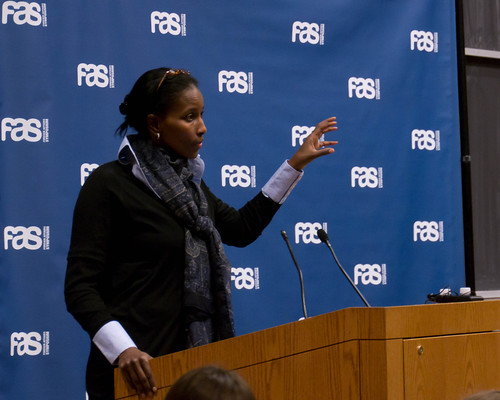
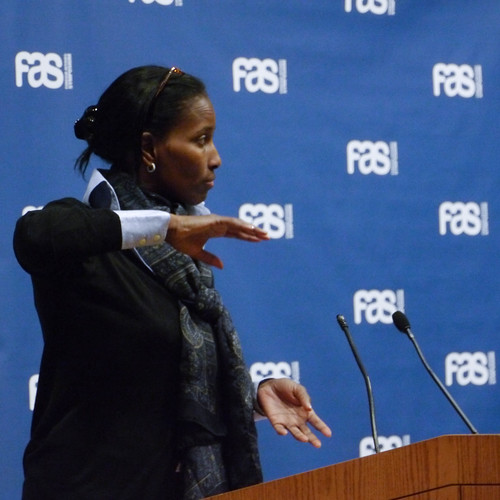
Ayaan Hirsi Ali at JHU in Baltimore, April 5th, 2011

Last night my wife and I attended the talk given by Ayaan Hirsi Ali at Johns Hopkins University for their Foreign Affairs Symposium series.


We brought a copy of Infidel in case she would be signing books, and though the announced she would at the beginning of the talk, at the end they cancelled it.
The talk was enjoyable, though slow to start, and she is generally soft spoken and showed a sense of humor at times. The auditorium at Mudd Hall was pretty packed, and she received a rather nice round of applause at the beginning and end. I saw a few atheists from the local community, and stopped Bill Creasy from the Baltimore Secular Humanists to say hello as I was packing my camera up by the exit.
At points, I saw my wife daubing tears from the corners of her eyes, and others a large smile on her face. In the Q&A part, one Jew (two people who stepped up to the mic made sure to identify themselves as such, so I use their identification) made some rambling statement about god, the torah and Ayaan "trying to make believers reject god". Her reply began "First of all, I find god to be very boring." to which my wife burst out in uncontrollable clapping. Ayaan took pause, smiled and thanked her (and the few others that joined in).
Another questioner, who stuck in my craw, decided to try to take a smarmy potshot at Ayaan. In her talk, she stressed the importance of questioning things, and he said "Given the theme of your talk, I want to know what things you've been hesitant to question at your place of employment?" He was referring to the conservative think-tank American Enterprise Institute. It wasn't even a real question, it was a childish political swipe... he might as well have stood up and said "I'm a liberal, I don't like conservatives." Then adjusted his diaper and sat back down.
Her answer was terrific, starting with "I have never hesitated to question anything." The day she joined, at lunch, she asked "Is it a problem that I believe that homosexuals should be able to marry?"
"No." was the response.
That same response was given when she stated she believed in euthanasia and a woman's right to have an abortion.
"Those are all fine, they are your beliefs." her fellows said.
"Then what am I supposed to believe?" she jokingly asked.
The questioner, not satisfied, decided that if she hadn't hesitated before, that he needed to tell her not to hesitate in the future. His hatred for the conservatives at the think-tank seemingly taking precedence over.. oh, I dunno, discussing women's rights in Islam - the topic of the conversation.

All the the quotes above are from memory, as I did not record the event.

I just recently purchased a new camera, and tried not to be annoying while taking photos. There was a professional there, and others, so I didn't feel it was out of line.