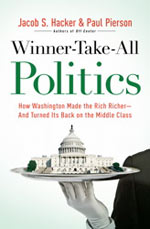
One historical source on the memo is from Winner-Take-All Politics: “How Washington Made the Rich Richer--and Turned Its Back on the Middle Class”. Quotes from this book were covered in the Bill Moyer’s show: The Powell Memo: A Call-to-Arms for Corporations and a portion is reproduced below:
the Powell Memorandum, a
call-to-arms for American corporations written by Virginia lawyer (and future
U.S. Supreme Court justice) Lewis Powell to a neighbor working with the U.S.
Chamber of Commerce.
In the fall of 1972, the venerable National Association of Manufacturers (NAM) made a surprising announcement: It planned to move its main offices from New York to Washington, D.C. As its chief, Burt Raynes, observed:
In the fall of 1972, the venerable National Association of Manufacturers (NAM) made a surprising announcement: It planned to move its main offices from New York to Washington, D.C. As its chief, Burt Raynes, observed:
We have been in New York since
before the turn of the century, because
we regarded this city as the center of business and industry.
But the thing that affects business most today is government. The
interrelationship of business with business is no longer so important
as the interrelationship of business with government. In the last several
years, that has become very apparent to us.[ National Journal, 1974, 14.]
we regarded this city as the center of business and industry.
But the thing that affects business most today is government. The
interrelationship of business with business is no longer so important
as the interrelationship of business with government. In the last several
years, that has become very apparent to us.[ National Journal, 1974, 14.]
 To be more precise, what had become
very apparent to the business community was that it was getting its clock
cleaned. Used to having broad sway, employers faced a series of surprising
defeats in the 1960s and early 1970s. As we have seen, these defeats continued
unabated when Richard Nixon won the White House. Despite electoral setbacks,
the liberalism of the Great Society had surprising political momentum. “From
1969 to 1972,” as the political scientist David Vogel summarizes in one of the
best books on the political role of business, “virtually the entire American
business community experienced a series of political setbacks without parallel
in the postwar period.” In particular, Washington undertook a vast expansion of
its regulatory power, introducing tough and extensive restrictions and
requirements on business in areas from the environment to occupational safety
to consumer protection.
To be more precise, what had become
very apparent to the business community was that it was getting its clock
cleaned. Used to having broad sway, employers faced a series of surprising
defeats in the 1960s and early 1970s. As we have seen, these defeats continued
unabated when Richard Nixon won the White House. Despite electoral setbacks,
the liberalism of the Great Society had surprising political momentum. “From
1969 to 1972,” as the political scientist David Vogel summarizes in one of the
best books on the political role of business, “virtually the entire American
business community experienced a series of political setbacks without parallel
in the postwar period.” In particular, Washington undertook a vast expansion of
its regulatory power, introducing tough and extensive restrictions and
requirements on business in areas from the environment to occupational safety
to consumer protection.
[ David Vogel, Fluctuating Fortunes: The Political Power of Business
in America (New York: Basic Books, 1989), 59; R. Shep Melnick,
“From Tax-and-Spend to Mandate-and-Sue: Liberalism After the Great Society,” in
The Great Society and the High Tide of
Liberalism, Sidney Milkis and Jerome Mileur, eds. (Amherst, MA:
University of Massachusetts Press, 2005).]
In corporate circles, this
pronounced and sustained shift was met with disbelief and then alarm. By 1971,
future Supreme Court justice Lewis Powell felt compelled to assert, in a memo
that was to help galvanize business circles, that the “American economic system
is under broad attack.” This attack, Powell maintained, required mobilization
for political combat: “Business must learn the lesson . . . that political
power is necessary; that such power must be assiduously cultivated; and that
when necessary, it must be used aggressively and with determination—without
embarrassment and without the reluctance which has been so characteristic of
American business.”
As mentioned at the talk
by Kevin Zeese what followed this
activation of the Chamber was it doubling in size within a year. The Chamber’s
board of directors formed a task
force of 40 business executives (from U.S. Steel, GE, ABC, GM, CBS, 3M,
Phillips Petroleum, Amway and numerous other companies) to review Powell’s memo
and draft a list of specific proposals to “improve understanding of business
and the private enterprise system,” which the board adopted on November 8, 1973.
Another consequence was the
founding of conservative institutions like CATO, AEI and ALEC. Sort of an activist approach to
government-corporate relations. So I guess Powell was sort of a hidden activist
judge, but then appointing a tobacco lawyer does suggest something on how the
game of appointments is played.
Images
- American Enterprise: http://www.greenpeace.org/usa/en/news-and-blogs/campaign-blog/the-lewis-powell-memo-corporate-blueprint-to-/blog/36466/
- Powell Memo: http://law.wlu.edu/powellarchives/page.asp?pageid=1251
- Winner-Take-All Politics