Wednesday, April 06, 2011

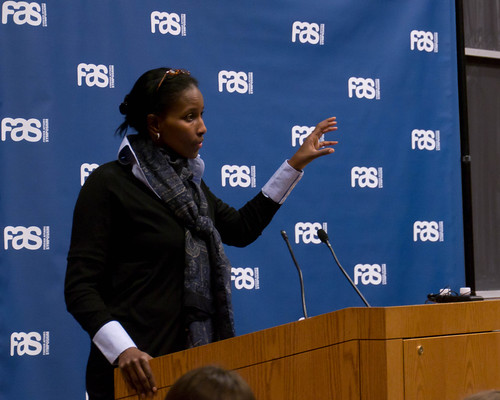
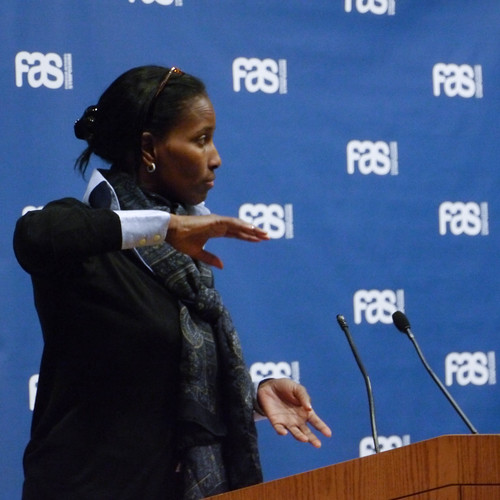
Ayaan Hirsi Ali at JHU in Baltimore, April 5th, 2011

Last night my wife and I attended the talk given by Ayaan Hirsi Ali at Johns Hopkins University for their Foreign Affairs Symposium series.


We brought a copy of Infidel in case she would be signing books, and though the announced she would at the beginning of the talk, at the end they cancelled it.
The talk was enjoyable, though slow to start, and she is generally soft spoken and showed a sense of humor at times. The auditorium at Mudd Hall was pretty packed, and she received a rather nice round of applause at the beginning and end. I saw a few atheists from the local community, and stopped Bill Creasy from the Baltimore Secular Humanists to say hello as I was packing my camera up by the exit.
At points, I saw my wife daubing tears from the corners of her eyes, and others a large smile on her face. In the Q&A part, one Jew (two people who stepped up to the mic made sure to identify themselves as such, so I use their identification) made some rambling statement about god, the torah and Ayaan "trying to make believers reject god". Her reply began "First of all, I find god to be very boring." to which my wife burst out in uncontrollable clapping. Ayaan took pause, smiled and thanked her (and the few others that joined in).
Another questioner, who stuck in my craw, decided to try to take a smarmy potshot at Ayaan. In her talk, she stressed the importance of questioning things, and he said "Given the theme of your talk, I want to know what things you've been hesitant to question at your place of employment?" He was referring to the conservative think-tank American Enterprise Institute. It wasn't even a real question, it was a childish political swipe... he might as well have stood up and said "I'm a liberal, I don't like conservatives." Then adjusted his diaper and sat back down.
Her answer was terrific, starting with "I have never hesitated to question anything." The day she joined, at lunch, she asked "Is it a problem that I believe that homosexuals should be able to marry?"
"No." was the response.
That same response was given when she stated she believed in euthanasia and a woman's right to have an abortion.
"Those are all fine, they are your beliefs." her fellows said.
"Then what am I supposed to believe?" she jokingly asked.
The questioner, not satisfied, decided that if she hadn't hesitated before, that he needed to tell her not to hesitate in the future. His hatred for the conservatives at the think-tank seemingly taking precedence over.. oh, I dunno, discussing women's rights in Islam - the topic of the conversation.

All the the quotes above are from memory, as I did not record the event.

I just recently purchased a new camera, and tried not to be annoying while taking photos. There was a professional there, and others, so I didn't feel it was out of line.


Subjective/Objective

Here's something that occurred to me recently. It's nearly-trivial, but I found it interesting.

The reason a subjective statement, like "Beethoven's ninth is his best symphony" is subjective is that a) it refers mental state, and b) that mental state can vary from person to person.

But it can be turned into an objective statement by simply saying whose mind it refers to: "Smith thinks that Beethoven's ninth symphony is his best". This is an objective statement, and its truth or falsehood can be ascertained simply by asking Smith. In a few years, maybe we'll even have scanners that can read the answer in Smith's brain.

Or instead of specifying a particular subject to whom the statement applies, we can specify a class of people, e.g., "Most music critics think that Beethoven's ninth is his best", or "Nobody likes being humiliated" (vs. "humiliation is bad").

One consequence of this is that it helps put morality on a reality-based footing: a question like "should the US intervene in the Ivory Coast?" seems hopelessly subjective, but we can at least ask questions like, "how many Americans think the US should intervene?" and "how many Ivorians want the US to intervene?". These questions, and their answers, are called polls, and they're used all the time. (I'm not saying that complex moral questions should be decided by polling. But polls can provide an objective underpinning to moral arguments. For instance, if 98% of Ivorians hated Americans and wanted the US to stay the hell away, that would undercut arguments like "we should move in: we'll be greeted as liberators".)

Secular morality is often attacked for being too subjective. I hope the above helps correct that perception. The whole point of having a system of morality is, presumably, to improve the universe in some way, and hopefully allow us to be happier and get along with each other in the process. What "better" means, above, is subjective, but at the very least we can see what people think, and what most of us can agree on.

Tuesday, April 05, 2011

Mike Huckabee Wants Christian Fraud taught at Gunpoint

Our Friend Rob Boston of Americans United has documented the fraudulent distortions and outright lies committed by David Barton. David Barton wants to demolish the “wall of separation” between religion and government. In the video below he introduces Mike Huckabee as “a guy who would be a great Black Robe Regiment guy … he has the mentality of take the Bible and apply it to every aspect of the culture.” He really sees Mike Huckabee as the best candidate to put in place his demented version of a right-wing Christian theocracy.

Gov. Huckabee returned the glowing praise with his “...wish that there would be like a simultaneous telecast and all American's would be forced, forced at gunpoint no less, to listen to every David Barton message...”.

I don't care if this is a joke. It is such an insane joke that it should disqualify this man for any elective office again ever.


The video embedded above is from Right Wing Watch. There is a longer You Tube clip on in another article from Reader Supported News. This one includes an excerpt from Ms. Chris Rodda's wonderful book, Liars for Jesus, The Religious Right's Alternate Version of American History Vol. 1. David Barton is a primary source of the lies debunked in her book.

Earthy, Scientific and Transparent Spring in DC

There's always things going on in the DC area and Spring is a great time for them. Natural beauty is here with the Cherry Blossoms and quickly prepares the way for Earth Day on the mall April 16 - 17. See http://dc.about.com/od/specialevents/a/EarthDayMall.htm.
(I hope the new budget allows the Environmental Protection Agency to host this annual event with its National Sustainable Design Expo that features a wide array of college students showcasing Earth friendly ideas.)

Even before this there's a great science talk:

"To Be and Not to Be a Monkey: The Myth of the 1.23% Difference" with Alain Prochiantz, CNRS Researcher in Neurobiology and Professor at the Collège de France presented Tuesday, April 05, 2011 from 6:00 PM - 8:00 PM at the Embassy of France. It's free and followed by a wine reception.

You can register at www.rdv-cnrs.eventbrite.com

A HAPPY B-DAY to PAUL ROBESON! April 9th.

And April is a great time for the Robert G. Ingersoll Washington, D.C., Walking Tour (see http://www.ingersoll.wash.org/content/tour/index.php)

There are 2 great, secular speakers talking in the area in April. Philosopher A. C. Grayling is discussing his new work "The Good Book: A Secular Bible" at 6:30 pm on Thursday, April 14th 2011 at Busboys and Poets, 2021 14th St NW in DC (walkable from the 14th & V / U Street Cardozo Metro). Grayling has apparently been working on this opus for several decades, and the result has been described as a rich manifesto for rational thought.

Later that week Freethinker Susan Jacoby takes on anti-aging hype in her new book "Never Say Die" at at 4:00 pm on Sunday, April 17th at the downtown Busboys and Poets 5th & K, 1025 5th St NW. It;s been described as an "impassioned, closely reasoned critique of the myth that a radically new old age - unmarred by physical and mental infirmity, financial problems, or loneliness - waits the baby-boom generation. "
You can these and more at http://www.busboysandpoets.com/events.php and http://www.busboysandpoets.com/events.php?loc=2

At the end of the month there's a really neat 2 day workshop called Transparency Camp run by the Sunlight Foundation. This is held in the form of an unconference , which means it is highly informal and a happening - see http://en.wikipedia.org/wiki/Unconference.
This year T-Camp is being held in Bethesda and it is a really neat meeting for people interested in transparent and open government. The Open Gov movement is still a work in progress, but progress is made each year as Sunlight helps us make information more accessible and transparently understandable. If you haven't seen Sunlight fact check political speeches you've missed an experience.

For more event details, visit the event page at http://tcamp11.eventbrite.com.
The weekend is basically free with just a $10 charge for 2 lunches.

Maybe I'll see you there. From there it is only a few days to the National Day of Reason, It's the 1st Thursday in May every year, to provide an alternative to the National Day of Prayer. See http://daysuntil.com/Day-Of-Reason/index.html

Sunday, April 03, 2011

Bracketology, Biases in Inexact Sciences, Energy Futures & Religious Projections


Spring in the DC region can be a mixture of both wonderful & maddening things. The cherry blossoms are wonderful. The budget battle is maddening. We are just ending a type of furious wonder with basketball's March Madness. This year with a baker's 68 we have a small extension of madness into April. Someone once describe the tournament as 4 weeks of Super Bowls!

I enjoy it, but do not participate in one thing that adds to some people's entertainment. This is filling out (and gambling on) brackets to predict the winners as the tournament unfolds. After the Sunday announcing the brackets people get their office copy machines busy on Monday. This locks in commitment for the next few weeks. (But another perspective from 1 survey is an estimate that March Madness distraction, during the 1st week of the tournament games are on Tuesday, Thursday and Friday afternoon, could cost employers as much as $1.8 billion in unproductive wages.)


But this year we hear the groans of people with "busted brackets" as we enjoy the heroics of teams like Butler and VCU. Most people's brackets were burned to toast early as top seeds exited and none of # 1 or 2 seeds made the final four. Saturday's national semifinals featured a No. 3 (UConn) beating # 4 (Kentucky), and # 8 (Butler) beating a ultimate underdog # 11 (Virginia Commonwealth) who had to play in from the new first round of 4.

Each year my son-in-law has my daughter and their kids fill in a bracket and he invites me to participate. This seems reasonable since I spend more time watching the BB season than he does. But I've never tried to fill in a bracket, because there are always teams (like VCU, Arizona, Oakland or Morehead State) that I've not seen in competition. I never feel that I know enough or have good bracketology sense to make even a good wager on likely outcomes. I know that lots of what I would do would involve bias rather than real informed decisions.

But like President Obama I might do as well if not better than supposed bracket experts. By the time of the final 4 the President had none of the finalists, but overall he ranked in the 94.9 percentile of ESPN.com's Tournament Challenge which had 5.9 million brackets were filled out. He was well ahead of supposed experts. Premier college basketball analysts for ESPN and self-proclaimed "king of bracketology" Joe Lunardi thought that all four No. 1 seeds would meet in Atlanta. Dick Vitale with 450 points as at the 21.5 percentile and he had seen most, if not all, of the teams play and had time to analyze then. But Vitale and others seems to have lots of confirmatory bias and favor the big guys or teams they see more of. They talk about the big teams all the time - it plays the odds. Once they get the idea that Pitt is a solid team they have trouble seeing their weaknesses. Note, our local noisy spotlight vampire Tony Kornheiser had an even worse score - 420 points or 12.0 percentile. This performance is up there with Wall St financial experts in 2006-2007.

Part of attraction of brackets is that is just fun to out guess the experts. From a fan's perspective, that's one thing that makes the tournament so special. We may avoid expert biases and get some excitement back underdogs.

But getting the brackets exactly right remains a low probability for anyone. Why is this? With some much time and effort spent, some of it from professionals and experts, one wonders why we don't have better predictions. Bracketology is all very humbling, yet it represents the type of thing that we humans do in understanding the world. Each year more there is more TV coverage of teams including special bracket busting games with match-ups previously seen only in the NCAA tournament. ESPN has numerous shows analyzing teams and ex-coaches and players offering insight. We have the stats on dozens of dimensions - 3 point shooting percentages, rebounding, fouling. We can watch the tape just as if we were a coach preparing for a game. Yet this year we have busted brackets galore.


To me it tells us something about the current, in practice limits of human expertise and knowing. Much of human knowing is guided by simplifications and leveraging assumptions and heuristics. To understand a complex topic we apply some simplifying principles such as "talent wins" or "experience wins".
Sure, but these are qualitative and judgmental. What is a significant talent gap? How do we aggregate across positions? We may be a bit more sophisticated and say. "Quality guard play is more important than interior depth."

Or we may balance things this way:

"Poor foul shooting is not usually an Achilles heel for a top-tier team, because talent can overcome that negative." Such things are in Jared Trexler's "99 Things You Wish You Knew Before...Filling Out Your Hoops Bracket." Jared is National College Basketball Columnist at Sports Network, and I'm not exactly sure how he did this year. His early predictions for the East's 2nd Round had 2 errors - George Mason over Villanova, Clemson over West Virginia. He got 3 of 4 right for the East's Sweet 16 teams: Ohio State, Kentucky, Syracuse, North Carolina but like Obama his regional final was all wrong - Ohio State vs. Syracuse. His West regional final? Duke vs. San Diego State - Nope, all wrong.

Vaguely the whole humbling process suggests a degree of caution in dealing with other complex topics some of which have oppositional frames. The Gulf oil gusher was an us against them saga with technology overtaken by natural risk. Opposition, which we artificially structure in games, reflects choice aspects that we simplify things into. Take energy choices. Do we want nuclear or something else? Well there are many other choices including conservation techniques that may not be considered. This is analogous to not making the NCAA selection cut. You are not part of the conversation.

Once selected as a topic, say for nuclear power analysis focuses on strengths such as benefit and risk . You can view it in a competitive (bracket) fashion and ask if you like the odds of nuclear power being a better choice than say coal. Binary choices are simpler. A front-page story (Nuclear power is safest way to make electricity, according to study) by David Brown in April 3, 2011 Washington Post, illusrates comparative risks of nuclear and coal power. In the data reviewed, nuclear power seems like a far lower of a risk to public health than coal generation. Like our brakets there is lots of data to consider, such as mining deaths vs. deaths from radiation etc.

"Compared with nuclear power, coal is responsible for five times as many worker deaths from accidents, 470 times as many deaths due to air pollution among members of the public, and more than 1,000 times as many cases of serious illness, according to a study of the health effects of electricity generation in Europe."

But there are lots of other factors that whiz by without an easy calculus. There is yet no solution to used fuel storage. There are qualitative factors and projections about the health impacts of climate change. But like expert predictions for BB brackets I've very unconvinced that the analysis reported by the Post is adequate. Citizens do have to choose which energy sources they might support, but the interactions with the environment of each energy approach is more like the team contest and equally hard to predict. Linear projections are untrustworthy tools for dynamic situations and there is always the aspect of human biases to wrestle with. It is well known that our perception of risk is not calculated logically from a neutral unbiased view of the evidence. Rather the psychology of how we process a perception and respond to risk situations mixes emotional reactions to how we interpret evidence. We can be very influenced by salient evidence, such as team rankings, the height of players, even their personality. Once we’ve made up our mind about a risk, a confirming bias takes over and we choose to believe the evidence that agrees with what we already believe. All very humbling and cautionary for how we bracket our decisions about important topics.

A final thought on analysis of religions and secular humanist. Don Wharton discussed some ideas on the possible end of religion - http://secularhumanist.blogspot.com/2011/03/end-of-religion.html Again something like a linear projection is involved and cultural paths of rival ideas is likely to be more dynamic. After all the alumni of some groups is pretty strong, has good guard play and a good recruiting system. Of yes, and they can play rough.

It might be fun to think about secularism in a contest with such religions.


We might have the Big Old West religions Christianity: 2.1 billion with many sub-divisions and New East religions Islam: 1.5 billion (all figures from http://www.adherents.com/Religions_By_Adherents.html

In the New West we have :

Secular/Nonreligious/Agnostic/Atheist: 1.1 billion

In the Old East we have:

Hinduism: 900 million
Chinese traditional religion: 394 million and
Buddhism: 376 million

That still leaves space for the mid-majors such as

Primal-indigenous (that old Pagan category?): 300 million
African Traditional & Diasporic: 100 million
Sikhism: 23 million
Juche: 19 million
Spiritism: 15 million
Judaism: 14 million
Baha'i: 7 million
Jainism: 4.2 million
Shinto: 4 million
Cao Dai: 4 million
Zoroastrianism: 2.6 million
Tenrikyo: 2 million
Neo-Paganism: 1 million
Unitarian-Universalism: 800 thousand
Rastafarianism: 600 thousand
Scientology: 500 thousand

I'm not exactly sure how to bracket these, but you know who I am rooting for overall. The thing is that predicting a winner in the next few rounds is hazardous and I'm not going to rely on a simple linear projection.
Saturday, April 02, 2011

How John Lennon Got Done With All the “God Shit”

RB is Robin Blacburn of Counter Punch Magazine
JL is John Lennon
Arthur Janov is a psychotherapist who encourages deep emotional re-feeling of past trauma in order to purge the continuing negative effects in the present.

[This is a small excerpt from the Counter Punch article available on-line here.]

JL:
At one time I was so much involved in the religious bullshit that I used to go around calling myself a Christian Communist, but as Janov says, religion is legalised madness. It was therapy that stripped away all that and made me feel my own pain.

RB: This analyst you went to, what's his name. ..

JL: Janov ...

RB: His ideas seem to have something in common with Laing in that he doesn't want to reconcile people to their misery, to adjust them to the world but rather to make them face up to its causes?

JL: Well, his thing is to feel the pain that's accumulated inside you ever since your childhood. I had to do it to really kill off all the religious myths. In the therapy you really feel every painful moment of your life--it's excruciating, you are forced to realise that your pain, the kind that makes you wake up afraid with your heart pounding, is really yours and not the result of somebody up in the sky. It's the result of your parents and your environment.

As I realised this it all started to fall into place. This therapy forced me to have done with all the God shit.

Gangster's Lover, Bishop's Mistress, Part II

Apse of the St. Apollinare Basilica
(translated from elpais.com), Part II

The case has provoked the imagination of dozens of police, journalists and judges. Ali Agca, the Turkish man who tried to assassinate the pope, has sworn he knows where she (Emanuela Orlandi) is. But only Minardi seems to have given reliable clues. Thanks to her statements, three people are now under investigation for the kidnapping. For the first time in 30 years. The three are old friends of De Pedis.

According to what Minardi has told the prosecutors, the head of the Testaccino gang, that is, Renatino, head of the most dangerous and mysterious branch of the Magliana gang, had a lot to do with the kidnapping of Orlandi. It has been thought for years that the great secret was hidden in Renatino's unbelievable tomb, located in St. Apollinaire Basilica's crypt, the church managed by Opus Dei since 1992, within a stone's throw of Piazza Navona, exactly where Emanuela Orlandi disappeared.

When the faithful objected to such a hallowed location becoming the tomb of a criminal, the one who came out in defense of the clergy was none other than Giulio Andreotti. According to the now 93 year old senator-for-life, "De Pedis may not have been a benefactor to humanity, but he has been a great benefactor to St. Apollinaire".

Friday, April 01, 2011

Free Will and Determinism

In a 1930 article, Albert Einstein wrote, “A God who rewards and punishes is inconceivable to him (one who is convinced of the universal law of causation) for the single reason that a man’s actions are determined by necessity, external and internal, so in God’s eyes he cannot be responsible any more than an inanimate object is responsible for the motion it undergoes.”1

There is a deep reluctance to accept that all our thoughts are a direct result of our brain functions and that our brains are the result of evolution just as is all other organs of all organisms. This is the view of Daniel C. Dennett in his excellent book Freedom Evolves.2

The intensity of this reluctance dramatically hit home on one occasion when I attempted to discuss free will and determinism while driving in my car. The passenger in my car became visibly upset and started to issue commands for me to drive in odd ad-hoc directions. Apparently the purpose was to document that I could act in an unplanned and unpredictable manner. Since I knew that predictability and determinism are radically different concepts, I tried to calmly point out that the suggested actions would not prove anything. I was shortly astonished to find myself wrestling for the control of my steering wheel.

After I regained control I was told, “All you proved is that you are stronger than I am.” I was hardly trying to document my strength. I just wanted to keep my car and body from getting smashed by oncoming traffic.