a review by Edd Doerr
Noah's flood and the David/Goliath story are pure fiction, based on the many centuries earlier Epic of Gilgamesh. So begins Allen Wright's interesting, naturalistic, secular, humanistic summary of the books of the Bible from Genesis through Kings II, the first half of the Jewish Bible and the first third of the combined JudeoChristian scriptures. The author makes repeatedly clear that these writings are pure fiction, but goes on to show when, why, how and for whom they were put together. These anonymous writings were developed during the Hebrews' Babylonian Captivity of 586 to 537 BCE, probably begun around the time of the death of the Babylonian empire's King Nabuchadnezzar in 562 BCE.
When the Babylonians occupied Judea in 586 BCE they hauled off to their capital only the Hebrew upper classes, leaving the commoners or lower classes behind in Judea. Beginning around 562 BCE Jewish writers in Babylon wrote these books to "sustain their ancient civilization and society during the years of the Babylonian-imposed exile of their upper classes", to "prevent the cultural demise that had befallen the Judeans' northern brothers and sisters in Israel". It worked, and when Christianity developed and spread, the whole collection of the books called the Bible came to be an important and influential cultural artifact, even though very largely fiction.
Reading the Bible can be very boring, but Allen Wright's condensed summary and explanation of its earliest portions is useful and not lacking in humorous touches. It fits nicely on the shelf with humanist rabbi Sherwin Wine's magisterial A Provocative People: A Secular History of the Jews (2012), which I have also reviewed for this blog.
Thursday, July 11, 2013


Saturday, July 06, 2013
Robert George Attacks Religious Freedom
by Edd Doerr
On June 23 the New York Times Book Review published a 1-page review of Robert P. George's book "Conscience and its Enemies: Confronting the Dogmas of Liberal Secularism" by Kay Hymowitz, a fellow at the very conservative Manhattan Institute think tank. Among the four critical comments published in the Times Book Review on July 7 is this ----
"Kay Hymowitz errs in writing that Robert George's book is 'a plea for liberty of conscience, or more specifically, for religious liberty.' In pushing his 'personhood at conception' ideology, George is lining up with the enemies of women's religious liberty and freedom of conscience. Hymowitz, as a Manhattan Institute fellow, is simply parroting George's misogynist conservatism.
"Edd Doerr, Silver Spring, MD (The writer is president of Americans for Religious Liberty)"
Now let's look at George's book itself, a rambling mistitled agglomeration of Tea Party and narrow clericalist screeds that provides something of a monochromatic pseudointellectual veneer for attacks on everything to the left of Jerry Falwell. He nowhere really discusses religious freedom, but does write that government's role is to be "subsidiary" to the work of "religious communities" and other local institutions. In a word, he wants to shrink government until it can be drowned in a baptismal font.
The book's main thrusts are extremely one-sided attacks on abortion rights, reproductive choice and same-sex marriage. Not a word about real women or real women's religious liberty, rights of conscience, or health, not a hint of understanding or compassion for women or anyone else not sharing his far-out extremism. His definition of traditional marriage would would produce widespread head-shaking and amusement. He misapplies science and indulges in a nasty ad hominem attack on Justice Harry Blackmun.
George is a professor of jurisprudence at Princeton (where James Madison studied and formed views on religious freedom the opposite of George's) and was awarded the Presidential Citizens Medal by George W. Bush.
It is sad to think of all the poor trees that were sacrificed to produce this abomination.
On June 23 the New York Times Book Review published a 1-page review of Robert P. George's book "Conscience and its Enemies: Confronting the Dogmas of Liberal Secularism" by Kay Hymowitz, a fellow at the very conservative Manhattan Institute think tank. Among the four critical comments published in the Times Book Review on July 7 is this ----
"Kay Hymowitz errs in writing that Robert George's book is 'a plea for liberty of conscience, or more specifically, for religious liberty.' In pushing his 'personhood at conception' ideology, George is lining up with the enemies of women's religious liberty and freedom of conscience. Hymowitz, as a Manhattan Institute fellow, is simply parroting George's misogynist conservatism.
"Edd Doerr, Silver Spring, MD (The writer is president of Americans for Religious Liberty)"
Now let's look at George's book itself, a rambling mistitled agglomeration of Tea Party and narrow clericalist screeds that provides something of a monochromatic pseudointellectual veneer for attacks on everything to the left of Jerry Falwell. He nowhere really discusses religious freedom, but does write that government's role is to be "subsidiary" to the work of "religious communities" and other local institutions. In a word, he wants to shrink government until it can be drowned in a baptismal font.
The book's main thrusts are extremely one-sided attacks on abortion rights, reproductive choice and same-sex marriage. Not a word about real women or real women's religious liberty, rights of conscience, or health, not a hint of understanding or compassion for women or anyone else not sharing his far-out extremism. His definition of traditional marriage would would produce widespread head-shaking and amusement. He misapplies science and indulges in a nasty ad hominem attack on Justice Harry Blackmun.
George is a professor of jurisprudence at Princeton (where James Madison studied and formed views on religious freedom the opposite of George's) and was awarded the Presidential Citizens Medal by George W. Bush.
It is sad to think of all the poor trees that were sacrificed to produce this abomination.
The Charter School Scam
a review by Edd Doerr
Charter Schools and the Corporate Makeover of Public Education: What's at Stake?, by Michael Fabricant and Michelle Fine. Teachers College Press, 2012, 151 pp, $25.95.
In June Stanford University's Center for Research on Education Outcomes (CREDO) published a major study of charter schools, concluding that three-fourths of them continue to be either worse than or no better than regular public schools. And this despite the fact that they enjoy such advantages over regular public schools as the ability to skim students from more "concerned/functional" families, to serve proportionately far fewer special needs kids, and ease in pushing out students they don't want.
Social scientists Michael Fabricant and Michelle Fine explore every angle of the two decade old charter school movement in this devastating comprehensive analysis and critique. While charters were originally conceived as a small scale experimental reform run by professional educators and tied to local communities, the movement was soon taken over by interests aimed at private profit, undermining and defunding public education, busting teacher unions, and pushing the country to the Right. Public attention has been distracted by a few good charters and a tsunami of propaganda veering to the political right, often the same forces behind the school voucher and tax-credit voucher drives to divert public funds to church-run private schools (as in Wisconsin, Ohio, Indiana, Louisiana, etc).
Charters "churn" teachers far more than regular public schools, disrupt many public schools through locating charters in the same buildings, pay their non-union teachers less, force many public schools to be consolidated with consequent damage to the poorest communities, spend less per student on actual instruction, and provide a cushy deal for private profiteers.
The book defies facile summary despite being short. But it is must reading for all who care a good public education for all kids of every class, race and condition. A healthy democracy needs well-funded good public schools for all kids.
Finally, this fight to defend public education is far more important than placing little bench monuments in Tobacco Road towns or getting worked up over religious statues on ski slopes in Montana.
Charter Schools and the Corporate Makeover of Public Education: What's at Stake?, by Michael Fabricant and Michelle Fine. Teachers College Press, 2012, 151 pp, $25.95.
In June Stanford University's Center for Research on Education Outcomes (CREDO) published a major study of charter schools, concluding that three-fourths of them continue to be either worse than or no better than regular public schools. And this despite the fact that they enjoy such advantages over regular public schools as the ability to skim students from more "concerned/functional" families, to serve proportionately far fewer special needs kids, and ease in pushing out students they don't want.
Social scientists Michael Fabricant and Michelle Fine explore every angle of the two decade old charter school movement in this devastating comprehensive analysis and critique. While charters were originally conceived as a small scale experimental reform run by professional educators and tied to local communities, the movement was soon taken over by interests aimed at private profit, undermining and defunding public education, busting teacher unions, and pushing the country to the Right. Public attention has been distracted by a few good charters and a tsunami of propaganda veering to the political right, often the same forces behind the school voucher and tax-credit voucher drives to divert public funds to church-run private schools (as in Wisconsin, Ohio, Indiana, Louisiana, etc).
Charters "churn" teachers far more than regular public schools, disrupt many public schools through locating charters in the same buildings, pay their non-union teachers less, force many public schools to be consolidated with consequent damage to the poorest communities, spend less per student on actual instruction, and provide a cushy deal for private profiteers.
The book defies facile summary despite being short. But it is must reading for all who care a good public education for all kids of every class, race and condition. A healthy democracy needs well-funded good public schools for all kids.
Finally, this fight to defend public education is far more important than placing little bench monuments in Tobacco Road towns or getting worked up over religious statues on ski slopes in Montana.
Friday, July 05, 2013
Belief and English language deficiency
By Mathew Goldstein
Many people have recognized that English vocabulary is sometimes deficient and some have tried to add words, usually without success. For example, many of the world's languages do not have gender-specific pronouns. Others, however – particularly those which have a pervasive system of grammatical gender (or have historically had such a system, as with English) – have gender-specificity in certain of their pronouns, particularly personal pronouns of the third person. Problems of usage arise in languages such as English, in contexts where a person of unspecified gender is being referred to, but the most natural available pronouns (he or she) are gender-specific. Michael Newdow tried to encourage us to substitute re, rees, and erm for gender non-neutral he, his, and him.
There is a similar, but more subtle, problem with the words belief and proof. The word belief is broad, it encompasses both justified and non-justified beliefs. The word proof is narrow, it designates an established fact. The problem is that we lack a good noun for properly justified belief that falls short of proof.
One symptom of this vocabulary deficiency is that some people overuse the word proof. If you see a link to an article with a title like "proof of existence of god" or "disproof of existence of gods" the best course of action is likely to not click on that link. Another result is that some people refuse to utilize the word belief on the grounds that they do not want to taint their well justified beliefs with the unjustified beliefs of the hoi polloi by sharing the same noun.
I do not know of any efforts to coin a new word that is synonymous with justified belief. The obvious problem is that the same hoi polloi will misuse the new word much like they already misuse the word proof. The goal of avoiding a "guilt by association" type of taint by utilizing a more obscure vocabulary also has a cost. Using a different word implies a different entity, but the entity itself is the same here. Belief is not the problem to be avoided. The problem is holding beliefs that are poorly justified.
There are some people who go so far as to claim that belief is the problem. I strongly disagree. A belief is what we have whenever the available evidences overall have a favored direction. I keep encountering people who claim that atheism is about having no beliefs. Yet I can no more not have a belief about the existence of gods than I can not have a belief about the existence of Leprechauns. The evidences do speak on these existence questions, the evidences are not neutral, and therefore the corresponding belief follows. We can expect one set of evidences if those entities existed, and a different set of evidences if they do not exist.
With an ultrasound we can detect pregnancy. That is proof. With Leprechauns, as with gods, as with the supernatural more generally, we can only infer. It is still proper to utilize the word proof in contexts where conclusions are inferred provided that there is a consensus of the experts that the conclusion is true. Without this usage restriction the word proof becomes too political and loses much of its meaning. There is a sense in which we arguably do have such a consensus - scientists de-facto abandoned supernaturalism several centuries ago. Unfortunately, many scientists are unwilling to acknowledge that this constitutes a consensus answer to this question.
Evidences can speak loudly by being consistent and pervasive, which is the case here. We do not need proof to have properly justified strong beliefs. Mind is a natural emergent property of particular physical configurations of matter-energy, matter-energy is not a supernatural product of a non-physical mind - so I believe.
Thursday, July 04, 2013
Defining supernatural
By Mathew Goldstein
A mutually exclusive, yes or no, binary type of decision can be simple to make. For some decisions we can directly observe the physical presence or absence of something and reach a definitive conclusion. But we often have no direct access to the answer and therefore we must infer a conclusion on a best overall fit with the available evidences basis. The conclusion is now going to be a probabilistic estimate, and therefore will represent a location on a continuous line joining the two end points. The binary, one or the other, proposition is thus converted into a continuum by the decision making process.
However, it is impractical to assign a particular probability number to our conclusion since we typically lack enough information to be that precise. Fortunately, Baysian probability analysis is still viable with only three discrete outcomes: Positive, neutral, and negative. We can assign the evidences one of three values, 1, 0, and -1 so that we can accumulate evidences into a single sum. Every evidence for the proposition adds to the total, every evidence against subtracts from the total. Does this conversion of our proposition from its original binary form to a discrete line form indicate that our proposition is incoherent and meaningless? No, this is merely the unavoidable outcome of the fact that we are not omnipresent and omniscient so we often need to retreat to approximate Bayesian probabilities to infer a conclusion.
Many propositions are not well defined. For example, we may ask if there is intelligent life elsewhere in the universe. We cannot even begin to reach an approximate probability estimate until we have a definition of intelligent life that includes a criteria which can be utilized for evaluating the evidences. The criteria selected to clarify the proposition will often unavoidably be somewhat arbitrary. Does this arbitrariness and ambiguity in the definition of a proposition indicate that the proposition itself is incoherent and meaningless? Lets try to answer this by identifying a criteria for intelligent life.
Our relationship with our pets, for better or worse, is limited by our inability to converse with them. So we can specify as a meaningful criteria for intelligent life the ability to symbolically communicate with an extensive vocabulary. There is still ambiguity here about what qualifies as extensive, but since inferring on the evidences is an approximation anyway we are not likely to benefit much from a more precisely defined proposition. Inferring on the evidence can be a coherent and meaningful activity even when we lack a precisely defined proposition.
We may sometimes need more than one criteria for evidencing a particular proposition. Furthermore, we may decide that each criteria by itself evidences for the proposition. This results in a complex proposition. When we apply the evidences we may find that according to one of the criteria the proposition is affirmed, but according to the other criteria the proposition is disconfirmed. Does the possibility of a such a paradoxical result mean that all complex propositions are incoherent and meaningless? Again, the answer is no. The possibility of such a paradoxical result is merely the unavoidable outcome of combining inference with a complex proposition. Nevertheless, we should try to avoid making the proposition more complex than is necessary to reduce the risk of a paradoxical outcome.
In their excellent essay "Does Science Presuppose Naturalism?" (the correct answer is no), philosophers Yonatan Fishman and Maartin Boudry propose a complex, three criteria definition of supernatural. I think their definition is a good start, but is unnecessarily complex and too weak. I am going to propose a simpler and more stringent definition using their proposal as a starting point.
I will drop the criteria that they label as (2), which is that the phenomena "exist outside the spatiotemporal realm of our universe". Although this criteria is associated with the supernatural, I want to keep the proposition as simple as possible and this criteria is not essential. I will then modify the criteria they label as (1) and reverse the order of the two remaining criteria. This results in the following two criteria for identifying supernatural phenomena: (1) They suggest that reality is at bottom purposeful and mind-like, particularly in a sense that implies a central role for humanity and human affairs in the cosmic scheme and (2) they operate in ways that fundamentally violate our current scientific understanding of what is permissible within the constraints set by natural laws.
The first criteria is important because it enables us to distinguish natural laws from supernatural laws. We need to be able to make this distinction to apply the second criteria. The second criteria is important because it defines the scope of what is possible within the natural framework. Many people greatly underestimate the capabilities of the laws of nature and as a result of this ignorance are overly dismissive of the viability of naturalism.
The existing natural laws are incomplete. Therefore the quality of residing outside the scope of natural law is an insufficient condition for identifying supernatural phenomena. Natural phenomena occurring outside the incomplete natural law framework are to be expected. This is why the criteria says that a fundamental violation of a natural law constraint must occur.
These two criteria can be combined into a single criteria. This results in the following definition of supernatural phenomena: They suggest that reality is at bottom purposeful and mind-like, particularly in a sense that implies a central role for humanity and human affairs in the cosmic scheme, and they operate in ways that fundamentally violate our current scientific understanding of what is permissible within the constraints set by natural laws. This requires an initial categorization of the existing scientific laws of the universe as being either natural or supernatural, which is done using the first half of the combined criteria. A violation of at least one natural law is now a requisite indicator of supernatural phenomena, but is by itself insufficient. Because we approach claims of supernaturalism skeptically, we will also require that the violation evince a mind-like, judgmental or supervised, purposefulness.
One common objection to any attempt to define supernaturalism is that the supernatural concept is always ruled out because it violates Occam's Razor. But Occam's Razor is a rule of thumb focused on dropping superfluous adornments, its not a fundamental law for disregarding the direction of the evidences. Another common objection is that all evidences favorable to supernaturalism should instead be interpreted as evidence of an advanced technology civilization trying to fool us. This is a mirror image of the perspective of some theists that evidences favorable naturalism are really favorable for god. Some people assert that supernaturalism entails unpredictability, undetectability, and similar attributes that place it outside the reach of evidences, rendering any attempt to evidence supernaturalism futile. This is actually false, supernaturalism entails no such particular set of attributes (the previously referenced essay by Fishman and Boudry addresses this).
Supernaturalists are inclined to try to argue that the current scientific laws of the universe are themselves supernatural. One argument that our laws are supernatural is the Fine Tuning argument. Victor Stenger, among others, argues that the premises of the Fine Tuning argument are false. But even if the Fine Tuning argument was valid, our current scientific laws predict a multiverse, and combining the Anthropic Principle with a multiverse undermines the Fine Tuning argument. Another argument that our laws are supernatural is the First Cause argument. However, the consensus of cosmologists is that there is no need for a non-natural first cause. It is difficult to avoid concluding that our universe overall is indifferent to humanity and to life more generally. Even people who should know better nevertheless avoid this conclusion for psychological and psychology related political reasons (people prefer to believe that our universe is about us).
Merely accepting the possibility of supernaturalism being evidenced doesn't produce such evidence or otherwise render our universe any less naturalistic. On the contrary, the fact that supernaturalism could be evidenced, but is not, is all the more reason to conclude that our universe is naturalistic. As philosophical naturalists, we can and should be willing to acknowledge that if our universe did evidence supernaturalism then we should be supernaturalists. Best fit with the evidences, despite its limitations, is the only viable method we have to accurately model our universe. At the end of the day the goal of our beliefs about how the world works is to accurately model reality, not to reach any particular, fixed conclusion.
Tuesday, July 02, 2013
Through Orators Robert Green Ingersoll Speaks

By Gary
Berg-Cross
Americans would be wiser and better informed if their
reading and education included a good dose of the thoughts of 19th
century freethinker Robert
Green Ingersoll. It's a point made before in my blog - Hearing the Voice of Freethinking Robert Ingersoll. As Susan Jacoby
illustrates in her new book Robert
Ingersoll: "The Great Agnostic and American
Freethought" Ingersoll
is one of the indispensable public figures. He not only speaks bravely on the issues of
the day, but helps protect the historical record and keeps a deeper, alternative
version of history alive. In Ingersoll’s case that alternative history included
Tom Paine’s forgotten secular history. In the case of issues from Ingersoll's
time these included women's rights, immigration, humanistic literature and
evolution. It is worth noting that these
retain their divisive potency in our times.
And it is wonderful to report that these and other topics were on
display recently at the 3rd Ingersoll Oratory Contest held in
DC.
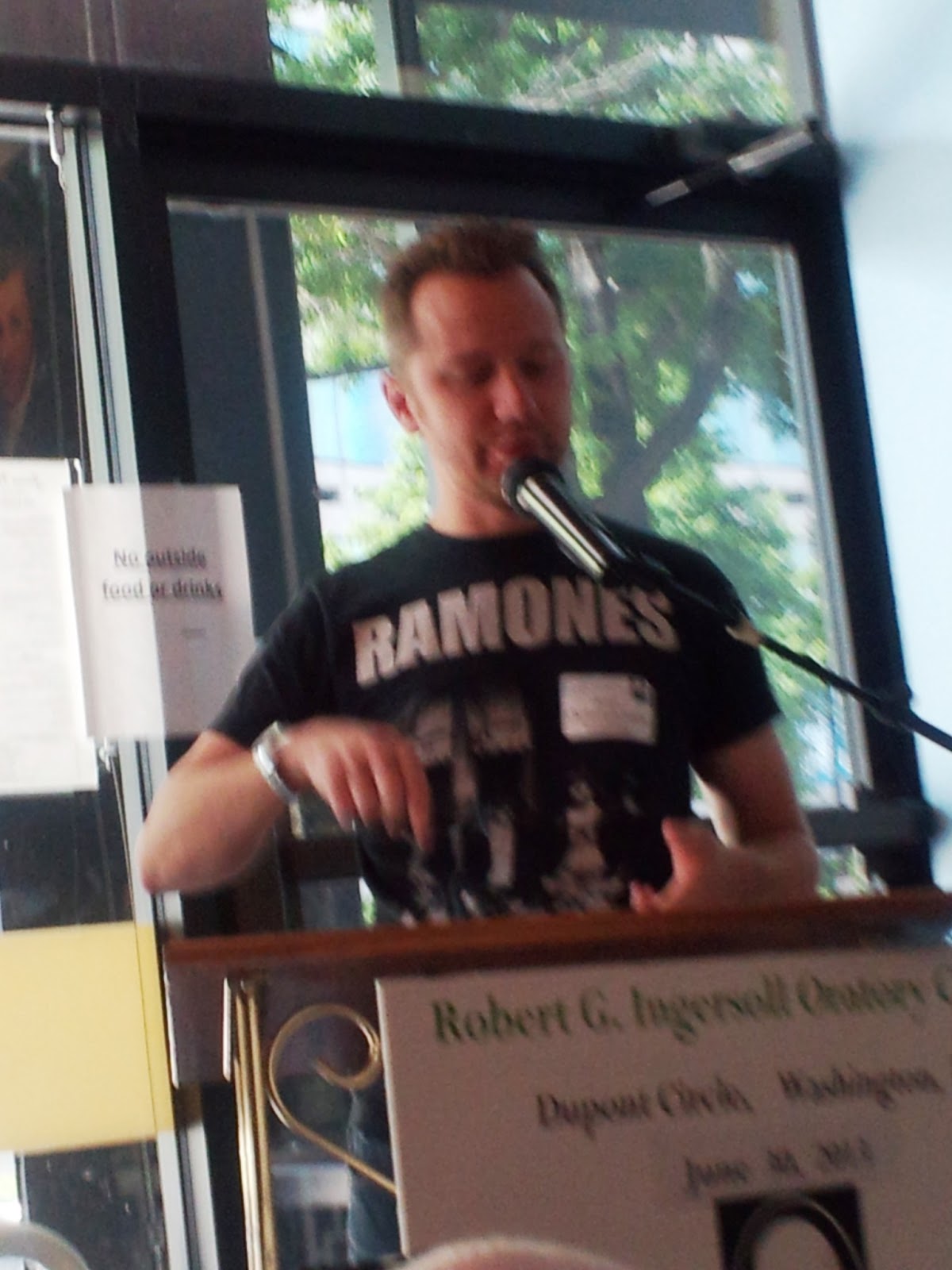
While rain forced a change of venue Sunday (to James Hoban's Restaurant ) we had a very nice
event. Eleven contestants, traveling from as far
as Florida, Indiana, and Delaware competed for 4 prizes. Steve Lowe served nobly as Master of Ceremonies
with assistance from Beth Kingsley, Brian Magee and Suzanne Perry. Links to photographs and videos will be posted on the
Ingersoll Oratory Facebook site and now are available, but a random sample of
quotes and images is below.
Carol
Ardell kicked off the event by a reciting, from memory, Ingersoll’s Twentieth Anniversary Lotos Club Dinner speech(1890). It begins sagely:
YOU
have talked so much of old age and gray hairs and thin locks, so much about the
past, that I feel sad. Now, I want to destroy the impression that baldness is a
sign of age. The very youngest people I ever saw were bald.
(These and other quotes from Secular
Web)
It goes on:
I am perfectly satisfied
that the highest possible philosophy is to enjoy today, not regretting
yesterday, and not fearing tomorrow. So, let us suck this orange of life dry,
so that when death does come, we can politely say to him, "You are welcome
to the peelings. What little there was we have enjoyed."

Terrance Madden followed with a reading from “Thomas
Paine (with
his name left out the history of liberty cannot be written.)”
At the age of
thirty-seven, Thomas Paine left England for
America, with the high
hope of being instrumental in the
establishment of a
free government. In his own country he could accomplish nothing. Those two
vultures Church and State – were ready to tear in pieces and devour the heart
of any one who might deny their divine right to enslave the world.
This was followed by Mike Schmidtmann who greeted fellow
Humanists before reading “About the Bible” & “The Ten Commandments.” Donald
Ardell also recited part of Ingersoll’s About
the Holy Bible which starts:
Somebody
ought to tell the truth about the Bible. The preachers dare not, because they
would be driven from their pulpits. Professors in colleges dare not, because
they would lose their salaries. Politicians dare not. They would be defeated.
Editors dare not. They would lose subscribers. Merchants dare not, because they
might lose customers. Men of fashion dare not, fearing that they would lose
caste. Even clerks dare not, because
they might be discharged. And so I thought I would do it myself."
Speaker selected topical talk including:
"There is no slavery but ignorance. Liberty is the child of intelligence."
Cody Smart heartfully recited, “What is Religion” - Ingersoll's last public address,delivered before the American Free Religious association, Boston, June 2, 1899.
"For many centuries and by many peoples it was believed that
this God demanded sacrifices; that he was pleased when parents
shedthe blood of their babes. Afterward it was supposed that he was
satisfied with the blood of oxen, lambs and doves, and that in
exchange for or on account of these sacrifices, this God gave rain,
sunshine and harvest. It was also believed that if the sacrifices
were not made, this God sent pestilence, famine, flood and
earthquake."

and Amelia Vogel read some of Ingersoll's beliefs from, “Suicide
and Sanity.”
"man is under no obligation to the imaginary gods; that all his
obligations and duties are to be discharged and done in this world;
that right and wrong do not depend on the will of an infinite Being, but on the consequences of actions, and that these consequences
necessarily flow from the nature of things. I believe that the universe
is natural."
As to what the 3 judges decided:
- Sarah Henry took first place reading from "Improved Man"
- Terence Madden took second place reading from Ingersoll's talk about Thomas Paine.

- Third place was won by Tya M. Pope who chose from two related speeches: "A Christmas Sermon" and What I Want for Christmas".

All agreed
that the performances were excellent and left us a bit more thoughtful and
perhaps wiser:
‘I believe that all actions that tend to the well-being
of sentient beings are virtuous and moral. I believe that real
religion consists in doing good. I do not believe in phantoms. I
believe in the uniformity of nature; that matter will forever
attract matter in proportion to mass and distance;’….
Partial answer to QUESTION: What is your belief about virtue, morality and religion? In Suicide N Sanity
Images
Taken by Gary Berg-Cross at the Event.
Brian - a helper.

Monday, July 01, 2013
Krauthammer Hammers Roe
This letter was published in the Washington Post on July 1, 2013 ----
"The legal basis behind Roe v Wade"
Charles Krauthammer was wrong in knocking Roe v Wade ["Roe v Wade, revisited," op ed, June 28]. Roe's recognition -- not "invention" -- of every woman's fundamental constitutional privacy right to terminate a problem pregnancy was based on the common law, the Bill of Rights, and the Ninth and 14th amendments. Further, Roe built on the Supreme Court's precedents, including the Griswold (1965) and Baird v Eisenstadt (1972) rulings.
Conservative legislators seeking to have government limit reproductive choice or impose on all women an unscientific, unbiblical, ahistorical "personhood at conception" ideology are attacking a fundamental right of more than half our population. Women who are opposed to abortion are under no obligation to have one.
Edd Doerr, Silver Spring
The writer is president of Americans for Religious Liberty
"The legal basis behind Roe v Wade"
Charles Krauthammer was wrong in knocking Roe v Wade ["Roe v Wade, revisited," op ed, June 28]. Roe's recognition -- not "invention" -- of every woman's fundamental constitutional privacy right to terminate a problem pregnancy was based on the common law, the Bill of Rights, and the Ninth and 14th amendments. Further, Roe built on the Supreme Court's precedents, including the Griswold (1965) and Baird v Eisenstadt (1972) rulings.
Conservative legislators seeking to have government limit reproductive choice or impose on all women an unscientific, unbiblical, ahistorical "personhood at conception" ideology are attacking a fundamental right of more than half our population. Women who are opposed to abortion are under no obligation to have one.
Edd Doerr, Silver Spring
The writer is president of Americans for Religious Liberty
Lights, camera, Religo-Conservative Action! A new Front on the Culture Wars

By Gary Berg-Cross
Despite what Former Pennsylvania Senator, and foot-in-mouth 2012 GOP presidential candidate Rick Santorum says, I was surprised to read that he has joined the movie industry. Well a very faith-based movie studio. As reported in the Washington Times Rick will be the new CEO of the Dallas, Tx-based EchoLight.
Wow, Texas is really gathering some conservative culture warriors. Let the culture wars begin! Well I guess they haven’t stopped just getting ready to ramp up.

Santorum was interviewed
by The
Christian Post at the International Christian Retail Show at the America's
Center Convention Complex in St. Louis, Mo and offered this.
"I've been involved in the culture for a long time.
Yes, the culture. Christian/Catholic culture. Bashing the Gays. Wars on Women type cultural discussion. All to be toned down and slid into subliminal, entertaining but progandistic stories.
“I think we have
an opportunity to present good, quality, entertaining content for folks out
there who don’t believe that what’s being produced in Hollywood is meeting
their values in a way they feel comfortable,”
To be fair
Rick has inspired some media culture. He reportedly inspired
'True Blood' Season 5, so says series creator Alan Ball.
If you are behind what the Christian right is selling you can catch up with guidance from Christiancinema.com. They already list best-selling Christian videos.
1.
|
 |
|||
2.
|
 |
|||
3.
|
 |
|||
4.
|
 |
|||
5.
|
 |
|||
6.
|
 |
|||
7.
|
 |
|||
8.
|
 |
|||
9.
|
||||
10.
|
![The Resolution [from the movie COURAGEOUS] - Print](file:///C:/Users/GARYBE~1/AppData/Local/Temp/msohtmlclip1/01/clip_image020.jpg) |
Now EchoLight has entered to help get the word, I mean Word out:

EchoLight
Studios and the Support Military Foundation have teamed up to help entertain and inspire families around
the world. Whether you're a NASCAR fan, or have a loved one in the military, or
just love watching movies together, we hope that these movies will
move you.
EchoLight Studios, founded only in 2011, is the first vertically integrated faith-based movie studio to offer production financing, marketing and distribution across all releasing platforms according to a release from the organization. Here’s an example from their site.
The Redemption of Henry Myers
It’s not who you
are. It’s who you become. EchoLight’s first theatrical release rides into
theaters this fall.
It’s already in the unholy, holy alliance business having partnered with Lynchburg, Va.-based Liberty University to produce films from that school’s cinematic arts program. First a stream of Liberty U lawyers, now this.
I know what films the T-party Reps will be screening in coming years.
I sure hope we don’t have an EchoLight Film Fest for
a while.
Images
EchoLight
images, from their site.
Subscribe to:
Posts (Atom)