Monday, October 26, 2015

Charter schools...an underminer of our public system


Edd Doerr, President of Americans for Religious Liberty, published his letter  in the New York Daily News on Oct 16, 2015  ----


“Charters vs  public schools”

Voicer Martin Brahms’ letter on charter schools was spot-on. Nationally, Washington’s large array of charter schools is considered the best in the US.  But a just-released study of DC charter schools reveals that about 90% of them serve far fewer at-risk kids than nearby regular public schools. Charter schools are part of a national campaign to undermine the public schools that, under- and unevenly funded, have served 90% of our growing population.
See also this Salon article


The Lowdown on the Hightower Lowdown

Edd Doerr

Jim Hightower, a former Texas Agricultural Commissioner, was a speaker at the AHA conference in Houston when I  was AHA president, and that’s where we got acquainted over a beer at the hotel. For 17 years he has been putting out the monthly Hightower Lowdown, an inexpensive ($15 per year) 4-page progressive newsletter that is superb. 

The current issue is devoted to the importance of High Speed Rail, something at which the US lags well behind Japan and western Europe.  I highly recommend it. 

Get a sample copy by sending a stamped self-addressed envelope to The Hightower Lowdown, Box 3109, Langhorne, PA  19047.

BTW, if you are not familiar with Voice of Reason, the quarterly journal of Americans for Religious Liberty, check out our web site – arlinc.org – where you will find 34 years of incisive writing on issues long of interest to Humanists, freethinkers and anyone who cares about church-state separation. VOR is only $25 per year.

Wednesday, October 14, 2015

Burundi, Overpopulation and Pope Francis


By Edd Doerr

Burundi and Rwanda are two very small countries in central Africa, each about the size of Maryland. Both became German colonies in the late 19th century, then Belgian colonies in 1916, and won independence in the early 1960s. The Germans and Belgians favored the Tutsi minorities over the Hutu majorities. Both countries suffered Tutsi/Hutu civil wars and massacres after independence, due largely to their being the most crowded, overpopulated, and rapidly growing populations in the world. Both are about 2/3 Roman Catholic, thanks to nearly a century of German and Belgian missionary activity.

Burundi’s  overpopulation crisis is spelled out in Jillian Keenan’s excellent feature article in the October 2015 issue of Population Connection, from which I quote relevant portions:

“The Catholic Church was among the institutions that benefitted from the colonial approach to land. Missionaries, known as the ‘White Fathers’, began arriving in the late 19th century, and over several decades, the king gave them large tracts of land, which they used to establish churches, schools, hospitals, and farms. After colonialism ended, the self-sufficiency that land provided the church helped it retain influence, even as its influence with the newly independent government grew fraught.” Despite opposition from military leader Jean-Baptiste Bagaza in the 1970s, “The church retained millions of Burundian followers, along with plenty of land, though no one, it seems knew exactly how much.”

“The Catholic Church was also complicit in nurturing Burundi’s ethnic divisions; Catholic schools, for instance, were largely reserved for ‘elite’ children, meaning Tutsis. Intensifying schisms led to various outbreaks of ethnic violence, and in 1972, the Tutsi-dominated military launched a series of pogroms targeting Hutus.”

Beginning in 2011 the Dutch and German governments began supporting “programs promoting sexual and reproductive health, among other human rights.” But, Keenan continues, “It’s an uphill battle. According to the United Nations, modern contraceptive use among females between the ages of 15 and 49 was just 18.9% in 2010. . . . Then there is the Catholic Church: In addition to claiming an estimated 60% of Burundians as followers, the church has affiliations with roughly 30% of national health clinics, which are forbidden from distributing or discussing condoms, the pill, and other contraceptives. ‘Catholic teachings against birth control are very resonant with Burundian culture, which says that children are wealth,’ explains Longman of Boston University. ‘Because the Catholic Church is so powerful and controls so much of the health sector, it creates a huge stumbling block for family-planning practice’.”

“In 2012, the Ministry of Public Health launched a series of ‘secondary health posts,’ which offer medical contraceptives; sometimes these clinics … are built right next  door to existing Catholic ones. . . . There is also tension over a variable with unknown dimensions: how much of the land the Catholic Church held onto after colonialism it still owns today. ‘The Catholic Church can’t keep owning all the land while Christians are starving,’ says a regional government employee in Kayanza, who spoke on condition of anonymity out of concern for his safety. … ‘National politics don’t allow us to focus on the Catholic Church,’ he says, referring to the fact that the church’s followers are also voters’.”

Many Burundians “fear that support for family planning is too little too late.”

A great many Catholics worldwide are concerned about overpopulation and climate change, and most ignore the Vatican’s regressive policies on contraception, abortion and other matters, but far too many politicians, especially in the US, are afraid to stand up to what they fear might be church pressure. Gutsy politicians would call out, “The king – er, bishops – have no clothes!” Relevant is what I wrote in the National Catholic Reporter in February 2015:

“Pope Francis [is} to be commended for [his] forward push on climate change. Many of us are hoping that Francis will do the one thing that he and he alone can do about climate change: rescind Paul VI’s 1968 Humanae Vitae encyclical, promulgated in defiance of the vast majority of his own advisers. Since 1968 there have been 1.5 billion abortions worldwide, 50 million in the US alone. Vacating Humanae Vitae would seriously lower the abortion rate, save women’s lives, and contribute to reducing overpopulation  and such concomitants of climate change as resource depletion, environmental degradation, deforestation, soil erosion and nutrient loss, biodiversity shrinkage, rising sea levels (40% of world population lives in coastal areas), and increasing sociopolitical instability and violence.”

If Pope Francis is serious about social justice and climate change, the mess his church has helped create in Burundi and Rwanda would be good places to put action where his mouth is.

Bertrand Russell wrote about overpopulation in his Marriage and Morals., the year before I was born (1930), when world population was ¼ what it is today. Harrison Brown and other scientists were writing about it when I was in college. Before my  kids  were out of college the Ford administration finished the National Security Study Memorandum 200 report on overpopulation, which was immediately “classified” and deep-sixed until shortly before the 1994 UN Cairo population conference and it still virtually unknown. I am apparently one of the very few writers who published reviews of it. And  today, with world population well over 7 billion, even a great many of the scientists, writers and politicians who are on the front lines on climate change are reluctant to say we need universal access to contraception, abortion and sexuality education, not to mention equal rights for all women.
http://www.arlinc.org/

Tuesday, October 13, 2015

Notes on Julien Musolino's "The Soul Fallacy" Lecture

by Gary Berg-Cross

Dr. Julien Musolino,  a Franco-American cognitive scientist, was one of the speakers at the recent WASHCON15. These are some notes (and pictures) from his talk. 
Julien is an author, and associate professor at Rutgers University, New Brunswick, where he holds a dual appointment in the Psychology Department and the Center for Cognitive Science.  Born and raised in France, Julien studied at the University of Geneva, in neighboring Switzerland, the University of North Wales, Bangor, in the United Kingdom, the University of Maryland, and the University of Pennsylvania.
His research has been funded by the National Institutes of Health and the National Science Foundation and some of this is captured in his recent book:

Dualism is obviously an old belief and deeply embedded in old philosophies and common sense language.   It's a perennial topic but not often critically addressed. (But see Lives Without Selves: Owen Flanagan
https://www.youtube.com/watch?v=POXTdHTKTL0 for some philosophical discussion on the nature of person.) 
But combining Self, aka Soul, as distinct from the body but interacting with it raises lots of questions, at least from a scientific point of view.  For example, there’s the problem of how something “immaterial” could interact with matter to produce results (the “psychological potency”idea that the soul influences how we act.).

We can ask Why isn’t belief in various gods, considered delusional? We d
o have some diagnostic categories for these types of things and what have been described as "visions" may just be hallucinations.  Professionals may think about this, but it is atouchy subject with the layman and invested religious professionals.  "Was Moses hallucinating?" is not a good topic in a temple, church or mosque.

As Mark Baker and Stewart Goetz observe in their book “The Soul Hypothesis,” “Most people, at most times, in most places, at most ages have believed that human beings have some kind of soul.” And the National Pew surveys suggest that belief in immortality is about 70%
It is clear that this hypothesis or "intuition" also plays a central role in most religious doctrines.  after all Pope John Paul II famously articulated the idea in a message delivered to the Pontifical Academy of Sciences in October 1996, in which the Holy Father declared that the human body might originate from preexisting living matter, but the spiritual soul is a direct creation of God.

Further, explaining the mind as a product of evolution, claimed the pope, was incompatible with the truth about man.
But Julien argues that the soul is a scientific claim in that it is an existence and influence claims. 
“Belief in an immaterial, psychologically potent, and detachable soul that can function apart from the body after we die amounts to a series of claims about physics, biology and the sciences of the mind,” 
This claim that can be investigated using the tools and methods of rational inquiry and science gives us every reason to believe that humans don’t have souls. It's one of those soul-in-the-gaps problems where things previously attributed to soul turn out to be explainable by brain science, Physics and the like.

For more on this come to the the WASH MDC meeting held in the Wheaton Library (11701 Georgia Ave., Wheaton, MD), Saturday, Oct 17th (10:45-12:45) where this and other topics from the WASHCon15 meeting will be discussed. 

As time permits we will provide updated information on Reason Rally 2016 planned for June, 4, 2016 as provided us by Sarah Morehead at the conference. Snapshots also from talks by Andy Thomson (Happiness in a Secular World), Ron Lindsay (The Necessity of Secularism) Jason Heap, Justus Cade (Are SAtheists hurting Humanism) and more.
See http://www.meetup.com/humanism-218/events/225993201/ for more details.

BTW, Julien now does twitter @JulienMusolino

For example:

Found this (Bible) in my hotel. Returned it to the front desk. Next time I'll request a non-smoking and non-religious room. 

Sunday, October 11, 2015

The misuse of language

by Gary Berg-Cross

There they go again.  Speaking Words Freely.  Well loosely. GOP presidential candidate Ben Carson danced around the idea of President Obama’s being a “real black president.”
“I wouldn’t even get into such a conversation,” he told host Wolf Blitzer on CNN’s “The Situation Room.” “He’s the president and he’s black. " We’re dealing with semantics," 
Sure we are, and it’s important. You don’t do language math by adding Black and President and get a real meaning for “Black President” which is a phrase that capture a whole culture of meaning.
Socrates, via Plato, is often quoted (in translation) on the impact of corrupting language. It is variously translated as "The misuse of language induces evil in the soul." Notwithstanding the metaphorical allusions to religio-philosophical concept of evil and soul we edge into danger when we express ourselves poorly or use language to disguise the true situation.  There is room enough for this in ordinary conversation when language is used pragmatically to bend the truth, or smooth things over in uncomfortable situations. It is language used in support of a “white lie.”  “I can’t make your Christening, I have a family obligation.”

But the art of group or personal spin has spilled its banks and taken on a corrupting color that is not white at all. One simple example from recent events is the inflamed phrasing such as “criminalization of ... faith” uttered in defense of Kim Davis’ actions. 
Penned in by an avaricious ad strewn society we know that the “buyer” has to beware.  But language is used to get around our conscious defenses. A hospital bill may list a $15 charge for “disposable mucus recovery system,” but this was in reality, just a box of Kleenex.

Since we are likely to hear more language bending (ads and otherwise) in coming days here are a few thoughts on just 2 types we run into:
·        Political talk and
·        Translations

A professional, routinized version of tortured language has emerged called Spinglish—a wordy, devious dialect of English (I’m sure they manifest in other languages) used by professional spin doctors. These are all around us, but a gaggle of them fly over the political scene putting reasoned speech in shadow.

It is common now as the trope of saying “mistakes were made.”  This is a  rhetorical device, allowing a speaker to acknowledge that “a situation was handled poorly or inappropriately but seeks to evade any direct admission or accusation of responsibility by not specifying the person who made the mistakes. That rose to prominence in a political context with Reagan’s Arms-for-hostage or Iran-Contra deal, but some trace of this type of thing goes back to Watergate and  May , 1973, when Nixon’s White House Press Secretary Ron Ziegler confessed to what amounted to sinful, spinful lies:
"I would apologize to the Post, and I would apologize to Mr. Woodward and Mr. Bernstein. We would all have to say that mistakes were made in terms of comments. I was overenthusiastic in my comments about the Post, particularly if you look at them in the context of developments that have taken place."

What context?  On the previous day, White House counsel John Dean and Nixon aides Ehrlichman and  Haldeman had resigned.

The impact can be substantial when false words become an active part of crafted messaging as in the case of the Watergate cover-up or just a cover for policies that would be unpopular if not protected by false narratives.   . The Platonic-era Greeks were getting a dose of this political narrative as part of Athenian democracy and more recently you don’t have to have just read Orwell’s 1984 to understand a the language has the power in politics to mask the truth and mislead the public. Contemporary politics has lots of this along with innuendo so in this era of social media megaphones it is even more important for the public to be aware of this power of false narratives.
In the current political season we depend on the media and competing parties to penetrate the language miasma. Some recent examples within the Republican contest concern people, like Trump, being allowed to imply that President Obama is a secret, and one supposes traitorous, Muslin. It is language labeling one as an enemy.  When polled Trump supporters mostly explained that they found various Trump message  pitched to a 3rd or 4th -grade level and wrapped in a pro wrestling atmosphere) appealing because it is “easy to understand”. Sure “Make America great again” has simple semantics (unless you say it in Mexican, I guess). “We know his goal is to make America great.”  This is the vaguest of ends with narry a hint of means unless it means firing a whole House of pols.  The slogan “First we kill all the lawyers” has been updated to imply that conventional, compromising pols are also included.

There have been efforts to take more nuanced stances and explore the implications of statements. Rand Paul scolded generalissimo candidate Donald Trump for “careless language” in general, while Lindsey Graham accused Trump’s language of “playing into this hateful narrative, ” and Chris Christie said Trump had an “obligation” to set the record straight, although Trump has responded that he has no responsibility for such language cleaning.  Just a matter of semantics via dog whistles one assumes.

Trump was, however, offended that Jeb Bush spoke “Mexican” recently in McAllen, Texas.  Apparentely this doesn’t make America great.  In this context “Mexican” also has dog whistle semantic overtones that fire up prejudice as Bush noted:

"Those are dog whistle terms; he knows what he's doing. These are very divisive terms. If we're going to win elections, we need to be much more open, open and optimistic, rather than sending signals that prey on people's angst."

Setting the record straight after it has whistled out is hard to do as Mark Twain noted:
“A Lie Can Travel Halfway Around the World While the Truth Is Putting On Its Shoes.”

Our language and cultural understandings are is also challenged by neat, translations from other languages and their cultures.  So can injustices wrapped in mistranslations and misunderstood expression. Two examples”
The idea that the Koran promises Islamic martyrs 47 virgins in heaven and the Iranian threats to destroy Israel.

Virginal beings  In Islamic mythology, there is a concept of  houris (which are described in a Wikipedia section as
“gazelle-eyed (woman)") or á¸¥Å«rÄ«yah  (are commonly translated as "(splendid)[2] companions of equal age (well-matched)", "lovely eyed", of "modest gaze", "pure beings" or "companions pure" of paradise, denoting humans and jinn who enter Jannah (paradise) after being recreated anew in the hereafter.”
Among non-Muslims, the concept of the houri received wide publicity as "virgins" (most usually 72 in number for each shahid) promised as a reward to Muslim shahids (martyrs), after their death. However, contrary to such reports, the Quran states that all believers (not just martyrs, and nowhere either is it said it's just men) who go to Heaven shall be granted the company of more than one houris—explicitly mentioned in the plural, and the number 72 comes from a hadith with a weak chain of narrators (i.e. less than totally reliable), and not the Quran.
Up close if is quite a bit different than we hear thrown into conversations about the motivations for martyrs. But of course, the pop image of the 72 virgins has provided a lure for corruption on an historic meaning with a fleshy new one.  Language misuse creates it own reality.

According to no less an intellectual than the very Jewish Noam Chomsky there may be a similar misreading of Iranian statements about Israel’s existence, a topic of some import in the recent arguments about a diplomatic solution to Iran’s nuclear program (see the Haaretz article  Iran Is Not an 'Existential' Threat to Israel - No Matter What Netanyahu Claims)

Chomsky, put it this way:

“To be sure, Israel faces the “existential threat” of Iranian pronouncements: Iran’s Supreme Leader Ayatollah Ali Khamenei and former President Mahmoud Ahmadinejad famously threatened it with destruction. Except that they didn’t—and if they had, it would be of little moment. They predicted that “Under God’s grace [the Zionist regime] will be wiped off the map.” Another translation suggests that Ahmadinejad actually said that Israel “must vanish from the page of time”. This is a citation of a statement made by Ayatollah Khomeini, during a period when Iran and Israel were tacitly allied. In other words, they hope that regime change will someday take place. They do not say that they will attack Israel either now or later.”

There’s more of the translation history and its formulations in Steve Rendall’s  2012 Lost in Translation, Iran never threatened to wipe Israel off the map, which includes this:

Israeli Deputy Prime Minister Dan Meridor agreed with interviewer Teymoor Nabili’s suggestion that the supposed remarks were never actually made. Iranian leaders, Meridor said,
come basically ideologically, religiously, with the statement that Israel is an unnatural creature, it will not survive. They didn’t say “we’ll wipe it out,” you are right, but [that] it will not survive, it is a cancerous tumor, it should be removed.
The Persian phrase Meridor was asked about, was used by Ahmadinejad in a 2005 speech in which neither maps nor wiping were mentioned. As Cole explained (Informed Comment, 5/3/06):
The actual quote, which comes from an old speech of Khomeini, does not imply military action, or killing anyone at all…. The phrase is almost metaphysical. He quoted Khomeini that “the occupation regime over Jerusalem should vanish from the page of time.” It is in fact probably a reference to some phrase in a medieval Persian poem. It is not about tanks.

Even the right-wing pro-Israel translation service MEMRI translated the Ahmadine-jad comment as “this regime that is occupying Jerusalem must vanish from the page of time” (CounterPunch, 
As they say, "The misuse of language induces evil in the soul." So we need to not only choose our words carefully to express ourselves, but interprete them critically. It’s another hard part of a citizen’s task as issues hiding in canned phrases are thrown about.


Friday, October 09, 2015

DC charter schools serve fewer at-risk students than nearby neighborhood [public] schools

Edd Doerr thinks that the  Oct 8 Washington Post online article  by Michael Alison Chandler “DC charter schools serve fewer at-risk students than nearby neighborhood [public] schools” is "Dynamite".

He noted curiously, that the Oct 9 print edition of the paper did not run the story. Here is what Edd posted in the paper online ---

The article details, with maps and charts, how about 90% of DC’s large charter 
school array serve fewer at-risk kids than nearby public schools and are rather selective, which regular public schools cannot be. As the DC charters are regarded as some of the best in the US, what does this say about charters generally? The big question is why did the Post omit this article from its Oct 9 print edition?

There is a strong consensus among educators and others that charter schools – and school voucher plans – are part of an ongoing Republican/conservative campaign to undermine and privatize public education. Diane Ravitch, Mercedes Schneider, and many others, including myself, have been writing about this for a long time.

DC School Vouchers

The Washington Post on Oct 9 did publish this story by Lyndsey Layton, ”8 on [DC] council seek end to private school vouchers.” The story refers to a letter that a majority on the DC City Council sent to a congressional committee on Oct 8 urging no further expansion of the school voucher plan imposed on the District of Columbia by Congress and the George W. Bush administration. You should be able to Google the story. Here is the comment I posted online ---

“Excellent! The Council majority accurately reflects public opinion against vouchers. Remember that in 1981 DC voters voted down a tax-credit voucher plan by 89% to 11%. Remember that DC vouchers are paid for not just by DC taxpayers but by all taxpayers nationwide.
“Let’s note also that the annual Gallup education poll in August showed that Americans nationwide oppose diverting public funds to private schools by 57% to 31%, a supermajority that has held for nearly 50 years and that is reflected in the 28 state referenda from coast to coast from 1966 through 2014.”

Monday, October 05, 2015

This is the place to find god

By Mathew Goldstein

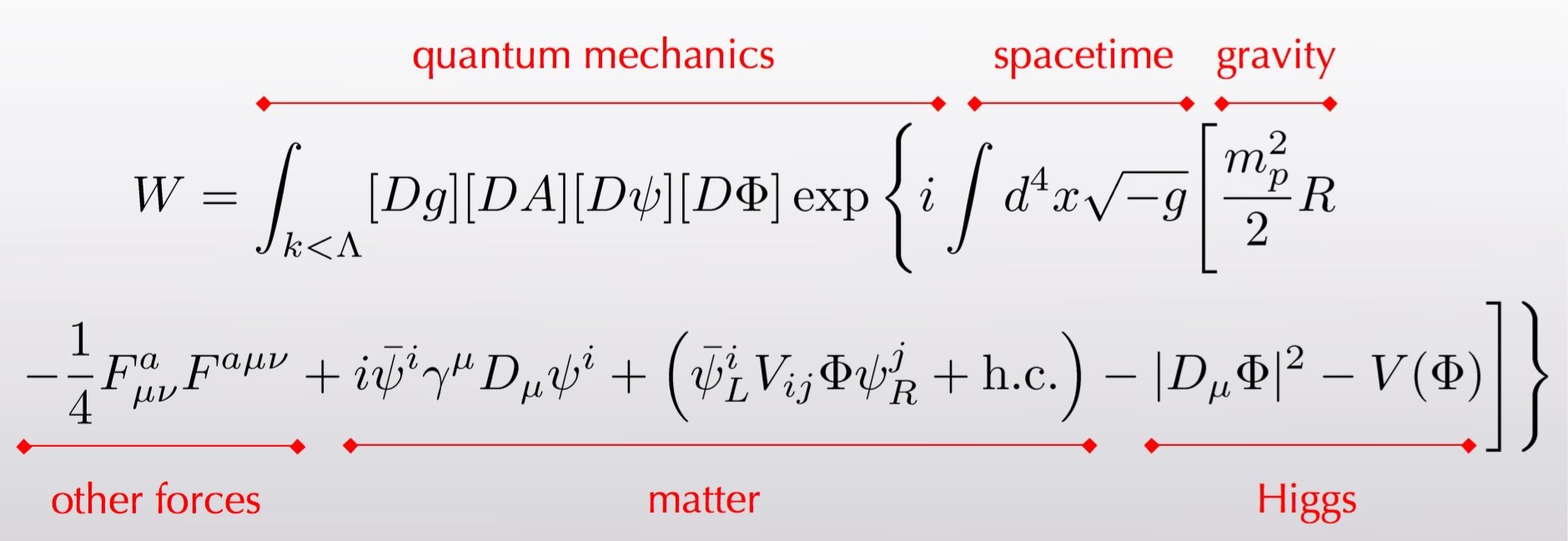
The equations of physics, because they are comprehensive (although incomplete) and accurate in modeling our universe, are strong evidence that we live in a material, physical, mechanical universe.  From this result we conclude, without needing to know the functions shown below or how to calculate with them, that our purpose is found in our individual lives and not in the overall functioning of the universe.

A common criticism of the above argument is that it is a "fallacy" called "scientism".  Actually, the above argument is a good example of an empirical argument and empirical arguments are the strongest possible type of argument.  The universe communicates to us how it functions via empirical evidence and it is from empirical evidence that the above equation is derived. Philosophical arguments which rely on assertions of first principles and appeals to intuition are among the weakest type of arguments.  Those kind of arguments, which are very common in theology and religion, and are also found in philosophy and outside of any religious context, consist of people talking to themselves about themselves while mistakenly claiming that they are talking about an objective reality outside of themselves.  Talk about the transcendent cosmic purpose that is not firmly anchored in our best current understanding of how the universe functions as derived from from physics and biology is more likely than not to be disconnected from reality. Arguments from first principles and intuition can be highly intellectual, but conclusions are not true merely because they are supported by intellectual arguments.  Philosophy can be, and is, very valuable provided that it relies upon factual statements about how the universe works that the overall available empirical evidence properly supports.

Sunday, October 04, 2015

To ignore a result call it a pressuposition

By Mathew Goldstein

Edward Feser is Associate Professor of Philosophy at Pasadena City College. He is associated with Princeton University's Witherspoon Institute.  He promotes the views of Thomas Aquinas and expresses views similar to those backed by the Vatican on his blog and in his books.  He has a loyal following among like minded theists.  Let's examine some of what he says in his recent article Scientists Should Tell Lawrence Krauss to Shut Up Already.

He starts by pointing out that the lack of mention of God in the game of checkers does not suggest that God does not exist and then he argues that likewise "the fact that scientists need make no reference to God when doing physics, biology, or any other science doesn’t prove—or even suggest—that the existence of God is doubtful."  This is a good illustration of a bad analogy.  Checkers has nothing to say about what is true or false about how the world works while science addresses that very question.  So in this context they are opposites, not equivalents.  What checkers says is indeed irrelevant to this question while what science says is very relevant.

He writes ".... science cannot answer the question why there is any world at all, or any laws at all. To answer those questions, or even to understand them properly, you must take an intellectual vantage point from outside the world and its laws, and thus outside of science. You need to look to philosophical argument, which goes deeper than anything mere physics can uncover.... Krauss is looking in the wrong place when he confines himself to science to find some reason to affirm a divine uncaused cause."  While it is true that we need more than a "mere" foundation to build a house, it is nevertheless also true that we should build houses anchored securely in a solid foundation.  Although it is not immediately apparent, professor Feser starts with this reasonable observation that physics, like a foundation for a house, is incomplete, and then quietly segues into the untenable position that physics is irrelevant.  He articulates the reasonable first position but then he adopts the unreasonable second position.  And all along the way professor Feser falsely stereotypes Lawrence Krauss as someone who fails to acknowledge that there is more to life than physics.

He says "The reason is that physics confines itself to describing the mathematical structure of the world, since only what can be so captured is susceptible of strict prediction and control. The inner nature of the reality that has that structure necessarily falls through physics’ methodological net."  There are emergent features of our universe not captured by the equations of physics.  This is one reason that we also have chemistry and biology.  We similarly have social sciences like economics and law and philosophy.  And we have food, music, art, recreation, etc.  All are important.   Not even atheist physicists like Lawrence Krauss claim otherwise.  But when it comes to the ultimate questions about how our universe works at the foundational level, a.k.a. "the inner nature of reality", we have no better alternative than physics.

He then says "It is thus comically inept for Krauss to assert in his recent article that 'the more we learn about the workings of the universe, the more purposeless it seems.'"  Krauss is correct.  Any answer to the second question of whether the universe has some human centered purpose is dependent on first determining the workings of the universe.  Philosophers like Feser who insist on disconnecting their answer to the first question from the answer to the second question are the ones who are being comically inept.

He says: "The reason is that purpose—what philosophers call teleology or final causality—is an irreducibly qualitative notion. Hence it cannot be captured in quantitative concepts."  Contrary to what Feser keeps saying, physics is not a-priori confined to finding equations or to quantitative concepts.  If the universe is mechanical then it can be described quantitatively by equations, otherwise it cannot be so described.  As it turns out, through no fault of the innocent physicists, our universe is mechanical and therefore it can be described by equations.  In other words, the pervasiveness of equations in physics is a result of a qualitative property of the universe.  This is a lucky result from the point of view of professional scientists but it did not a-priori have to be this way. If the universe were not mechanical, not material, not physical, then there would not be equations describing its function and physicists, along with the rest of humanity, would have to manage the best we could with that result.

Physics is about more than quantitative concepts.  The equations of physics describe the mechanical functioning of our universe.  Understanding that our universe functions mechanically is a necessary starting point for evaluating its purpose.  The irony here is that theism is built upon a recognition of the centrality of understanding the function of the universe to determining its purpose.  This is a primary reason theists keep insisting there is a god.  Theism reasons backwards, starting with a demand for cosmic purpose and then inserting an imaginary god into the functioning of the universe to provide the cosmic purpose.  So when theists like Feser complain that physics tells us only about the functioning of the universe and therefore tells us nothing about the purpose of the universe they are employing an inconsistent double standard.

He then says: "If you confine yourself to quantitative concepts—as physics does—then you are guaranteed not to find purpose even if it is there."  This is false.  If the functioning of the universe exhibits cosmic purpose then physicists, and scientists more generally, are capable of discovering this fact.  If, for example, the weather is better where more people spend more time worshipping in a Catholic church then this pattern can be detected and once detected will be reported.  When we quantify weather in terms of high, low, and average temperature, humidity, etc., we are facilitating, not obstructing, our qualitative understanding of the weather.  The equations of physics are a result of our universe being mechanical, material, and physical.  The resulting equations are powerful evidence that our universe is self-confined to being mechanical and material.  But professor Feser will not admit this because his theism takes priority over the facts, so he declares this result to be a presupposition.