Friday, October 09, 2015

DC charter schools serve fewer at-risk students than nearby neighborhood [public] schools

Edd Doerr thinks that the  Oct 8 Washington Post online article  by Michael Alison Chandler “DC charter schools serve fewer at-risk students than nearby neighborhood [public] schools” is "Dynamite".

He noted curiously, that the Oct 9 print edition of the paper did not run the story. Here is what Edd posted in the paper online ---

The article details, with maps and charts, how about 90% of DC’s large charter 
school array serve fewer at-risk kids than nearby public schools and are rather selective, which regular public schools cannot be. As the DC charters are regarded as some of the best in the US, what does this say about charters generally? The big question is why did the Post omit this article from its Oct 9 print edition?

There is a strong consensus among educators and others that charter schools – and school voucher plans – are part of an ongoing Republican/conservative campaign to undermine and privatize public education. Diane Ravitch, Mercedes Schneider, and many others, including myself, have been writing about this for a long time.

DC School Vouchers

The Washington Post on Oct 9 did publish this story by Lyndsey Layton, ”8 on [DC] council seek end to private school vouchers.” The story refers to a letter that a majority on the DC City Council sent to a congressional committee on Oct 8 urging no further expansion of the school voucher plan imposed on the District of Columbia by Congress and the George W. Bush administration. You should be able to Google the story. Here is the comment I posted online ---

“Excellent! The Council majority accurately reflects public opinion against vouchers. Remember that in 1981 DC voters voted down a tax-credit voucher plan by 89% to 11%. Remember that DC vouchers are paid for not just by DC taxpayers but by all taxpayers nationwide.
“Let’s note also that the annual Gallup education poll in August showed that Americans nationwide oppose diverting public funds to private schools by 57% to 31%, a supermajority that has held for nearly 50 years and that is reflected in the 28 state referenda from coast to coast from 1966 through 2014.”

Monday, October 05, 2015

This is the place to find god

By Mathew Goldstein

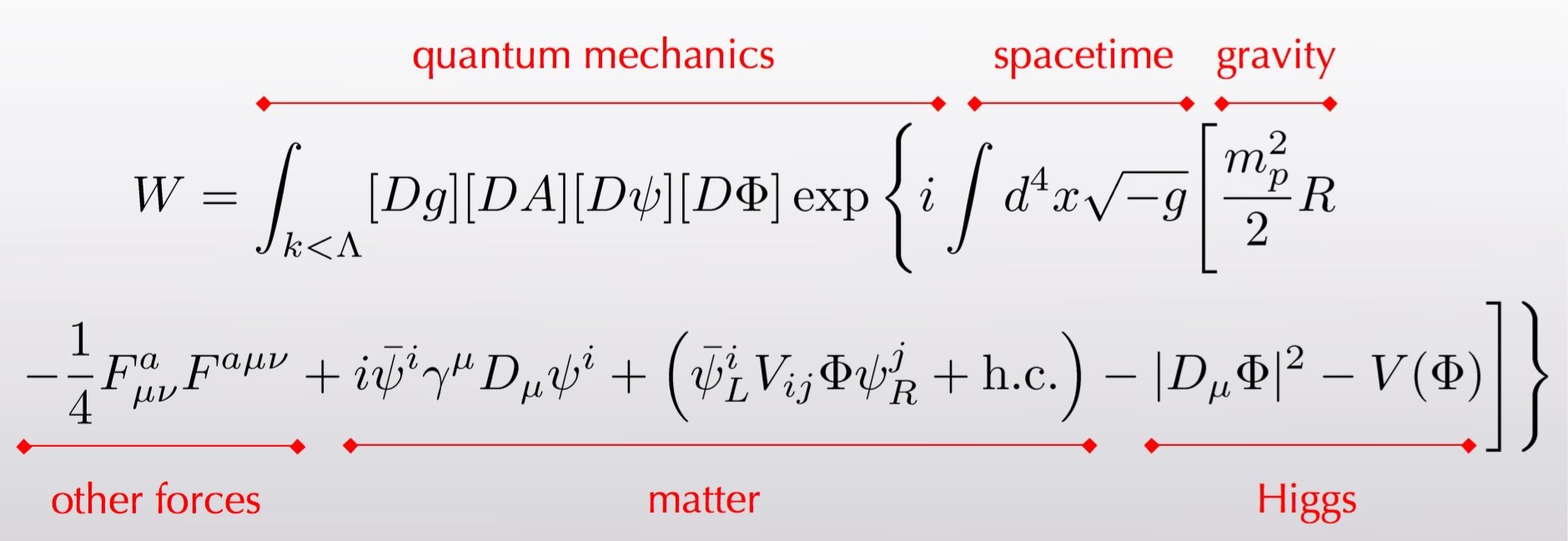
The equations of physics, because they are comprehensive (although incomplete) and accurate in modeling our universe, are strong evidence that we live in a material, physical, mechanical universe.  From this result we conclude, without needing to know the functions shown below or how to calculate with them, that our purpose is found in our individual lives and not in the overall functioning of the universe.

A common criticism of the above argument is that it is a "fallacy" called "scientism".  Actually, the above argument is a good example of an empirical argument and empirical arguments are the strongest possible type of argument.  The universe communicates to us how it functions via empirical evidence and it is from empirical evidence that the above equation is derived. Philosophical arguments which rely on assertions of first principles and appeals to intuition are among the weakest type of arguments.  Those kind of arguments, which are very common in theology and religion, and are also found in philosophy and outside of any religious context, consist of people talking to themselves about themselves while mistakenly claiming that they are talking about an objective reality outside of themselves.  Talk about the transcendent cosmic purpose that is not firmly anchored in our best current understanding of how the universe functions as derived from from physics and biology is more likely than not to be disconnected from reality. Arguments from first principles and intuition can be highly intellectual, but conclusions are not true merely because they are supported by intellectual arguments.  Philosophy can be, and is, very valuable provided that it relies upon factual statements about how the universe works that the overall available empirical evidence properly supports.

Sunday, October 04, 2015

To ignore a result call it a pressuposition

By Mathew Goldstein

Edward Feser is Associate Professor of Philosophy at Pasadena City College. He is associated with Princeton University's Witherspoon Institute.  He promotes the views of Thomas Aquinas and expresses views similar to those backed by the Vatican on his blog and in his books.  He has a loyal following among like minded theists.  Let's examine some of what he says in his recent article Scientists Should Tell Lawrence Krauss to Shut Up Already.

He starts by pointing out that the lack of mention of God in the game of checkers does not suggest that God does not exist and then he argues that likewise "the fact that scientists need make no reference to God when doing physics, biology, or any other science doesn’t prove—or even suggest—that the existence of God is doubtful."  This is a good illustration of a bad analogy.  Checkers has nothing to say about what is true or false about how the world works while science addresses that very question.  So in this context they are opposites, not equivalents.  What checkers says is indeed irrelevant to this question while what science says is very relevant.

He writes ".... science cannot answer the question why there is any world at all, or any laws at all. To answer those questions, or even to understand them properly, you must take an intellectual vantage point from outside the world and its laws, and thus outside of science. You need to look to philosophical argument, which goes deeper than anything mere physics can uncover.... Krauss is looking in the wrong place when he confines himself to science to find some reason to affirm a divine uncaused cause."  While it is true that we need more than a "mere" foundation to build a house, it is nevertheless also true that we should build houses anchored securely in a solid foundation.  Although it is not immediately apparent, professor Feser starts with this reasonable observation that physics, like a foundation for a house, is incomplete, and then quietly segues into the untenable position that physics is irrelevant.  He articulates the reasonable first position but then he adopts the unreasonable second position.  And all along the way professor Feser falsely stereotypes Lawrence Krauss as someone who fails to acknowledge that there is more to life than physics.

He says "The reason is that physics confines itself to describing the mathematical structure of the world, since only what can be so captured is susceptible of strict prediction and control. The inner nature of the reality that has that structure necessarily falls through physics’ methodological net."  There are emergent features of our universe not captured by the equations of physics.  This is one reason that we also have chemistry and biology.  We similarly have social sciences like economics and law and philosophy.  And we have food, music, art, recreation, etc.  All are important.   Not even atheist physicists like Lawrence Krauss claim otherwise.  But when it comes to the ultimate questions about how our universe works at the foundational level, a.k.a. "the inner nature of reality", we have no better alternative than physics.

He then says "It is thus comically inept for Krauss to assert in his recent article that 'the more we learn about the workings of the universe, the more purposeless it seems.'"  Krauss is correct.  Any answer to the second question of whether the universe has some human centered purpose is dependent on first determining the workings of the universe.  Philosophers like Feser who insist on disconnecting their answer to the first question from the answer to the second question are the ones who are being comically inept.

He says: "The reason is that purpose—what philosophers call teleology or final causality—is an irreducibly qualitative notion. Hence it cannot be captured in quantitative concepts."  Contrary to what Feser keeps saying, physics is not a-priori confined to finding equations or to quantitative concepts.  If the universe is mechanical then it can be described quantitatively by equations, otherwise it cannot be so described.  As it turns out, through no fault of the innocent physicists, our universe is mechanical and therefore it can be described by equations.  In other words, the pervasiveness of equations in physics is a result of a qualitative property of the universe.  This is a lucky result from the point of view of professional scientists but it did not a-priori have to be this way. If the universe were not mechanical, not material, not physical, then there would not be equations describing its function and physicists, along with the rest of humanity, would have to manage the best we could with that result.

Physics is about more than quantitative concepts.  The equations of physics describe the mechanical functioning of our universe.  Understanding that our universe functions mechanically is a necessary starting point for evaluating its purpose.  The irony here is that theism is built upon a recognition of the centrality of understanding the function of the universe to determining its purpose.  This is a primary reason theists keep insisting there is a god.  Theism reasons backwards, starting with a demand for cosmic purpose and then inserting an imaginary god into the functioning of the universe to provide the cosmic purpose.  So when theists like Feser complain that physics tells us only about the functioning of the universe and therefore tells us nothing about the purpose of the universe they are employing an inconsistent double standard.

He then says: "If you confine yourself to quantitative concepts—as physics does—then you are guaranteed not to find purpose even if it is there."  This is false.  If the functioning of the universe exhibits cosmic purpose then physicists, and scientists more generally, are capable of discovering this fact.  If, for example, the weather is better where more people spend more time worshipping in a Catholic church then this pattern can be detected and once detected will be reported.  When we quantify weather in terms of high, low, and average temperature, humidity, etc., we are facilitating, not obstructing, our qualitative understanding of the weather.  The equations of physics are a result of our universe being mechanical, material, and physical.  The resulting equations are powerful evidence that our universe is self-confined to being mechanical and material.  But professor Feser will not admit this because his theism takes priority over the facts, so he declares this result to be a presupposition.

Friday, October 02, 2015

A scientific theology for a god on skeptics.com

By Mathew Goldstein

A recent article from Skeptic magazine 20.3 (2015) titled 'THE “GOD” CONSTRUCT: A Testable Hypothesis for Unifying Science and Theology', written by California State University, Fullerton Psychology Professor Douglas J. Navarick, argues that the  empirical evidence is a best fit with the conclusion that life is a supernatural phenomena.  He claims that the available evidence favors vitalism, which is the conclusion that a supernatural force animates the machinery of all living cells.  He posits that this supernatural force acts both through, and independently of, natural laws and is consistent with theism.

He cites the fact of biogenesis as evidence for vitalism.  He contrasts this with the evidence for abiogenesis which he claims is of the same poor quantity and quality as the evidence for extra-sensory perception.  In both cases, he claims, there is no established mechanism through which the phenomena could occur.  He also claims that the available evidence favors the conclusion that life started once in one place and this is a better fit with biogenesis via supernatural vitalism than with abiogenesis via naturalism.

The available evidence that suggests life may have started only once in one place is limited and inconclusive.  It is possible that life started more than once, but then went extinct before leaving evidence of its multiple origin events.  Or that multiple origins of life resulted in similar biochemistry with subsequent exchanges of genetic material further blurring the distinct origins over time.  Or that life started different times on different planets but this alien life, because it is physically distant, remains undetected.  We do not know how often and in how many places life originated.

His claim that abiogenesis and extra-sensory perception are both equally lacking a plausible mechanism is so exaggerated that it warrants being considered false.  Life functions within the constraints of known natural laws, while extra-sensory perception would function outside of the constraints of known natural laws.  The laws of nature are an archetype of established mechanisms.  When we examine life closely we always find organic chemistry abiding by all known laws of nature, thus evidencing that biology is itself a product of the laws of nature.  

The remaining question for abiogenesis is filling in the details regarding a viable pathway for the organic chemistry to become sufficiently complex to draw in the energy needed to be self-sustaining and to become self-replicating.  There are multiple proposed origin of life scenarios that are taken seriously by biochemists because there is supporting empirical evidence for those scenarios.  Professor Navarick, by dismissing all such scenarios out of hand because they are conjectures, is ignoring the empirical evidence that supports those conjectures.  He is also mistaken when he claims these scientists are adopting a lopsided top down approach while reasoning about naturalism, they are equally following the available evidence bottom up.  The fact that a virus exhibits at least some of the capabilities we associate with life and a functional infectious virus has been manually built by physically placing RNA in "cell-free juice" is significant evidence that life is a strictly material phenomena.

His claim that the ubiquity of biogenesis is evidence for supernaturalism is a weak argument.  Biogenesis prevails because of reproduction.  Reproduction, like metabolism, is a natural process.  There is a strong correlation between death and material deterioration or destruction from aging or injury. This is exactly the correlation we expect when the mechanisms underlying life are physical and material.  Vitalism, in contrast, requires that the supernatural force be acquired by every newly living cell and removed from every cell that dies.  The only mechanism for these transfers suggested by Professor Navarick is undetectable magic by a hidden god.

Why would a god hide a massive ongoing divine intervention on earth that animates all living cells, including all deadly human disease bacteria and all fungus and insects that killed crops and livestock that caused human starvation, by so intervening only within the constraints of natural laws?  And why would this god do this only on one lonely planet in one randomly selected galaxy in the vast universe?  If such a capricious god exists than that god is an amoral god who is effectively hiding from us.  Professor Navarick's claim that his vitalism hypothesis is rationally consistent with theism is dubious. People who are rational obtain their beliefs by following the available empirical evidence because that is the one method that has a solid track record of success.  Therefore rational people should not believe in a hidden god undetectably intervening only on earth even if this imagined god exists.

Biogenesis always starts with a complete set of the physical machinery needed for life to function within the laws of nature. What explains the existence of the initial cell containing the requisite machinery for it to be supernaturally animated while otherwise operating within the constraints of natural law?  The moment that Professor Navarick concedes that the first living cell was built supernaturally he has contradicted his premise that the supernatural force acts only through the laws of nature.  The moment he concedes that the first living cell assembled itself naturally before it could be supernaturally animated we are left wondering - what is the value added of biogenesis over abiogenesis as an origin of life hypothesis and where is the evidence that this final divine animation step was also needed?  He argues that abiogenesis is implausible because the machinery of life is too complex to originate naturally yet he completely ignores that his vitalism hypothesis, because it functions through natural laws to animate already existing cells, fails to resolve this same problem.


Our lack of knowledge of the details of abiogenesis is not surprising and therefore does not qualify as evidence for the absence of abiogenesis.  We have multiple plausible explanations for this lack of evidence.  Conditions on early earth when life first appeared were substantially different from conditions that prevailed later.  Life may have started billions of years ago as a result of those temporarily existing past conditions.  After life populated the oceans the presence of life could interfere with the origin of life process or with the survival of newly started life. The evidence of the abiogenesis event or events is lost in history.  The inability to create life appears to reflect the needle in a haystack complexity of finding a viable path to life given the much larger set of non-viable paths.

The lack of radio signals from other planets is indeed puzzling if we assume that the universe should be teeming with intelligent life.  But this is far from sufficient to justify supernaturalism over naturalism.  After all, if supernatural vitalism is true then why wouldn't there be many other habital planets all featuring intelligent life, both in our galaxy and in many other galaxies?  If naturalism is true then there are plausible explanations for why we have so far not found indications of intelligent life elsewhere.

The conditions that prevail in our universe overall are inhospitable to intelligent life.  Radiation bursts from nova, supernova, and black holes, and collisions with meteors, comets, and asteroids promote repeated extinction events.  Earth has had a magnetic field that shields it from the sun's radiation since its infancy, our solar system has large middle orbit planets that reduces the number of earth collisions with large meteors, we are located out in one arm of the Milky Way distant from other exploding stars in the more crowded Galaxy interior, we have plate tectonics and oceans, there are heavier elements needed to support life from prior supernova.  Yet it took billions of years to go from single celled life to multiple celled life to intelligent life on earth.  Multi-celled life could be much rarer than single celled life.  Furthermore, intelligent life can destroy itself by war or by environmental destabilization, and it could rely on technology that does not produce radio waves.  Intelligent life may opt to try to hide its presence to avoid risking conflict with other intelligent life that may travel within or between galaxies.

We do not know much about the origin of life or how frequently life is residing elsewhere in our universe.  We know that life on our single planet appears to have a common ancestor and intelligent life with technology could be rare.  Professor Navarick claims there is sufficient evidence here for concluding there is a supernatural, life giving force.  His unbalanced argument is rooted in underestimating what is possible within the constraints of naturalism.  He is also understating the large distance between the existence of such an animistic supernatural force and the existence of a god that humans are properly justified to believe exists, let alone that humans should worship.

Tuesday, September 29, 2015

Did Junipero Serra embody the church’s direction?


Edd Doerr (arlinc.org) posted online in the Washington Post on 9/24/2/2015  -in response to the story “Serra embodied church’s direction, pope says”  -------


The canonization of Junipero Serra, a process begun before Francis became pope, should be a source of great embarrassment to the Catholic Church. It is certainly a slap in the face to the Native Americans who suffered horribly at the hands of the Spanish missionaries. The abuse of the Indians in California was so bad that the Spanish civil governor of California (1775-1782), Felipe de Neve, severely criticized Serra and the missionaries. The missions' mistreatment of the Indians is detailed and documented in California Latino author Elias Castillo's important 2015 book, A Cross of Thorns: The Enslavement of California's Indians by the Spanish Missions. After Mexico won independence from Spain its government expelled the Spanish missionaries and closed the missions. And all this was before California became part of the US.

Curiously, the Vatican never canonized Bartolome de las Casas, the earlier missionary who exposed and criticized the mistreatment of Native Americans.

It is embarrassing that Serra's statue stands in the US Capitol. It should be removed and replaced by the statue of Thomas Starr King, the real American that Lincoln credited with keeping California in the Union during the Civil War. Starr King's and Serra's statues stood in the Capitol since 1931 until Starr King's was replaced by that of Ronald Reagan. Serra's should now be replaced by that of Starr King. Jerry Brown should start the process. 

Monday, September 28, 2015

Young Earth Arguments Like Trickle Down Economics Never Go Away

by Gary Berg-Cross

As part of progress it would be nice for some arguments like Flat and Young Earths to go away. Yet, with entities like the Institute for Creation Research one still run into images of cave men riding dinosaurs. The latest one that I bumped into was from the September 15 edition of VOB’s Down To Brass Tacks which featured Dr. Russell Humphreys presented a lecture called Scientific Evidence For A Young World presented on 
September 10 at the Lloyd Erskine Sandiford Centre. He claimed to present 14 pieces of solid scientific evidence for a young world, contradicting the scientific view with a biblical time scale for the origin of planet Earth and its various species within just a few thousand years.

It's all summed up with Dr Humphreys, himself a former atheist, statement: “You can trust The Bible.”

I think one cannot even trust Dr. Humphreys. One can find his arguments on Evidence for a Young World on the Institute for Creation Research site.
Here we find a list of things like:
1. Galaxies wind themselves up too fast.
3. Comets disintegrate too quickly. and
12. Not enough Stone Age skeletons.


One gets the impression that these are new, never answered conundrums but that is far from true. You can see 
David E. Thomas answers to these going back almost 20 years to , 1998 “Creationist Physicist” Russell D Humphreys and his Questionable “Evidence for a Young World” 

for example on Galaxies wind themselves up too fast (maximum age: a few hundred million years). Humphreys shows off a computer simulation in which a very simple "galaxy," a line of stars about a center point, develops a spiral shape. This spiral then winds up and disappears in just a few hundred million years. In this way, Humphreys claims to "prove" that galaxies can not be billions of years old. In his super-simple simulation, however, the stars are attracted to a "galactic center" - but not to each other! As a result, more distant stars move more slowly about the "galactic center," just as planets do around our Sun. But Humphreys fails to mention that the situation in real galaxies is far more complex than this: for one, real stars attract each other with large gravitational fields. Only the outermost stars of real galaxies have the "Keplerian" orbits he assumes, while the inner stars of a galaxy can move very differently, often almost as a rigid disk. Humphreys dismisses one of the modern theories of spiral formation, "density wave theory," as too complex, but it's really his ideas that are far too simple

On 
Not enough stone age skeletons (Upper limit for duration of Stone Age: 500 years).
"Perhaps, in a thousand centuries, some of those burial sites might just have been eroded away, or covered with tons of soil or debris. Predators or vandals might have disturbed some of the graves, and subsequent generations of cavemen may have even re-used some of the same traditional burial sites. In any event, it is clear that the number of discovered Stone Age graves does not provide a very accurate "clock" for finding the age of the Earth. "

The arguments, which on first blush seem good critical analysis turn out to be a distraction, a way of not accepting a hard truth about Hebrew Bible claims. It's the type of threat that things like Copernican theory started and the Renaissance picked up on. Hebrew scriptures assumed & asserted that everything had been created in 7 days and designed for the use of man. If the earth plays a much shrunken role as a mere speck in a vast, billion year old universe, mankind is knocked from its center. 


 “No attack on Christianity is more dangerous than the infinite size and depth of the universe.” 

 Therefore it has to be denied and evidence has to be fabricated against it and against the scientific spirit which seemed very American to Walt Whitman. 

“I like the scientific spirit—the holding off, the being sure but not too sure, the willingness to surrender ideas when the evidence is against them: this is ultimately fine—it always keeps the way beyond open—always gives life, thought, affection, the whole man, a chance to try 

over again after a mistake—after a wrong guess.” 

I'd say that a similar story applies to politically correct, economic theory like Trickle Down. That's an even longer story but a start is   a recent study published by the International Monetary Fund (IMF) has concluded that, contrary to the principles of “trickle-down” economics (Adding another nail to the coffin of Reaganomics) , an increase in the income share of the wealthiest people actually leads to a decrease in GDP growth.


NY Times Sept 21 editorial “The Pope and the Birth Control Ban”

Edd Doerr

The NY Times Sept 21 editorial “The Pope and the Birth Control Ban” is one of the best ever.
 It made all the right points and could not be condensed. Actually, it made exactly the same points that I have long been making in various venues. It needs to be read and circulated far and wide.

The only thing that could be added to it is that Pope Francis’s good words about action on climate change and social justice will fall well short if the Vatican does not reverse its perverse, damaging, misogynist bans on birth control and abortion. I made this point in a short piece published in the National Catholic Reporter in February. Overpopulation will thwart nearly all efforts to deal with climate change and its concomitants – atmospheric CO2 build-up, fossil fuel overuse, environmental degradation, toxic waste accumulation, deforestation, desertification, soil erosion and nutrient loss, rising sea levels, increasing sociopolitical instability and violence.

BTW, I recently  noticed that Bertrand Russell brought up the overpopulation problem in his 1929 book Marriage and Morals, when world population was about ¼ of what it is today.

Sunday, September 27, 2015

Petition the University of Warwick students union

By Mathew Goldstein

Update: The Warwick SU now says they made a mistake and they apologized to Ms. Namazie, who apparently had consulted with lawyers regarding the feasibility of taking legal action against the student union or the university.

The Warwick Students Union made a pusillanimous decision to bar Maryam Namazie from giving a talk on campus to Warwick Atheists, Secularists and Humanists, apparently because her apostasy offends some Muslims.  For those unfamiliar with Maryam, she is a secularist, a human-rights campaigner, a voice for reason, and leader of the Council of Ex-Muslims of Britain.  There have been a string of such ugly double standard decisions over the past year by various university organizations in multiple different countries to refuse speakers who abandoned Islam.  People who abandoned Judaism, Christianity, or any other religion are never rejected as speakers by these same university organizations.  Tell the student union that they should not be coddling people who hold their religion to be sacred by forbidding speakers who reject religions as false and harmful.


https://www.change.org/p/warwick-students-union-allow-maryam-namazie-to-speak-at-the-university-of-warwick?recruiter=1838688&utm_source=share_petition&utm_medium=copylink