Showing posts with label Israel. Show all posts

Sunday, August 10, 2014

Outrageous Solution to the Israel-Palestine Conflict -Part 3 of a Series

by Gary Berg-Cross

Having outrageously dispatched 2 global problems in prior posts on Climate Change and the Wealth Gap, we can try some simpler regional problem like Israel-Palestine (I-P).  Well to be fair as a child there were 3 intractable disputes: South Africa, Ireland-Northern Ireland and Israel-Palestine. With difficult 2 of these have been handled and the tougher nut is left.

 You might say that the Irish issue goes back pretty far and has called for outrageous, but modest proposals for solution. In 1729 Jonathan Swift  anonymously & satirically published “A Modest Proposal for Preventing the Children of Poor People From Being a Burthen to Their Parents or Country, and for Making Them Beneficial to the Publick.  It took a while to settle that one, and the I-P conflict goes back to an even earlier invasion.  

Even Jon Stewart can’t solve this one, although he has some modest proposals, like fewer weapons sent to the area. Seems like an important ingredient but this has already gotten him criticized so we have to step delicately here too and note that the problem is dynamic and when something is tried such as things that worked in either South Africa (boycotts) or George Mitchell diplomacy (Ireland) there is blockage even if some negotiations start. Unfortunately I-P negotiations aren’t between the likes of MLK and Gandhi.  It’s more like warlords. As with the wealth gap there are asymmetries to the situation. One side has the power and uses disproportional responses. So the other side uses unconventional means.  Both seem to be criminal in their own way.

In I-P the key folks know how to bollix things up.  There is, for example, Israel's sequence of reasons offered for attacking Gaza – see  video report. So maybe sidelining them is a solution ingredient.

The usual approach of first diagnosing the problem of being responsible, as well as fact based and settling into hard negotiations over a long time. But you know understand the situation hasn’t been fruitful. The problem is as emotional as they come. Revenge seems an important ingredient.

At first blush, since the problem of land control disputes and conquest goes back thousands of years (per the previous upsetting animation on the history of conflict in this land) we might try some older techniques.  I was thinking of the old royal hostage exchange. 

“In medieval Europe hostages were given, not taken. They were a means of guarantee used to secure transactions ranging from treaties to wartime commitments to financial transactions. In principle, the force of the guarantee lay in the threat to the life of the hostage if the agreement were broken but, while violation of agreements was common, execution of hostages was a rarity. Medieval hostages are thus best understood not as simple pledges, but as a political institution characteristic of the medieval millennium, embedded in its changing historical contexts.” From Hostages in the Middle Ages  Adam J. Kosto


The idea is that each side offer some of its elite children, who would grow up in the others land and help preserve the peace. We’d have to put Jewish children near the Gaza border, for example, so that their presence would stop the type of bombing and destruction we saw as IDF troops move in.  Palestine would be raised in Israeli cities and towns and…
you know this isn't going to work.  

There is not much risk to their being killed by small rockets or suicide bombs.  The previously mentioned asymmetry of the situation doesn't make this outrageous approach feasible.

Back to the sketchy pad. 

So again we need something simple and bottom line. Something like getting a bunch of the war crime responsible parties before the International Criminal Court ICC.  Human Rights Watch for example is for this. This would give some space for moderates.

What to do next as past crimes are being prosecuted and each side has
some revenge going? Well the US has leverage with both sides.  The Palestinians need us to negotiate as the indispensable country. Israel needs our vote at the UN and we provide $3 billion or so a year in support. Sure this is hard to use as leverage because in the US American Israel Public Affairs Committee takes Pols out who disagree with the conservative Israeli government policies.  So if a Pol argues, as some have, that you only get progress when Israel is pressed, you find yourself running against a well-funded opponent.

How to get around that blockage?  There is the simple idea again of using a moral argument.  We’d have to reinforce it maybe with ur secular religion (see part 2 of outrageous solutions). It should help promote the idea around the world, and recall we already talked about UN and ICC backing. With this in place we argue that it’s just seems fair that from now on with the ICC going parties responsible for any new damage should pay for them.  I mean financially sort of like implied by the “your break it, you bought it idea.”  It’s bottom line stuff that everyone can understand. Jewish author and scholar Norman Finkelstein, touched on this briefly in an interview.

“It’s really a kind of weird conflict. I mean, there are so many weirdnesses about
this conflict. Israel blows everything up. Nobody even talks about Israel paying reparations. It’s just taken as a matter of fact that the international community rebuilds after Israel destroys. … We destroy, they pay. Nobody even discusses the possibility maybe Israel should pay reparations for its death and destruction in Gaza.”

Ok, so we have some American Jews buying in. But Palestinians have to pay for the damage they cause too, just as the relevant people have to go to the ICC for war crimes. Let’s say that we could agree on making the groups doing the damage responsible for them.
Now asymmetry works to dampen the damage.  And throw in the idea that the US will allocate $$ from the 3 billion a year it ships over.  So if we have a $5 billion or so conflict in Gaza with Israeli weapons that’s almost 2 years of the money Israel normally receives. 


This is getting a bit complicated, but we need one more outrageous idea to make this work.  

There will be lots of legal wrangling over this. Like Oslo this process would be gamed.  So we need a good legal team with the right experience to manage this.  It has to be better than what was done in Oslo.  I think that we need a team of  LA divorce lawyers to handle the negotiations.  It’s probably the only group that has the experience and tenacity to handle the egos involved.  Too bad that Donald Sterling won't be available. 

One thing though.  Can we afford these lawyers with just 3 billion or so to work with after damages?

Sunday, July 20, 2014

Events and Entropy are in the saddle

by Gary Berg-Cross

Ralph Waldo Emerson is supposed to have said:
"Events are in the saddle and ride mankind." 

It seems an apt image for these eventful times which are riding roughshod over humanity. Just a while ago things were bad enough with Veteran Affair scandals and the Supreme Court riding citizens, especially women, and favoring business, religious & sectarian interests with activist retro decisions. Sure there were climate change issues with a record year of temperature in 2013 and monster storms, but this all seems mild compared to the flood of happenings now. Did I mention Iraq, Syria or Afghanistan? Or someone with guns named Bundy? Sorry I am distracted. One worries that it’s a bit like climate change itself with old weather patterns shifting and new turbulences everywhere. Just a while ago scenes of families and children on our border filled headlines and the sights of the children tugged at our hearts. This has been blown away by new headlines.  The NYT captured only a tiny bit of the tumult and angst with:

A Week of Agony, From Eastern Ukraine to the Gaza Strip

Russia’s asymmetric and opportunistic proxy war in Ukraine has turned into a real war with bombing of cities and shoot downs. Events seem to be evolving to a new form of Cold War which will bring more proxy state battles, red scares and us-against-them reasoning.  The elite adults, our best and brightest, seem inefective again and the populous has lost faith in them.  While it is not yet the floodgate of the  Guns of August, we've just celebrated  the 100th anniversary of Austrian  Archduke's assassination in Sarajevo. Chaos breaths new opportunities for violence and so we see the acute escalation in another asymmetric conflict as the Israeli state bombards areas and tanks “churned into Gaza to hunt down militants raining rockets on Israel.”  

It’s déjà vu all over again with unending and escalating conflicts & crises that can’t be stopped by normal means and we drift into that helpless feeling that events and animosities are in control. Every side sees itself as victims and can justify the carnage. That's not a good long range vision and as they say eventually an eye for an eye culture leaves us blind.

A predictable, percolating fallout of this blindness is that truth and its pursuit becomes the first casualty of conflict.  Conflict is just too important to the conflicted to be covered in an objective way. Sound discussion is silenced by conflicting emotions as the 2014s gets defined as a time when “paroxysms of senseless tragedy that the world cries out for a halt.”  But there seems no easy way to halt events till “We Win!”  Or to consider it another way, peace loses.

I was foolish enough to take a book of readings on Peace for a short
vacation and the contrast between such thinking and curre,nt events was triply upsetting as I wished for more than being at peace but being able to make peace. But then the investment in armaments is much greater than the investments is peace-ments.

In human affairs we’ve had momentous times. Some leading up to war and others following it.  One thinks of WWI and its immediate aftermath which involved the two current hotbed locations of Russian with the communist revolution and the collapse of the Ottoman Empire and, as discussed by Paul McGeough its dicing up by Britain’s Mark Sykes and France’s François Georges-Picot. They struck a deal on how to carve up the region should the Ottoman Empire collapse as a result of World War I. Fans included colonizing conservative pols like Winston Churchill:

”The British grabbed Palestine, attempted to set up puppet monarchies in Arabia and in 1921 cobbled together hostile peoples—Kurds and Sunni and Shiite Arabs—into the artificial and unstable kingdom of Iraq, ruled by the imposed Hashemite king Faisal. ….this form of indirect rule was "empire lite" as fashioned by Churchill, then colonial minister. “(see Cambridge historian Catherwood’s Churchill's Folly: How Winston Churchill Created Modern Iraq)


Sure we need pols like Churchill at times that can ride events and like the feeling of control. But they can be invested in their own empires and occupations and associated visions and rhetoric that eventually un-horse us. As further discussed in McGeough's article on Mid-East borders, people are still devising ways of diving the territories up.

It’s the natural course of entropy that trends toward disorder, unless events are in the hands of a intelligent horseman.  So we’d like an intelligent horseman like FDR please. But then we'd need a whole stable of FDRs along with cultural change. Not likely, alas.


Friday, February 07, 2014

Another Thing a Hebrew Bible Story Got Wrong

by Gary Berg-Cross

The story lines read "Archaeologists Carbon-Date Camel Bones, Discover Major Discrepancy In Bible Story." It's another one of those areas where scientific understanding runs up against mythic stories.  In this case Researchers Lidar Sapir-Hen and Erez Ben-Yosef (Tel Aviv University) report what seems like an historical mistake  laid out in the Bible tale.

The Hebrew Bible (aka Old Testament) mentions  camels as pack animals as early as the story of Abraham. Though there is no archaeological evidence of Abraham's life, we hear from some of the religious and scientific communities, including Chabad and the Associates For Biblical Research, cite the 20th century BCE as his time of birth. 
But carbon-dating has been used to determine the age of the oldest-known camel bones, and these support the view that camels were first introduced to Israel around the 9th century BCE. That's a few hundred years before the time the compilation Hebrew stories were written down, but perhaps a century after Abraham's life. Scholars tell us that "with the exception of a few biblical sections in the Prophets, virtually no biblical text is contemporaneous with the events it describes, and was subject to revision by later authors"....So we have reasonable evidence that writing or editing of the Hebrew text happened quite a bit after the events that are narrate stories.  (There have been large lists of Biblical criticism including sloppy editing.) Here we have a seeming case of human editing the "revealed" truth and making a rationalized, perhaps sensationalized certainly human contextualized story.  
Who to believe? There are some who revere the authors in absentia and still take the stories literally in part because the view of the world they tell of fallen heros, chosen groups, god-fearing behavior and non-interest in worldly things is compelling.
"Too bad", as someone once said of Freudian theory," it's a wonderful story, but it isn't true".

Sunday, February 24, 2013

Inconveniently Documenting Real Life


By Gary Berg-Cross

The 2013 Oscars have their big light drama with serious movie contenders like ‘Lincoln’ one at least based on a serious book (‘Les Miserables’).  Less watched, discussed or popularized are nominees in the documentary category. They lack glitz and glamour of actors on the A-list or celebrities directors (like Michael Moore). What they have are non-celebrity protagonists living our real dramas narratives.


One that has attacked some attention is called “The Gatekeepers” and is about Shin Bet - the shadowy internal security intelligence, and counter-terror operations brother agency to the Mossad. Director Dror Moreh somehow convinced 6 former living heads of the agency to conduct on-the record and pretty frank interviews along with raw footage and reenactments of dramatic historical events that are sewn together into a documentary with some power. As Newsweek noted:

To tamp down Palestinian rebellions and foil attacks on Israelis, Shin Bet operatives have regularly engaged in some unsavory measures—rough interrogations and targeted killings, to name two—all in the service of maintaining Israel’s grip over territories it captured in the 1967 war.

And this is an important part of what we heard from 6, powerful men breaking their silence as Richard Cohen noted unlike what will ever had with past CIA directors. These are 6 men spanning 1980-2011 with access to the most classified information and long experience to understand events historically.

The movies’ arc included the period of Palestinian terrorism and insurrections, the rise of the Israeli settler movement, the assassination of a prime minister, brutalities (“I think he took a rock and smashed their heads in.” )  and cover-ups. The result is what some uncomfortably call an admirable documentary that raises eyebrows if not angst as it argues for Israeli compromise as it documents errors and perhaps bad political faith. As the film voices make clear intelligence gathering has all shades of gray, wrapped in subtle situations that require nuanced understanding.  Yuval Diskin, who led Shin Bet from 2005 until 2011 as well as his former colleagues tell how their nuanced advice have been largely and repeatingly dismissed by most Israeli prime ministers.  As a group they accuse the PMs of ignoring the Palestinian territories and the peace process in favor of kicking an increasingly explosive can down the road.  To paraphrase Ariel Sharon quip, “ I love the peace process so much it hope it never ends.”

WapPo’s Ann Hornaday 4 star  review “An unsettling true-life thriller” (“first must-see movie of the year is a riveting espionage thriller that just happens to be true.” ) suggested the most disheartening messages of “The Gatekeepers” is how many times Israeli leaders squandered opportunities to end the occupation of the West Bank or allowed illegal settlements despite a virtually guaranteed violent response. “What’s the difference between Golda Meir and [Menachem] Begin?” asks Avraham Shalom, who directed the agency from 1980 until 1986. “Nothing. He didn’t visit the Arabs. She didn’t, either.”

One broad theory as to why former Shin Beth leaders allowed the interview is that it involves growing religious influence in Israeli society. According to this view “the film is somehow the parting shot of an old secular elite in Israel, which is steadily being supplanted by another group, this one more religious and less prone to compromise. (The current Shin Bet head is religious.)” from Newsweek’s review which also included this from the film:

Carmi Gillon, who led the Shin Bet from 1994 to 1996, describes the Russian Compound in Jerusalem, where Palestinians are frequently interrogated, as so old and forbidding “that any normative person who walks in the door would be willing to admit to the murder of Jesus” just to get out of there.

Yuval Diskin, the most recently serving chief, tells of the coercive measures required to get Palestinians to snitch on their friends and even family. “[It] involves taking a person who doesn’t really like you and causing him to do things that he never thought he’d be willing to do.”

In one of the more startling moments in The Gatekeepers, Moreh reads to Diskin the comments of the late Israeli intellectual Yeshayahu Leibowitz, who wrote in 1968 that ruling over the Palestinians would effectively turn Israel into a police state, “with all that this implies for education, freedom of speech and thought, and democracy.”

It’s a long, secular look at difficult times maybe now sliding along down a road with new religious fervor added.

There is an interview with Israeli filmmaker Dror Moreh on  The Gatekeepers from Democracy Now.

Thursday, October 13, 2011

Egypt, Palestinian Rights and the Camp David Accords


September 2011 Attack on the Israeli Embassy in Cairo

Many non-Egyptians fear that the revolution will lead to war with Israel in support of a Palestinian state. Some say that a stronger role for the Muslim Brotherhood in Parliament will lead to abrogation of the 1978 Camp David accords and the 1979 treaty with Israel.  From my understanding of Egyptian history and culture and multiple visits since February 2011, I am convinced that war is not imminent and that the accords and treaty will be respected. However, Egypt will become a more active player in the efforts to establish a Palestine state.  Such a role will grow out of the efforts of Egyptians to establish a separation of powers among democratic institutions, civilian control of the military and transitional justice.

Until recently, analysts have considered the decisions of Egyptian leaders to be the most important factor in the country’s relations with Israel, Palestine and other Arab countries.  Today, Egypt’s engagement on Middle East political issues is more dependent on the establishment of its own responsive democratic institutions, modern political parties and effective advocacy groups.  Voices suppressed for decades are now in a position to influence government policy.  At the same time, the power of the military to influence foreign policy has become more overt.  Revolutionary groups have become important players in both domestic and foreign policy.

The interplay of these forces will lead to changes in Egypt’s role in the Middle East.  It is impossible to predict exactly what positions or actions the Egyptian Government will take.  We can be sure, however, that its actions vis-a-vis Israel and Palestine will correspond more closely to the desires of the Egyptian population.

To appreciate the factors that will influence Egypt’s Middle East policy, it is important to understand modern Egyptian history and the relationship between its leaders and people. I will present an overview of the events that have shaped Egyptians' feelings on Israel and Palestinian rights in three blog posts. This post traces Egypt’s history from the Ottoman Empire until Egypt’s defeat in the 1967 Six-Day War with Israel.
The Ottoman Empire
Egypt and Palestine were part of the Ottoman Empire for hundreds of years. In 1882, the British occupied Egypt.  While many Egyptians objected to Ottoman control of Egypt, they were pleased that the Ottomans, a Muslim but non-Arab people, controlled Jerusalem.  British colonialism was strongly opposed by Egyptians, especially after the dissolution of the Ottoman Empire following World War I and the creation of the British mandate for Palestine in 1922.
British Control, Liberal Democracy and the Monarchy
Saad Zaghlul, Founder of the Wafd Party and First Prime Minister of Independent Egypt


Three of the ideologies that influence post-revolutionary Egypt and its role in the Middle East were forged during the British occupation – liberal nationalist, communist and Islamist.  Opposition to British control in Palestine led Palestinians to revolt in 1920, 1929 and 1936. In Egypt, the British allowed the development of a liberal democracy based on a modern constitution, with an effective Parliament and active political parties. Nationalists in Egypt led uprisings in 1919 and 1921, which forced the British to formally recognize the independence of Egypt under King Fuad, with nationalist leader Saad Zaghlul as Prime Minister.  However, the British continued to occupy Egypt and interfere with its governance. Communists and the Muslim Brotherhood competed with liberal nationalists in opposing the British.  Some of them joined with Arab nationalists in Palestine to support the 1941-42 drive across North Africa led by Nazi General Rommel, which was eventually stopped by the British General Montgomery in November 1942.
The 1948 Arab-Israeli War, Creation of Israel and Palestinian Displacement
May 1948 Israeli Declaration of Independence and Beginning of Arab-Israeli War

Both Egyptian leaders and citizens showed solidarity with the Arabs of Palestine during the 1947 Partition, the1948 Arab-Israeli war, the creation of the state of Israel and the displacement of Palestinians from their lands. The Egyptians, under King Farouk, Fuad’s successor, and the nationalist-dominated Parliament rejected the 1947 UN Partition Plan for Palestine and sent 20,000 troops to join other Arab League members fighting in the 1948 Arab-Israeli war. Farouk saw this war as a means to build Egypt’s leadership of the Arab world and a way of extending Egypt’s authority to southern Palestine. The 1949 armistice gave the Gaza Strip to Egypt.
The creation of the State of Israel and the annexation of the West Bank and Jerusalem by Jordan were bitter blows to Egyptian leaders, who spent the next eight years in a cold peace with Israel. Egyptian citizens were disappointed in the performance of their military.  In solidarity with other Arabs, Egyptian leaders voiced the sympathy of their citizens for the hundreds of thousands of Palestinian refugees displaced during the war.  
Free Officers Movement, Creation of a Republic Government and the 1956 Suez Crisis
Free Officers Movement, including Nasser and Sadat

A fourth major ideology affecting Egypt’s role in the Middle East today was born in the 1950’s – Nasserism. A coup d’état by the “Free Officers Movement” in 1952 led to the fall of the monarchy, the creation of a republican government in 1953 and the assumption of power by Gamal Abdel Nasser in 1954.  In 1956, as the British pulled out of the Suez Canal, their last remaining foothold in Egypt, Nasser nationalized the Canal, and barred Israeli shipping through the Canal as well as through the Straits of Tiran leading to Israel’s port of Eilat.  Israel then invaded and occupied the Sinai.  Britain and France undertook a bombing campaign and sent troops to secure the Suez Canal. Pressure from the US eventually led to withdrawal of these forces and the establishment of UN Peacekeepers in the Sinai, but the Egyptian population was left with a stronger view of Israel as the enemy and greater pride in the Egyptian military.   
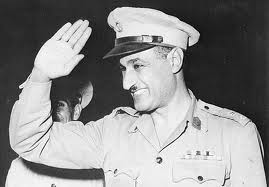
 Gamal Abdel Nasser – Arab Nationalism and Repression
Gamal Abdel Nasser

The vast majority of Arabs throughout the Middle East viewed Nasser as a hero.  Most Egyptians were proud of Nasser’s strong Arab nationalistic rhetoric, anti-imperialism, support for revolutionary movements in Algeria and Yemen and vehement opposition to Israel.
Nasser transformed Egypt by investing heavily in infrastructure, building the government bureaucracy and pursuing a significant program of land reform.  His goal was the establishment of a secular, militarized State. However, over the next decade, Nasser created a totalitarian state that gave primacy to the military. He established tight control of the military and intelligence services; abolished all but the ruling political party; led campaigns of severe repression against Islamists, communists, minorities and foreigners; and took total control of the media and national Muslim institutions.  In 1965, he imprisoned and eventually executed Sayyad Qutb, the Muslim Brotherhood’s leading theoretician.  Egyptians showed their support for Nasser in electing him as President in referenda where he was the only candidate.
Consequently, any opposition to Nasser’s intervention in Israel was repressed.  Those voices who opposed or supported another approach to his Israel and Palestine policies, whether communist, Islamist or liberal, were not part of the public discourse.
Creation of the PLO
Nasser Addressing the PLO

To demonstrate his leadership of the Arab world and ability to use Palestinians to pressure Israel, Nasser helped organize the Palestine Liberation Organization (PLO) by passing a resolution at an Arab League summit meeting in Cairo in January 1964.  The founding conference of the PLO took place in Jerusalem in May 2004, resulting in the creation of the Palestinian National Council, serving as the Palestinian parliament-in-exile. It also issued the Palestinian National Charter.  The Charter sought the establishment of a Palestinian state in the place of Israel, affirmed the Palestinians’ right to return and called for armed struggle to liberate Palestine.  It also aimed for the elimination of Zionism, which it called racist, fanatic, aggressive, expansionist, colonialist and fascist. 
Many Egyptians hailed this initiative in support of their Arab brethren and the recuperation of what Nasser called “Arab land.”  As tension mounted with Israel from 1965-1967, the vast majority of Egyptians supported the efforts of Nasser to use the PLO to prepare for the Six-Day War that broke out in June 1967.
The Six-Day War and its Aftermath
Egyptian Soldiers Surrendering to Israelis

Persuaded by a massive domestic public relations campaign of the strength of the Egyptian army, most Egyptians were proud that Nasser had decided to use the military forces again after 11 years for his purpose of recovering “Arab land” from Israel and “restoring the rights of the Palestinian people.”  His first step was to demand the removal of UN troops from the Sinai.  Then, as in 1956, he ordered the military to blockade the Straits of Tiran to prevent shipping to the Israeli port of Eilat. After Nasser massed Egyptian troops in the Sinai, Israel started hostilities on June 5 by bombarding and destroying the Egyptian air force.  Its troops then encircled and bombed the Egyptian army, which performed poorly and was confused by a retreat order. The Israelis took Gaza on June 7 and arrived at the Suez Canal by June 8. The Egyptian army had been defeated, even though most of its units had little chance to fight. Unlike in 1956, Israel remained in control of the Sinai and Gaza after the war, a bitter loss to Egypt.
Nasser was deeply shamed by the poor performance of the Egyptian military and the loss of the Sinai and its oil fields.  Almost all Egyptians were in a state of shock, finding it difficult to believe that Nasser could have led their country into such a cataclysm.  Some of them could no longer view him as a hero and began to think of his Arab nationalist project as a bad dream. Nasser never recovered psychologically and died in 1970.  His Arab nationalist movement died with him, as Egypt increasingly became a militarized police state with an ever-growing bureaucracy.
Nasser did leave a legacy of frustrated and repressed idealists, whether Arab nationalists, liberals, communists, Islamists or those who supported the supremacy of the military.  Each of these groups remained committed to the rights of the Palestinian people, coming from their own ideological perspectives.  The interaction of these groups and their attempts to support the Palestinians provided some of the seeds of the 2011 Egyptian revolution.


Rick Gold
Cross-posted from Post-Revolutionary Egypt