
by Gary Berg-Cross
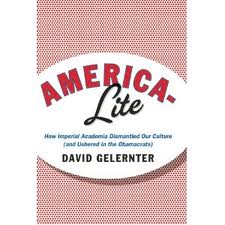
In this book-crowded summer of contentious reads David Gelernter has added to the pile with his America-Lite: How Imperial Academia Dismantled Our Culture (and Ushered in the Obamacrats). One may agree with some of the broad statements: "The nation is filling inexorably with Airheads, nominally educated yet ignorant; trained and groomed like prize puppies. " But wait a minute who does he say are the puppies? Good liberals. Oh, I had some other airheads in mind. Did Gelernter follow the Republican primary?
The book's already the object of battling reviews. The National Review cautiously likes it and talks about it's argument of Dismantling of a Culture - "America’s elites now disdain the rest of America."
They interviewed a disgruntled Gelenter, who was happy to add to his earlier arguments from Americanism:The Fourth Great Western Religion .
They interviewed a disgruntled Gelenter, who was happy to add to his earlier arguments from Americanism:The Fourth Great Western Religion
.
In that earlier work Gelenter asked what it means to “believe” in America? Why do we always speak of our country as having a mission or purpose that is higher than other nations? I think our founders gave us some hope for this with things like separation of church and state. But David argues that modern liberals have "invested a great deal in the notion that America was founded as a secular state, with religion relegated to the private sphere." So to Gelernter, America is not secular at all, but a powerful religious idea—that males its sort of a religion in its own right. What kind you ask? Gelernter says that what we have come to call “Americanism” (as in American Exceptionalism) is in fact a secular version of Zionism. This is scary language to some since Zionism has produced a conservative state based on religion. And it attitude towards the use of the military option and settling disputes with neighbors leaves something to be desired.
His new book takes off from there to continue the attack on intellectual elites, a topic I've blogged on earlier.
"In a piddling few decades, the world’s most powerful, influential cultural establishment happened to get demolished and rebuilt from the ground up. What had been basically a Christian, patriotic, family-loving, politically moderate part of society became contemptuous of biblical religion, of patriotism, of the family, of American greatness. The American cultural elite used to resemble (more or less) the rest of America. Today it disdains the rest of America. That’s a revolution."
A good counter arguement to Gelenter's is offered in Russell Jacoby's review of the book in an article called Dreaming of a World With No Intellectuals.
As he notes Gelernter highlights the role of American Jews as a way to trace the enormous cultural change and its consequences in higher education. But Gelenter's argument seems to be one of selective data and does not live up to comparative analysis as suggested in the quote below from Jacoby's review which includes quotes from the book.
"Up through the 60s, th e WASP establishment excluded Jews from elite universities. But by 1970, Jews had pushed their way into student bodies, faculties, and administrations. The consequences? Again, easy. Jews are both leftist and aggressive. "Naturally, we would expect that an increasing Jewish presence at top colleges" would imprint the schools with those qualities. "And this is just what happened." Colleges and universities became more leftist as well as more "thrusting" and "belligerent."...
 e WASP establishment excluded Jews from elite universities. But by 1970, Jews had pushed their way into student bodies, faculties, and administrations. The consequences? Again, easy. Jews are both leftist and aggressive. "Naturally, we would expect that an increasing Jewish presence at top colleges" would imprint the schools with those qualities. "And this is just what happened." Colleges and universities became more leftist as well as more "thrusting" and "belligerent."...
"Gelernter is Jewish, and it is not likely that a non-Jew would airily argue that obnoxious leftist Jews have taken over elite higher education. But Gelernter does so with enthusiasm untempered by facts. Aside from quoting Jewish neoconservatives such as Norman Podhoretz as  sources, Gelernter does not offer a single example of what he is writing about. Who are these belligerent leftist Jewish professors? Anthony Grafton? Steven Pinker? Richard Posner? Martha Nussbaum? Perhaps Alan Dershowitz?
 sources, Gelernter does not offer a single example of what he is writing about. Who are these belligerent leftist Jewish professors? Anthony Grafton? Steven Pinker? Richard Posner? Martha Nussbaum? Perhaps Alan Dershowitz?
Moreover, the entire formulation remains vague. What does it mean that colleges have acquired "a more thrusting, belligerent tone"? The whole college? The administration? The students? One might imagine that Brandeis University, founded in 1948 by Jews, would be a perfect example to verify Gelernter's argument. Is it loud and leftist? Gelernter does not mention it."
Chris Hayes has also written a book this summer on called Twilight of the Elites. In Hayes' view the problem is less ideological of left and right and more of elite self interest which detracts from solving problems. "Part of the problem is that this kind of elite solidarity, this
self-protection impulse, it stretches across the public and private
sector, and it stretches across, in some way, ideological lines," (More on Hayes book, perhaps in a later post.)It would be gre
 at to get Chris and Gelernter to debate this point and one might hope we could see this on Chris's weekend show Up with Chris Hayes. If he invites Susan Jacoby to the discussion it should be world class. She was great when the Up show discussed the Reason Rally this Spring. He could also invite Janine R. Wedel who could discuss her idea of Shadow Elite - see
The Scandal of Anti-Intellectualism and Elites.
Picture/Image Credits
America Lite:http://www.writersreps.com/America-Lite
American Zionism: http://www.fourwinds10.net/siterun_data/history/zionism/news.php?q=1341887958
Twilight of the Elites: America After Meritocracy : http://www.insidehighered.com/views/2012/07/11/review-christopher-hayes-twilight-elites-america-after-meritocracy
Why Are Jews Liberals? :http://www.toqonline.com/blog/sailer-on-podhoretz/


