Showing posts with label logic. Show all posts

Monday, May 06, 2013

Abelard's Early Humanist Reasoning


by Gary Berg-Cross


At a recent conference a lunchtime conversation turned to examples of sound reasoning and the scholar Peter Abelard was raised as an interesting example.  Abelard is better known to most of us as a tragic love story.  Abelard and Heloise remain one of the more a celebrated couples of all time, in part from their writing and in part from the classic tragic events that eventually separated them:


1.    two well-educated people, brought together by their passion they fell in love;

2.    Heloise became pregnant, so

3.    they married secretly in 1118.

4.    Her uncle Fulbert, a canon of Paris,  had Abelard castrated by thugs believing that he had abandoned Heloise,

5.    after which he became a monk and

6.    Sent to a convent by her uncle, Heloise later became a nun
In a letter to Abelard, Heloise reflected on her loss:

"You know, beloved, as the whole world knows, how much I have lost in you, how at one wretched stroke of fortune that supreme act of flagrant treachery robbed me of my very self in robbing me of you; and how my sorrow for my loss is nothing compared with what I feel for the manner in which I lost you."

This part of the history I knew a bit, but Peter Abelard (1079-1142) as an12th century medieval French philosopher, theologian, and logician I had heard less about.  After all these are the Middle Ages, so I was pleasantly surprised to learn the history and form of his thinking.
It goes something like this. A bright boy he rapidly jumped from school to school gaining an easy rise to fame. He wound up in a pre-University of Paris setting to study under William of Champeaux, head of the cathedral school and archdeacon of Notre Dame. Along the way his brilliant reasoning and debate were matched by a Chris-Hitchens-like arrogance. As with Hitch he generated many foes as wells as admirers. His mentor William, for example, was famous for a realist stance on the nature of universals, while pupil Peter took a nominalist and soundly won a series of debates. This success lead to a following, among students who provided a core for what was late to become the great University in Paris. Abélard's deep understanding of Aristotle's theory of knowledge surpassed anything widely available in 12th century Europe, which he cultivated in his Paris students. His was an example of great teaching that came to live as a Liberal Arts curriculum and style of teaching when universities were formally founded.
One of his important contributions was a work on ethics which took as its title the Socratic admonition, "Know thyself." In this work Abelard veered from the established course of strict commandments to stress the importance of intention in evaluating the moral/immoral character of an action. This was a step towards more nuanced reasoning about moral action.

Some of his early persuasive arguments swayed leaders like Pope Innocent III, who accepted Abelard's Doctrine of Limbo – children are innocent before the age of reason. But reasoned debate about reason itself was his real forte and passion - outside of Heloise. A famous debate was with Bernard of Clairvaux over the conflicts of reason and religion.  This conflict that made him a hero of the Enlightenment.

In Dialogue of a Philosopher with a Jew and a Christian Abelard plays a combination of a Socrates and Swift like character as he debated religious dogma. Abélard juxtaposes apparently contradictory quotations from the Church Fathers & the Bible on many of the traditional topics of Judeo-Christian theology (he was the first to use ‘theology’ in its modern sense) only to “discover(ed) the Jews to be stupid and the Christians insane.”  As you can imagine making common folks reasoning look foolish does get noticed. His teachings backed by sound reasoning were controversial, and he was repeatedly charged with heresy. His book on the Trinity was condemned to be burnt at Soissons in 1121.

One can see the controversy in one his works on Logic Reasoning "Sic et Non," an early scholastic teaching text whose title translates from Medieval Latin into a simple “Yes and No" dichotomy (for more on limitations of dichotomy see my article on Binary Thinking). As in his previous “Dialog” we see what happens when we apply reason to the teaching of revelation or at least questions that come out of revealed truths.

In the Prologue, Abélard outlines logical rules for reconciling contradictions but the core of the book is a list of 158 philosophical and theological questions.  The first five questions give a sense of these:

  1. Must human faith be completed by reason, or not?
  2. Does faith deal only with unseen things, or not?
  3. Is there any knowledge of things unseen, or not?
  4. May one believe only in God alone, or not?
  5. Is God a single unitary being, or not?


  • Use systematic doubt and question everything
  • Learn the difference between statements of rational proof and those merely of persuasion
  • Be precise in use of words, and expect precision of others
  • Watch for error, even in Holy Scripture (danger Will Robinson!!)
Wonderful advice even today.  Maybe especially today.
One can why Peter got in trouble as the rational arguments on the non-doctrinaire side seem as good as the Church’s position. And rational argument is still getting freethinkers in trouble.
Abelard was probably not the forerunner of modern atheism as some have argued. He seems more comfortably fit into a proud humanistic tradition–extending from Socrates. He takes a  bold Medieval step towards human centering in ethics by taking moral authority and responsibility away from gods and their servant. Intentions and reasoning make it our responsibility.  Bravo Peter A for your love of reason and balance along with the worthy Heloise.

Images


Monday, March 05, 2012

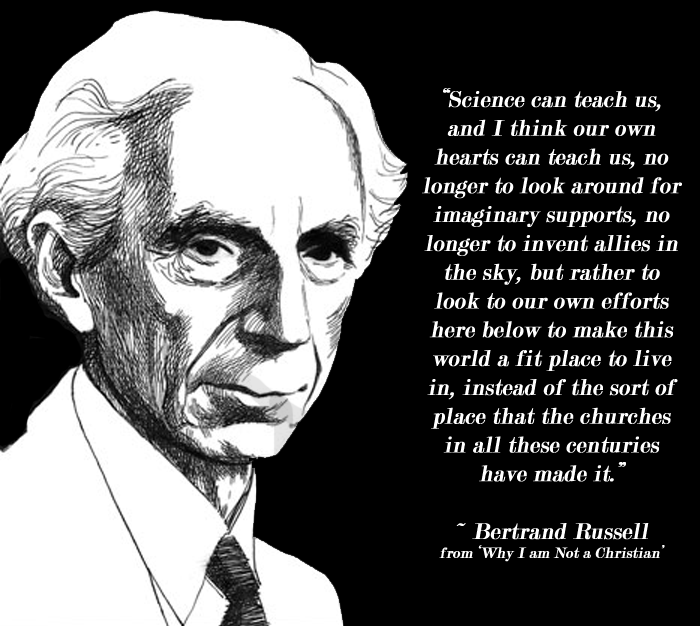
Hearing the Voice of Bertrand Russell


by Gary Berg-Cross

The recent mention of Bertrand Russell in the Washington Post was nice reminder of a philosophical thought leader who was influential during my childhood. The article’ discussion takes place in a drum beat atmosphere for war with Iran and focused on some of Russell’s thinking about how we could survive in an age of nuclear weapons. Generally pacific, although he supported WWII, his approach during the Cold War was to confront, but not attack the Soviet Union over its nuclear materials and weaponry. Russell thought that a defensive deterrence stance was the right approach for ending war and “the only hope for humanity’s long-term survival in a nuclear age. Still sound advice and “ahead of his time” as the article notes.
Russell, born into the liberal aristocracy (his godfather was John Stuart Mill), was justifiably famous as a mathematician & logician with a three-volume work Principia Mathematica, on the foundations of mathematics, written with Alfred North Whitehead on 1910. Logic has moved on from the atomism of that work but Russell’s generally writing earned him a nobel prize for literature in 1950 "in recognition of his varied and significant writings in which he champions humanitarian ideals and freedom of thought". It is a bit wonderful to hear humanitarian ideals being praised so freely. Bertie is remembered broadly as a campaigner for intellectual, social and sexual freedom, as well as peace and disarmament. It's a voice that heard in my mind as I read his wrtitings in paperback as a youth. For me and for many Russell’s image combined a rational, skeptical, humanist, and philosophical voice with an atheist one. Russell was probably the most prominent atheist voice of the era and well known for this from the 1920s on. His broad knowledge and clear philosophical argument provide a standard that only people like Dan Dennett attain:
"Dan Dennett is our best current philosopher. He is the next Bertrand Russell. Unlike traditional philosophers, Dan is a student of neuroscience, linguistics, artificial intelligence, computer science, and psychology. He's redefining and reforming the role of the philosopher." Marvin Minsky
In logical and analytic debates with clerics like the Jesuit Copleston he prefigures and illuminates the current debates by people like Richard Dawkins. Dawkins has been called by one critical of both he and Russell, “the nearest thing to a professional atheist we have had since Bertrand Russell.”
He wrote about his view on Religion in Why I am Not a Christian (published in 57, but given in a lecture in 1927). In outline it covers:
Russell’s logical approach is great to read and you can see a 3 minute video Bertrand talking in 1959 about this, truth, intellectual belief and his discarding of Christian dogma in his pursuit of knowledge onYouTube. One might find it amusing to see the interviewer trying to find some scrap of religious belief in Russell who focused responses as a “passionate skeptic” of such things are an intellectual joy to behold.
“A good world needs knowledge, kindliness, and courage; it does not need a regretful hankering after the past or a fettering of the free intelligence by the words uttered long ago by ignorant men.”
— Bertrand Russell, British philosopher, logician, mathematician, historian, and social critic

Thursday, September 01, 2011

Flexible Thinking in a Time of Imprecise Statements


By Gary Berg-Cross

Even in normal times politicians can say the darndest, imprecise but attention getting things. In a big election season the ante is raised leading to many vacuous or misleading statements. One of the recent ones, expressed in great dismay by Rick Perry in announcing his run for the Republican presidential nomination, was the seeming injustice that “nearly half of all Americans don’t even pay any income tax.”

This infallible, conservative attack line is one of those statistical facts that is an un-fact. It’s imprecision is aimed at an impression from one perspective. It reduces some complexity to a misleading statement. You can find support for the statement in reality. There is a recent estimate, by the nonpartisan Joint Committee for Taxation, that in 2009 about 50 percent of taxpayer units (individuals or couples) had no income tax liability. However, a more precise way and better perspective to understand the data is that 20 some percent had no actual income liability (many are retired people living on Social Security), while 30 percent received refundable credits that wiped out any liability they owed in income taxes. Some may remember that this idea for tax credits was a favorite idea of conservative economists and promoted under Reagan. But never mind, politicians know who to blame and how to pass on a destructive meme.

Another part of the imprecision is that the 50% statistic doesn’t consider all taxes, just state and federal income taxes. It does not include payroll taxes (such as Social Security and Medicare) or taxes on gas. Since the Social Security tax is levied on only the first $106,800 of income, this falls mostly on the poor and middle-class. Indeed as Gale & Rohaly of the Tax Policy Center note, 75 percent of tax filers pay more in payroll taxes than they do in income taxes. So when income taxes and payroll taxes are combined, there is significant tax burden on the working class poor.

The way I view it there is a continuum of realism, precision and perspectives made in statements. Science and Logic places a highly value on realism, precision and adequate answers in light of everything we know, while politics seems at the other extreme.

But one problem with precise statements is that they are often brittle and rely on support from other statements and validation from observation. The above example was made precise by looking at people paying income taxes, but left out quite a bit of reality of other taxes which give a more contextualized perspective.

Other situations that politicians discuss come with their own imprecision, but people try to make neat sounding pronouncements about them anyway. It’s the type of thing well understood in critical thinking and Logic classes. Consider the situation of Libya which is currently in turmoil without a defined government. This reality affects the range of statements we can make. Consider the statement "The current President of Libya is bad." People like Bertrand Russell wondered how to logically answer such a question: Is this statement true, false, or is it meaningless?

It does not seem to be true, for there is no present President/ leader. But if it is false, then one would suppose that the negation of the statement, that is, "It is not the case that the current President of Libya is bad " or some equivalent - "The current President of Libya is not bad," is true. Neither of these seems to have a greater claim to truth than the original statement, although the statement is not meaningless as a sentence. One can understand the question.

The problem is the implied assertion that there is a leader in Libya. It’s part of what Logicians talk about as a definite description which ties language to reality. Definite descriptions denote a fact in the form of a phrase such as “the current President of the US". Logicians say a definite description is proper if the phrase’s noun applies to a unique individual or object which the above does. For example: The “first US president” or the “current Senate Majority Leader” are proper. The definite descriptions "the person in Houston" and "the leader of Libya" are improper because the noun phrase applies to more than one thing, and the definite descriptions "the first man on Venus" and "the Senator from Libya." are improper because the noun applies to nothing. Improper descriptions raise some difficult philosophical questions about the law of excluded middle as well as denotations faithful to realism.

A philosophy of realism asserts that reality and its constituents exist independently of human linguistic or conceptual representations. I can talk about Libyan leaders as a theoretical or cultural idea, but it doesn’t change the facts. But sometimes social and material reality that there are alternate views of reality with equally legitimate perspectives on reality. The perspectival stance maintains that there may be such alternative views. I have a sense that liberals and progressives tend to prescribe to such a philosophical position more than conservatives. One of conservative criticisms of liberals is that they are unrealistic, usually in a politically pragmatic sense but also in allowing alternate views. It seems to me to be a misunderstanding of liberal thinking. You can believe in perspective and still be a realist. A philosophical stance of perspectivalism is constrained by realism. It does not amount to the belief that just any old view of reality is legitimate. There is a method to establish which views are legitimate. In this we weigh a hypothesis against their ability to survive critical tests when confronted with reality. The acid test is scientific experiments, but in everyday life we have less formal means of testing ideas such as illustrated on the previous example on taxes.

It is a fact that sciences change with time just as the situation in Libya does or our understanding of what taxes people pay. And so at some time in the future there may be a current President of Libya (and in a good economy more will pay income taxes). This introduces another idea from Science – that all assertions we make should be conditional and understood against the background of fallibilism. This stance (Of Charles Peirce and Karl Popper, for example) accepts that our theories and classifications of reality are subject to revision. At any one time they may be adequate for our purposes, but not the final answer of what is reality.


We should be skeptical of political statements which violate realism, logical rigor and the test of adequacy. They are not to be trusted.


See Michael Weinman, Two Forms of (Political) Fallibilism for more on this topic.