Showing posts with label words. Show all posts

Wednesday, April 10, 2013

Dan Dennett's Latest Cognitive Toolbox


by Gary Berg-Cross

Daniel Dennett's new book "Intuition Pumps and Other Tools for Thinking", should be out in a few weeks but it already has some reviews. The book is about methods can we use to answer life's most fundamental questions. You can actually preview some of the chapters which stat by dealing with
General Thinking Tools - like Occam's razor, but also Occam's Broom. This is followed by discussing Tools for Meaning, tools for thinking about evolution, consciousness and the like.  These include "imagination extenders and focus-holders" that Dennett and others have developed for dealing with difficult topics that some of us like to read about and discuss: evolution, meaning, mind, and free will. In other words topics that cross and integrate great philosophical, psychological and biological ground.

As always Dennett offers insight and ideas that are debatable. A big topic here is a continuation of Dawkins' discussion of memes and how they obey some abstracted tenets of Darwinian Evolutions.


His starting argument asking if words are things, symbolic but thingy.  This going to provoke some commentary.

 If you grant that words are" things" then we offer the possibility of consider memes some kinds of "things" also perhaps in a realm between physical things and symbolic thing. Well how about calling it a conceptual thing?

Images

Intuition: http://philosophicalchasm.blogspot.com/2010/07/intuitions-and-ethics.html

Intuition Pumps: http://www.barnesandnoble.com/w/intuition-pumps-and-other-tools-for-thinking-daniel-c-dennett/1113141240

Dennett: http://www.homodiscens.com/home/areas/why_philosophy/index.htm

Friday, August 31, 2012

A Matter of Semantics - Words, Concepts and Things


By Gary Berg-Cross


Modern society bombards us with words and no more than during a political season when candidates compete for our attention with punchy slogans and catchy phrases. It seems too close to the word manipulation of George Orwell’s 1984. 1984 isn’t yet the good old days, but people seem pretty confused by the flood of political language as we descend into a world of thin, distorted or made up meanings. Paid wordsmiths now hawk a language of fractional facts, non-sense, almost sense and truthiness that is captured in the Lewis Carroll quote:

“When I use a word,’ Humpty Dumpty said in rather a scornful tone, ‘it means just what I choose it to mean — neither more nor less.’
’The question is,’ said Alice, ‘whether you can make words mean so many different things.’
’The question is,’ said Humpty Dumpty, ‘which is to be master — that’s all.”


In ordinary conversations, when people debate a point and the words they are using for discussion, they often backhand this disagreement with the phrase “It’s a matter of semantics.” Well perhaps, but that seems to trivialize meaning a bit. It’s more than a choice of words. Semantics is about the meaning of things, which seems more important than a making it something like “you say Po-tat-o and I say Po-ta-to.” 


In comparison to marketers and political writers most layman seem to understand little about semantics, but it is a deeply refined field over the last 120 years or so. Semantics is often contrasted with syntax in language. Syntax gets at the structure of language expressions, while semantics has a focus on the relations between a class of signifiers, such as words, phrases, signs, and symbols, and what they stand for or denote. The meaning of meaning is a lot to think about so one needs a bit of model to help.


A core of what is written above and what we should know about semantics, readily applied  at least simple, single word semantics, is represented by what is called a triangle of reference shown below. BTW. it is also known, as noted in Wikipedia, as the triangle of meaning, and the semantic triangle. A version of the triangle, shown below, was published in The Meaning of Meaning (1923) by Ogden and Richards, but a more sophisticated version was penned earlier by the great American, pragmatic philosopher Charles Peirce, but also by French linguist Sassaure.

Ok, so what does this model assert? It’s a model of how linguistic symbols are related to the objects (or whatever) they represent. These are the 3 corners of the triangle and each relates to the other. I represent concept parts in sq. brackets [] and word parts in quotes ‘’ “ to make clear which vertex part is being discussed. 

Let’s start with the referent, which in my example is some thing we recognize as a [tree]. This is to say that we have a concept [] or category for the referent part of reality. A concept should be adequate and fit reality. That's part of a meaning, but only part. And we have a word for that concept “tree.” That's another part. If we say “tree” for that concept , we are correct. If we say “bush”, well close, but not correct. "Bush" shows we've used the wrong category.  That concept is not adequate for the isolated part of reality that makes up the referent - tree in reality.
A clearer example is when, say a child, has an initial concept for the category of thing that we see in the world –[bird]. If we categorize them by a flying attribute a child can quickly realize, or be told, that a flying thing I/we call a “plane” would then be classified as  [bird]. Not true, or at least we can do better and not be so confused as to not mean what we say. So the child should align the concept and referent part and not use the word "bird" for it.

And what about an ostrich? Not all birds fly. 
So I might make several types of mistakes in relation to a concept for a part of reality and its name. The correct, scientific alignment is that birds have feathers. That's a much better, consistent model for bird that aligns with we see when we test the world systematically with observations. Here we have the very important point that there should be a relation between our words and things.  The connection is through our thoughts but they are fallible. 

And even here the semantic game is difficult, since what we call "dinosaurs" seem to have had feathers. We have different names for things along an evolutionary path as our knowledge or reality advances.

So “it’s a matter of semantics" turns out to cover a pretty complicated, cognitive and scientific situation. Meaning is not in the referent of something like a tree. It’s isn’t just in the concept we have or in the words we use. When we are expressing ourselves with language the meaning is in the relation of 3 parts and is constructed.

There’s the rub. Or at least a starting part of a much deeper, but interesting story of semantics.

You can also see another challenge in the diagram in that the part of reality that I've tried to isolate and call "tree" is embedded in a larger context.  I could call it "tree in a yard" or "tree near a cemetery." What  I call it depends on the concepts evoked and this my meaning.  Or digging deeper into what Cognitive Science has revealed, the mental models we have that organize our understanding of the world. Another person hearing the phrase "tree in a yard" may have a similar concept and comprehend it in a similar way, but it is in this complicate conceptual processing that meaning comes about. Thinking fast with associative memory as discussed in my earlier blogs plays a big part in what meaning we come to.

When we are communicating we may share a common vocabulary, but differ on how we hook them up to our concepts. What do we mean by a term like “god”, “pro-life”, "legitimate rape" or “American”? Hooking "American" and "Exceptionalism" together is not just a syntactic affair and not something that has one, consistent meaning as discussed in earlier blogs. 

These are all pretty complex affairs and often used with different referents.  Using different words can evoke many different concepts in a cognitive agent.  The referents aren’t clear and the concepts are varied even in normal life let along in the wolf whistle world of current politics . Misunderstandings fly by and sometimes intentionally so as meanings get bent to a Humpty Dumpty purpose.  

Oh, and by the way, that is a third part of language - the pragmatics of what we say which is driven by what we are trying to communicate or not communicate.  We may just be trying to confuse someone's concepts and take over the usual meaning of words.  Over time words get weighed down by various associations. "Indian" used to mean something a bit evil, but the concept has evolved as we have gotten away from the Indian Wars.

This side of Socrates many don’t seem to make an effort to connect the parts and communicate. Next time you hear that it is “just a matter of semantics” you might have some concepts and new words to communicate back to the speaker.

                                          Image Credits
Tree: http://fineartamerica.com/featured/tree-in-grave-yard-danny-jones.html
God as a concept: http://www.patheos.com/blogs/christianpiatt/2012/01/atheism-a-null-hypothesis-on-god/

Friday, June 17, 2011

Words, Things and Simplifying Explanations like Free Will


By Gary Berg-Cross
Language is a wonderful, adaptive, social tool. We use it to communicate to others, and thus it has evolved in part to serve social purposes. Putting a name to things helps bring some simplification to complex phenomena. But words can also be Procrustean beds that dice up real, roundish objects to fit into our square conceptual holes. For example, we can say that that a clock is happy or in pain, but to our best knowledge these are social rectifications of some concept that may not correspond to reality. They are borrowed from our social realm and used to explain things there. To some degree they reflect the fact we thinking and linguistically express things anthropomorphically as objects. We see and name the world in terms that make sense to us.Science is a discipline sitting on top of our social world with a specialized language. But the Sciences are also social so Scientists create causal hypothetical concepts such as the Ether or phlogiston to explain things.  If these fail to be validated by observation they come to be seen as artificial creations. 

Philosophy probably has had an equal number of word creations if not more. Among them are concepts like consciousness, self, spirit, will and free will. Is there a reality to them? Some like spirit, that have been pulled into religion and laden down with dogma, no longer seem viable as causal philosophical concepts. Others like consciousness seem fair game for a joint cognitive science-philosophy effort.
The Free-Will versus Determinism argument has been raging for quite a while and very now and then every now and then some thinker takes a whack at it. This usually stirs the pot anew. Philosophers with a good grounding in modern science have provided some new perspective on the topic using neuroscience and an evolutionary perspective. For example Daniel Dennett’s in his Consciousness Explained (1991) approached the issue something like an update to David Hume’s ideas in the light of our neo-synthesis of Darwin's theory of evolution. Dennett calls the idea that we live in the here and now, moving steadily into the future an illusion. Instead cognitive "real time" is a spider web process of zigzagging through memories as we assess our progress on goals, hopes, plans and regrets! Indeed,in his view the Self like Consciousness is a type of internal reification. It is a constructed web of tales spun by us to make sense of experience. To Dennett our human consciousness, along with our narrative self-hood, is a product of experience not their source. This makes sense for several reasons including the fact that as children are learning language they see others as objects and so it is easy to identify oneself as a similar object. This concept of a conscious self serves a role of a unified agent who we can speak about in simple words. During this period we may pick up a term like "soul" and make a simple connection to a concrete concept so that the term comes becomes part of an unverified system of belief.
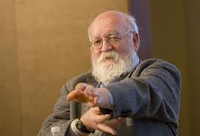
More recently Dennett took on the issue of whether there can be freedom and free will in a deterministic world in his Freedom Evolves. Surprisingly he frames his conclusion in the other direction considering the idea that as cognitive agents we can avoid some things we foresee. Our ability to understand some things mitigates the idea of inevitability.  
"Some things we can avoid. We are free to avoid some things such as ducking to avoid a tree branch. Very useful, but it doesn’t work so easily with a Tsunami. So some parts of the future is inevitable and others not within a deterministic world. So some concept of freedom is not an illusion but an adaptive, objective phenomenon that is distinct from other biological conditions and found in only humans through evolution. We are less instinctual, automated creatures and can even chose to be non-adaptive to prove a point."


See http://dontdontoperate.wordpress.com/2011/05/29/free-will-religion-without-god-dennetts-compatibilism/ for Dilbert's view on Free Will.

Even more recently Sam Harris has had a go at the issue in his The Moral Landscape (pp. 102-110), which has further stirred the pot. To Harris, unlike Dennett, the problem with free will is that no account of causality leaves room for it. All our internal life of thoughts, moods, and emotions effect of us in ways that are: “from a subjective point of view, perfectly inscrutable.”
Harris asks why he might have used the term “inscrutable” in the above sentence and answers for us that he has no idea. It is not clear that he was free or constrained to do this and even the meaning of the claim is inscrutable or opaque. 
Harris’ stance mixes philosophy and cognitive-neuroscience observing that only a small fraction of momentary information that our brains process becomes conscious. This requires attention which we have in small amount. You can actually experience how limited this is in the selective attention video on YouTube. 
The essential message is that human evolution has given us a cognitive system that allows us to note only important changes in our environment. It has not produced an all knowing or even totally rational system. We use simplifying models to helps us make sense of a complex world. While we are aware of some our inner life of thoughts and emotions, we are personally unaware of the neural events that produce these changes. Thus we generate models of the world of ourselves and of other people explain why things happen. These such as concepts of a unified self are simplifications, but pretty good ones to start with. It’s just that Science has moved us along and is helping us un-muddle the words used for concepts that are not simple “things” but processes.
Perhaps somewhere between Dennett and Harris’ views is Schopenhauer's summary statement pushing the issue a bit farther back to cognitive primitives:
'Man can indeed do what he wants, but he cannot want what he wants'.
It seems to capture an important aspect of the argument.