Showing posts with label memes. Show all posts

Wednesday, October 22, 2014

Some Truth about Truthy

by Gary Berg-Cross

Republican FCC member Ajit Pai had an Op-Ed in the Washington Post the other day (10/18/2014 _ called  'Truthy' project is unworthy of tax dollars. Essentially this seemed to me to be something of an unjustified and/or confused attack on a bit of NSF funded research.  Here is the way the posting started off:

If you take to Twitter to express your views on a hot-button issue, does the government have an interest in deciding whether you are spreading "misinformation"? If you tweet your support for a candidate in the November elections, should taxpayer money be used to monitor your speech and evaluate your "partisanship"?

Sounds ominous and Ajit went on to warn of NSF funding an Indiana University project to “collect and analyze your Twitter data.”  It's called Truthy and you can check out the site yourself.

What analysis do we find there? Well the aim is to detect what the researchers deem "social pollution" and to study what they call "social epidemics," including how memes -- ideas that spread throughout pop culture -- propagate. I think that Ajit alarm bells went off because the types of social pollution targeting included "Political smears," (aka "astroturfing") and other forms of "misinformation."  To Ajit this effort might be the beginning of a government effort to monitor and control social media.


Really he may been building on a scare rumor scary seems to have started with a discredited and disingenuous article at the Daily Beacon. . As noted in the Columbia Journalism Review “Conservative media’s reaction to an Indiana University project shows how shoddy information can quickly become an online narrative.”  And we actually know, due to analytic studies how the rumor meme spread:

The Free Beacon’s article was shared about 4,000 times on Twitter and 10,000 times on Facebook, according to Muck Rack analytics. It was crossposted on FoxNews.com the next day, garnering an additional 2,000 shares on Twitter and 15,000 shares on Facebook. And it was quickly picked up by a handful of other prominent right-wing websites, becoming fodder for paranoia-inducing analyses by The Week, Reason, and Breitbart.com. “Other blogs twisted the meme and mutated the meme until it became completely outlandish,” Menczer said. “I don’t think there’s anything we can say to change that.”  - See more at: http://www.cjr.org/behind_the_news/how_misinformation_goes_viral.php#sthash.Mh4zCBBK.dpuf

I like knowing something about this meme contagion.  Groups that get smeared unjustly and are interested in the truth can profit know transparency.  If you go to the site you can see and read about different types of social networks and patterns. 
Social Network


Really, one thinks of outlets like the Drudge Report that have been accused of planting stories and in other conservative media. And indeed
Twitter Spam
campaign or partisan groups tweeting under the guise of grassroots activity.  Seems worth knowing and the Truthy study does not look only at conservative sources it looks at liberal ones to.

I was annoyed enough by the lack of good arguments in Ajit’s article to send a letter to WAPO which was later published as this:

“It is important to remember that the study is by the Center for Complex Networks and Systems Research. While it is government-funded, it is not a government project. The study aims to understand Twitter activity, such as how sentiments change over time in response to events, including political ones. Its results are published
on its Web site.

Truthy is not aimed at controlling tweets. It analyzes tweets to determine things such as, "Who are the most influential users and which are most popular over time?" It analyzes both liberal and conservative political issues and seeks to show how information spreads in the social network.

Seems like something the public would like to know."

Indeed invisible influence peddlers may be the ones who should be worried here.

Saturday, December 28, 2013

Winter Season Memes and Meme Wars


By Gary Berg-Cross

A Washington Post Editorial called The Christmas story, still captivating the world, published: December 24 stirred up some discussion about the contemporary meaning of the holiday.  They contrasted the story in radio “DAYS of old (1947 to 1956, to be exact)” as they called it when the narratives were mainly:

“from the Bible, mostly from the life of Jesus, presented with the urgent energy of radio drama and the sort of background music, spirited dialogue and sound effects that made it a good deal more compelling than Sunday school. It was widely popular for a time

This pop-up style they contrasted with a more enduring story of generosity, the need for shelter, the feeling of home and a new start to things (throw in New Year’s). This universal appeal:

“ is a tale with universal appeal extending beyond any one faith or doctrine, a story of love and triumph over adversity and also of humility, of the good lay in their warmth, humanity and simplicity, …….an enduring reflection of both the “comfort and joy” of the carol and also of the spirit expressed in a seasonal exhortation last week from Pope Francis: “Let us act so that our brothers and sisters never feel alone.”

Washington Area Secular Humanist 
HumanLight Party 2013
Yes, it seems as Alistair Cooke noted, "Washington's birthday is as close to a secular Christmas as any Christian country dare come this side of blasphemy."
There were numerous responses to this more secular, humanist slant to the season. The following from FL-Chet represents a meme of a  more traditional, Christian view of the season.

The Christmas story without his claim that he was fully God while being fully man is like Christmas dinner without the main course. Yes, we can nibble around the table of the Christmas story and learn from these truths. But to ignore his claims to be God come down to rescue us leaves our hearts and lives wanting, and needing more.

Put me on the side of the universal Humanist appeal of the season. Long before there was Christianity we had people celebrating the winter solstice - the shortest day and longest night of the year which falls (in the Northern hemisphere) on December 21 or December 22.  The harvest is in but some plants &  trees remain green thru winter and thus had a special meaning for people in dark, cold times. Today homes in Western culture are decorated with pine, spruce, and fir trees. In ancient times peoples also hung evergreen boughs over their doors and windows (to keep away witches, evil spirits, and illness after all the sun-god gets weak in winter) but this seems mostly buried by the later Christmas story meme.

Washington Area Secular Humanist 
HumanLight Party 2013

I say let’s keep the non-spiritual side of the season alive with growing Humanist memes about kindness and sharing along with traditions like HumanLight and song.  For the latter I like Vienna Teng’s  The Atheist Christmas Carol.  It is by no means an atheist song, but rather a Humanist one as is Ode to Joy with its inspired message that 'all men shall be brothers'.

. 

As to seasonal wishes there are many that I like. One builds on Mary Ellen Chase’s idea, beyond shopping malls and temples the winter celebration, people, is not a calendar date. It is a state of mind and one in which children can be grateful to parents who fill stockings and a natural sun that stays a minute or so longer each day.


"Keeping a holiday spirit is good, but sharing it is better."
after-- Arnold Glasow

Wednesday, May 01, 2013

Ontologists Discuss the God Meme & Its Arguments

By Gary Berg-Cross
 
The ontolog-forum can be a fun thing to read about semantic topics and our understanding of reality. 
It can also generate off-topic discussion thread and a recent one concerned Dennett’s God meme ("an idea, behavior, or style that spreads from person to person within a culture.) as the primary application of memes that seems to interest both Dawkins and Dennett.
 
Memes were already being discussed when someone through in a reference to Giussani's "The Religious Sense" 
some reflection of an driving need for truth, goodness, and beauty. Giussani is the founder the lay Catholic ecclesial movement Communion and Liberation (CL), similar to the Neo-Catechumenal Way, Foculare, and Opus Dei. He writes popular books to spread memes, I guess, and in "The Religious Sense" his pushes the idea that values of truth and beauty constitutes the fabric of the religious sense, which is evident in every human being everywhere and in all times.
 
Ontologists on the forum are not shy about taking shabby arguments to task. I thought that 
readers of this Blog be interested in here some of the argument and exchange.
 
 
Polymath John Sowa responded briskly, and tongue in cheek, as it were:
 
I'm willing to grant that all arguments for the existence of God are unscientific. 
But I also believe that all arguments *against*  the existence
of God are equally unscientific.  It's actually harderto develop
a solid proof that something does *not* exist.   
 
That's why I recommended that any exploration of the "god meme"
should be based on a study of gods such as Zeus, which don't
seem to be tied up with much emotion, either pro or con.   
 

An equally deep and insightful Pat Hayes added to the put down with an appeal to the flying spaghetti monster. 

The basic scientific argument against the existence of God is that there is 
absolutely no observational evidence for the existence of a God,  nor any reason  to hypothesize such an entity in order to explain anything that is observable.  A very straightforward application of Occam's principle then suffices. Of  course this is not a *proof*, but it is a sound *scientific* argument. Proofs   are irrelevant here. There is no proof that the flying spaghetti monster does  not exist, but that does not shake the faith of the true Pastafarian.   


Matthew West picked up in the proof idea to add:


All one can say scientifically is that the existence of God is a hypothesis that it is unlikely that we will ever be able to prove or disprove scientifically, because there is no experiment that we can conduct (or at least I cannot think of any) that would prove or disprove the hypothesis. (Of course you can always set up God hypotheses that you can disprove, but they are not generally ones the "faithful" actually believe in).   

As to Pat’s There is no proof that the flying spaghetti monster does not exist, but that does not shake the faith of the  true Pastafarian.  
 
Matthew added:
 
And that is the essence. It is a matter of faith, not science. So any
scientific argument is irrelevant. Irritating though that may be to those
who believe only in science.    
 
Pat disagreed a bit here saying
 
No, this makes the situation seem symmetrical. But science is not symmetrical
in this way: one only has a burden to show something that is hypothesized in
order to explain something else. God does not explain anything that cannot be
explained better without using that hypothesis. Every attempt throughout
history to offer an argument for the existence of God (e.g. to explain the
cosmos, to explain life, to explain morality) has turned out to be wrong. Every
one, without exception. I would say that this was pretty convincing argument, myself.

As for experiments, how about the recent empirical tests of the efficacy of prayer? (In sum: it has zero effect.)

Oh brave freethinking people out there.


Images


Wednesday, April 10, 2013

Dan Dennett's Latest Cognitive Toolbox


by Gary Berg-Cross

Daniel Dennett's new book "Intuition Pumps and Other Tools for Thinking", should be out in a few weeks but it already has some reviews. The book is about methods can we use to answer life's most fundamental questions. You can actually preview some of the chapters which stat by dealing with
General Thinking Tools - like Occam's razor, but also Occam's Broom. This is followed by discussing Tools for Meaning, tools for thinking about evolution, consciousness and the like.  These include "imagination extenders and focus-holders" that Dennett and others have developed for dealing with difficult topics that some of us like to read about and discuss: evolution, meaning, mind, and free will. In other words topics that cross and integrate great philosophical, psychological and biological ground.

As always Dennett offers insight and ideas that are debatable. A big topic here is a continuation of Dawkins' discussion of memes and how they obey some abstracted tenets of Darwinian Evolutions.


His starting argument asking if words are things, symbolic but thingy.  This going to provoke some commentary.

 If you grant that words are" things" then we offer the possibility of consider memes some kinds of "things" also perhaps in a realm between physical things and symbolic thing. Well how about calling it a conceptual thing?

Images

Intuition: http://philosophicalchasm.blogspot.com/2010/07/intuitions-and-ethics.html

Intuition Pumps: http://www.barnesandnoble.com/w/intuition-pumps-and-other-tools-for-thinking-daniel-c-dennett/1113141240

Dennett: http://www.homodiscens.com/home/areas/why_philosophy/index.htm

Tuesday, February 28, 2012

Is A One Percent Justification Meme Spreading?


By Gary Berg-Cross

In The One Percent Doctrine Pulitzer Prize winning journalist Ron Suskind discussed the Bush Administration hunt for terrorists after 9/11 and its conflation with a justification for attacking Iraq. The title comes from VP Cheney’s position that:

“ If there's a 1% chance that Pakistani scientists are helping al-Qaeda build or develop a nuclear weapon, we have to treat it as a certainty in terms of our response. It's not about our analysis ... It's about our response.”

With the war drums beating for an attack on Iran some, like Robert Parry (Consortium News) see an early Return of Cheney's One Percent Doctrine:

But it should be clear what the game is. Israeli hardliners and American neocons want a return to former Vice President Dick Cheney's "one percent doctrine….. That is, if there is even a one percent chance that a terrorist attack might be launched against the United States, it must be treated as a certainty, thus justifying any preemptive military action that U.S. officials deem warranted.

That was the mad-hatter policy that governed the U.S. run-up to the Iraq War, when even the most dubious - and dishonest - claims by self-interested Iraqi exiles and their neocon friends were treated as requiring a bloody invasion of a country then at peace…

One % positions and their murky data provide weak justification for war but seem enough for people predisposed to hawkish positions. As Suskind himself argues t not every 1% hypothesis gets treated enough to get what Cheney calls “a response”. Besides being some broad rationalization of an angry, militant response the One Percent idea also has as an aspect of confirmatory bias that I’ve previously discussed. This means we can actually ignore data that doesn’t fit our hypothesis. Analysis leading to other conclusions is “undesired.”

In practice I believe that many people operate on something like a 1% approach and do it dynamically. That is, they may only require a small hint of something being possible to confirm it in their mind. Then over time on top of a 1% possibility we strengthen our belief by using a fraction of new evidence and selected analysis. One winds up with a .1 or .01% doctrine or principle.

This is the type of thing, I believe, one sees in layman beliefs and debates over climate change. Barely half the U.S. public thinks carbon pollution could warm Earth. It’s just too complex and as noted in The Psychology of Climate Change Denial:

Even as the science of global warming gets stronger, fewer Americans believe it’s real. In some ways, it’s nearly as jarring a disconnect as enduring disbelief in evolution or carbon dating…Our response to disturbing information is very complex. We negotiate it. We don’t just take it in and respond in a rational way.”

On one side there is an enormous aggregate of evidence and analysis such as in an IPCC report ranging from weather statistics and extremes, atmospheric measurements, climate history, glacier melting, changes in animal migration, arctic melting, rising sea level, stronger floods and droughts, the spread of tropical diseases and the decline of sensitive species. Against this a non-believer cites one little piece of evidence from how scientists discuss analysis in emails! It’s more of a .1% principle than even a 1%.

This has some relation to defining characteristic of true believers like VP Chaney, Newt Gingrich or Rick Santorum who seem to be spreading the meme for a low evidence belief. They have disdain for serious analysis and believe instead in a narrow view of reality that is emotionally backed by a cohesive group of fervent believers. You hear them in some Republican debates howling support for 1% claims such as a war on Religion or how Fannie and Freddie caused the real estate bubble. disturbing. Believing and understanding otherwise is something they don’t want to think about. So what they do in political debate is what they do in daily life - create a bubble world where the 99% possibilities are not present or accepted. Keep uncomfortable ideas at a distance is likely to lead to a serious problem 99% of the time or so.

Thursday, September 01, 2011

Flexible Thinking in a Time of Imprecise Statements


By Gary Berg-Cross

Even in normal times politicians can say the darndest, imprecise but attention getting things. In a big election season the ante is raised leading to many vacuous or misleading statements. One of the recent ones, expressed in great dismay by Rick Perry in announcing his run for the Republican presidential nomination, was the seeming injustice that “nearly half of all Americans don’t even pay any income tax.”

This infallible, conservative attack line is one of those statistical facts that is an un-fact. It’s imprecision is aimed at an impression from one perspective. It reduces some complexity to a misleading statement. You can find support for the statement in reality. There is a recent estimate, by the nonpartisan Joint Committee for Taxation, that in 2009 about 50 percent of taxpayer units (individuals or couples) had no income tax liability. However, a more precise way and better perspective to understand the data is that 20 some percent had no actual income liability (many are retired people living on Social Security), while 30 percent received refundable credits that wiped out any liability they owed in income taxes. Some may remember that this idea for tax credits was a favorite idea of conservative economists and promoted under Reagan. But never mind, politicians know who to blame and how to pass on a destructive meme.

Another part of the imprecision is that the 50% statistic doesn’t consider all taxes, just state and federal income taxes. It does not include payroll taxes (such as Social Security and Medicare) or taxes on gas. Since the Social Security tax is levied on only the first $106,800 of income, this falls mostly on the poor and middle-class. Indeed as Gale & Rohaly of the Tax Policy Center note, 75 percent of tax filers pay more in payroll taxes than they do in income taxes. So when income taxes and payroll taxes are combined, there is significant tax burden on the working class poor.

The way I view it there is a continuum of realism, precision and perspectives made in statements. Science and Logic places a highly value on realism, precision and adequate answers in light of everything we know, while politics seems at the other extreme.

But one problem with precise statements is that they are often brittle and rely on support from other statements and validation from observation. The above example was made precise by looking at people paying income taxes, but left out quite a bit of reality of other taxes which give a more contextualized perspective.

Other situations that politicians discuss come with their own imprecision, but people try to make neat sounding pronouncements about them anyway. It’s the type of thing well understood in critical thinking and Logic classes. Consider the situation of Libya which is currently in turmoil without a defined government. This reality affects the range of statements we can make. Consider the statement "The current President of Libya is bad." People like Bertrand Russell wondered how to logically answer such a question: Is this statement true, false, or is it meaningless?

It does not seem to be true, for there is no present President/ leader. But if it is false, then one would suppose that the negation of the statement, that is, "It is not the case that the current President of Libya is bad " or some equivalent - "The current President of Libya is not bad," is true. Neither of these seems to have a greater claim to truth than the original statement, although the statement is not meaningless as a sentence. One can understand the question.

The problem is the implied assertion that there is a leader in Libya. It’s part of what Logicians talk about as a definite description which ties language to reality. Definite descriptions denote a fact in the form of a phrase such as “the current President of the US". Logicians say a definite description is proper if the phrase’s noun applies to a unique individual or object which the above does. For example: The “first US president” or the “current Senate Majority Leader” are proper. The definite descriptions "the person in Houston" and "the leader of Libya" are improper because the noun phrase applies to more than one thing, and the definite descriptions "the first man on Venus" and "the Senator from Libya." are improper because the noun applies to nothing. Improper descriptions raise some difficult philosophical questions about the law of excluded middle as well as denotations faithful to realism.

A philosophy of realism asserts that reality and its constituents exist independently of human linguistic or conceptual representations. I can talk about Libyan leaders as a theoretical or cultural idea, but it doesn’t change the facts. But sometimes social and material reality that there are alternate views of reality with equally legitimate perspectives on reality. The perspectival stance maintains that there may be such alternative views. I have a sense that liberals and progressives tend to prescribe to such a philosophical position more than conservatives. One of conservative criticisms of liberals is that they are unrealistic, usually in a politically pragmatic sense but also in allowing alternate views. It seems to me to be a misunderstanding of liberal thinking. You can believe in perspective and still be a realist. A philosophical stance of perspectivalism is constrained by realism. It does not amount to the belief that just any old view of reality is legitimate. There is a method to establish which views are legitimate. In this we weigh a hypothesis against their ability to survive critical tests when confronted with reality. The acid test is scientific experiments, but in everyday life we have less formal means of testing ideas such as illustrated on the previous example on taxes.

It is a fact that sciences change with time just as the situation in Libya does or our understanding of what taxes people pay. And so at some time in the future there may be a current President of Libya (and in a good economy more will pay income taxes). This introduces another idea from Science – that all assertions we make should be conditional and understood against the background of fallibilism. This stance (Of Charles Peirce and Karl Popper, for example) accepts that our theories and classifications of reality are subject to revision. At any one time they may be adequate for our purposes, but not the final answer of what is reality.


We should be skeptical of political statements which violate realism, logical rigor and the test of adequacy. They are not to be trusted.


See Michael Weinman, Two Forms of (Political) Fallibilism for more on this topic.


Monday, August 15, 2011

Celebrating the Diversity of the Freethinking Species


By Gary Berg-Cross

Recently I was involved in a discussion of the relations of Atheism to Freethinking, Secular Humanism and allied concepts. One person proposed a common sense model with atheism at the center. The basic idea reflects the hypothesis that most people grow up in a religious culture, but for various reasons some move away from a family/childhood religious identify. The idea is that the natural tendency is to simply settle on some variant that calls itself atheism or agnosticism. There are other allied, freethinking positions such as skeptics, humanists, secularist or even secular humanists. Some people are exposed to these ideas and values in their family and/or education. But these represent a minority of the various groups that make up the allied complex of atheists and Freethinkers. In this view a complex movement like Secular Humanism is, by and large, not well understood even by freethinking people who move to and stay with the Atheism label and concept.

Trying to understand the diverse relations of freethinkers I started to think of a slightly different model for the various groups. While imperfect, and perhaps embarrassingly so, I found it amusing to play around with an Evolutionary Biology metaphor of species classification. In this rough analogy ideas (meme?) are organisms with bio-features. One could think of Atheism or Agnosticism as at the root node (call either of these the A-cell species). We can think of this as species made up of a single cell representing the idea feature – there is no god. The analogy is a certainly a bit jury rigged and can break down, but at least provides a way of talking about some phenomena and issues such as diversity. So as with Bio-species, religious cell populations (R-cells) can mutate into any one of these A-cells types and so the Atheist population can grow in this way too. This type of mutation is what happens in the world of ideas. There is also merging of ideas (cells) to form a new organism and some of these can reproduce as a new species.

Given the idea of Atheism as species we might think of this as a population of cells each having a meme for that Atheist idea. Some A-cells might mutate back into an R-cell. Bit this A-cell population can reproduce and can produce various non-branching types of Atheists populations. Some are militant others not. Some have allied ideas but still reproduce as an A-cell.

Biological populations and the implied dynamic of Freethinking thought then becomes somewhat analogous to what happens with the evolution of different species - there is a branching evolution of species. Isolation from the main population can also produce speciation. So if one population of atheists finds itself with tolerant religious populations it may emphasize a less assertive form of atheism than one that is an intruding religious population that is messing with the environment. Over time this becomes its own species distinct from the original A-cell population. The model represents various species as population descendents of the cell branch off of the A-node. As in Biology the later forms tend to be more complex – muti-cellulars made by aggregating additional ideas. These arise mostly from a series of step-wise, co-linear mutations, but not all new species survive and continue to reproduce. They may be only temporary, but lead to fitter forms.

Over time the Atheist tree looks different as some descendents thrive. Diverse richness is built slowly as some species fall away as intermediate forms. Those that survive are specialized reflecting selection based on environments that support additional ideas. These ideas provide some fitness advantage in some environment. So Atheism can exist in most environments, but a slightly more complex “organisms” like Secularism or Humanism formed over time can exist in dynamic balance with Atheism in a goodly portion of the environment. These will do better in environment that are less religious and provide some humanist or secular nourishment.

Reproduction is obviously a key factor and includes the idea of a merged mating as well as direct copying. Mating blends ideas but preserves the overall species design. There may be natural barriers to prevent individuals of one species from mating with another. For example there are various forms of isolation to overcome. Two individuals from different species may not have compatible behavior to allow merging. One thinks of examples of inharmonious freethinking positions clashing. Or the barrier may be that they don’t frequent the same territory (talk about the same ideas?). In the real world this is the case with tigers and lions. They don’t usually find them selves in similar environments. But they can in zoos. Lion fathers mating with tiger moms produce the exotic Liger.

Which brings me to that exotic specialized organism that is the product of Secularism and Humanism. I speak of Secular Humanism in the way that Paul Kurtz defines it using 5 ideas beyond the non-theistic idea that is the basis of simple Atheism:

  1. Emphasis on methods rather than conclusions,
  2. Naturalism & science,
  3. Ethics,
  4. Democracy, and a
  5. Planetary scope.

One might add others and make finer distinctions, such as the idea if rationalism, the value of peace or detailing the caring for planet earth, but these features alone requires represent an evolved population and require a certain environment, such as valuing Science, to survive. Is this exotic creature, a philosophic counter to Religious species, on its way to being endangered or even possibly extinction? I think and hope not, but a challenge is always reproduction in the face of changing environments. Neither Secularism nor Humanism need spawn a Secular Humanist. And the reproductive rate for Secular Humanists seems not to be high as individual may not find each other to produce Secular Humanist children. Children may devolve back to one of the simpler forms. As a complex organism Secular Humanist have some advantages and we might expect much from this population. But it face various challenges including how do members of the population signal to each other in a teaming environment filled with other species of Freethinker? Members face reproductive issues – what is produced in mating with just a Secular person? Is it the species of Secular Humanism? Will a Liger-type species be produced or is Secularism a dominant form that results? Will the population help produce an environment more favorable to population survival?

These are just a few of the issues that the metaphor promotes, but does not necessarily answer. As in the Biological world one can argue that species diversity represents a value in itself and is an implicit foundation for human existence. If the metaphor applies then the full range of freethinking species also represents a foundation on which ideas at the apex of the classification, like Secular Humanism is built. All are needed as part of a supporting rich mix.

I like the image of an ideational world with this diversity of freethinking species arising via something analogous to macroevolution. We can imagine the Freethinking Genus as network growing out of roots with founder populations represented by idea of Heracleitus & Protagoras. These evolve and radiate to later populations represented by ideas from Hobbes to the local American sub-species of Robert Ingersoll and on to Bertrand Russell, John Dewey, Corliss Lamont and the more recent Paul Kurtz, Richard Dawkins, Sam Harris and Daniel Dennett. Perhaps we can have it all, but perhaps we need to think about endangered species and the role they play in the Freethinking web. I like the implied progress by advanced forms of freethinking such seen in this progress and as formulated more fully in Secular Humanism.

Monday, February 28, 2011

OK and Some Not OK Memes: The battle for Union Rights

Some ideas just catch on like viruses. You know the kind – tunes playing in our heads from the Oscars, Super Bowl ads, storylines and bumper sticker slogans attacking teacher union selfishness and campaign-like talking points (‘public employees need to start making some "shared sacrifice’). The idea of mind viruses, aka "Memes" was developed by Richard Dawkins in his book The Selfish Gene. Dawkins came to this construct by analogy to how genes propagate themselves. Genes use the physical bodies they are housed in, as Dawkins said, selfishly. That is they have evolved to act only for their reproduction without knowing about or caring about their host’s quality of life. Genes succeed just as long as they are passed on. A side effect is that they help construct hosts that survive their environments.


Looked at this way genes are reproducing and infective specialists with side effects for hosts who need to survive environments to reproduce. Dawkins generalized this idea to propose that our mental life includes entities, which he called memes, that are similar to genes but a unit of cultural transmission. They are ideas that play in a mental host and "seek" to replicate themselves in one mind after another. Having a host with advanced skills (think of early humans making tools) and communicative abilities allows better reproduction of ideas, especially if they are selfish in spreading themselves. So without conscious intent (let along divine ones) our memes infect host-minds, copying themselves not for host interests but for their own reproductive ability. The idea is more of a framework than a well worked out theory but people like Daniel Dennett think that considering the meme focus on “who profits” answers some key evolutionary and cultural ideas, such as chain reaction of one innovation leading to and affording another. A simple example is the idea of a belonging meme for human gregariousness. The concept of staying with others is reproduced, since there was safety in numbers for our ancestor’s tribes.
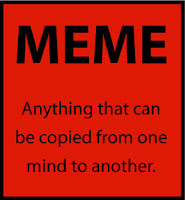
Dennett and Dawkins along with others have applied the idea vigorously to discuss various memes that they hypothesize are involved in propagating religious ideas. In this formulation ideas giving people a feeling of belonging to a group (say a religious group) have an advantage. There is also the idea of distinguishing oneself by doing something new, innovative, or significant. An individual with memes about how to find food, shelter, and stands out from the crowd is more likely to find a potential mate. Religious leaders stand above others and so a religious story meme is likely to be reproduced as they are voiced by what a tribe recognizes as favored mates.

But other non-religious cultural advances and economies of scale efficiencies may also be propagated by a concentrated population. One group economy of scale comes with such innovations such as farming which requires stable groups. Population concentration also then works to increase mate choices and possibilities, who in turn can pass on innovations.


I was reminded of the meme model by 2 recent things. The first was a light BBC article called 'How did the word "OK" conquer the world' which illustrates why some ideas spread and take over. The article was based on Allan Metcalf’s book OK: The Improbable Story of America’s Greatest Word in which he traces the word’s journey from “joke to business tool and then to staple of everyday conversation and an attitude toward life.” "OK" like "you know" or "I mean" crops up in daily speech dozens of times every day, although it seems habitual and carries little real meaning. My personal knowledge of OK’s origin was limited to what was declared in a Pete Seager song - "All Mixed Up". This asserted that OK came from Native American Choctaw - Okeh. But as Allan Metcalf explained the sound is also similar to Scottish German, Finnish and Greek affirmative words. Some idea-thing like OK is a good viral candidate in part because it sounds distinct but has simple acoustic components that are familiar to a multitude of languages. Thus its sound travels well and its graphic balance of the round /O/ and a /K/ made of straight lines makes it stand out clearly, easily distinguished from other words. These are good distinctions for a “Virus of the Mind” as Richard Brodie notes in his book of the same name. They help a meme virus get into the system and be communicated to others via a diffusion network. You can see some diffusion networks for recent memes that are afforded by the internet and social media online.

But as Dawkins noted early on, we are now aware of memes and so are at a new stage where people can intentionally design mind viruses. Those of us aware of the danger or having an interest can track some forms using a tool like Truthy .

Viral marketing is now a well known phenomena, which brings me to the 2nd phenomena that reminds me of memes – the attack on organized labor and the various memes of conservatives echoed my a mostly passive and tame media. It starts with simple sounding quotes as recorded in a NY Times article on dueling protests in Madison WI.

“‘You don’t care about this country! Shame on you, you’re selfish,’ one supporter of Gov. Scott Walker’s proposal told union supporters, wagging his finger as he spoke.”

Eric Alterman, for one, believes the issue of selfishness implied here isn’t merely rhetorical, but something we need to understand. It is dangerous. Alterman asks how did our country become a culture where “poor and middle-class folks willingly engage in internecine class warfare against one another, with one side essentially acting as a cat’s paw for mega-wealthy conservatives intent on undermining every worker protection in existence.” See http://www.thenation.com/blog/158844/whats-matter-wisconsin for the full article and the analogy to crabs fighting to escape a steaming pot. Altermann thinks that Thomas Frank framed an understanding of deceptive efforts by conservatives in his 2004 book, What’s the Matter with Kansas? The problem is that many of us have fallen for well designed memes disguised as populist, conservative messages that are in fact in conflict with the middle and working classes best interests. These have been called truthy memes since they rely on deceptive tactics to represent misinformation and half truths as fact. In a phrase we are infected with some bad ideas, which we are also in danger of passing on. They are spreading through the culture in part because they are driven by some basic fear of decline and by being packaged in a simple, relatively message about who to blame. Easy targets make for simple messages, which move along more easily than cognitively complex ones.

One thing that makes these messages difficult to resist is that the mainstream media has adopted conventional storylines as their hot button topics. This is done while crowding out competing and less sexy memes that provide the larger context digging into the real causes of the accelerating budget deficits seen in Wisconsin and elsewhere around the country. The real story might be to understanding the confluence of the failed housing market, high unemployment and Wall Street speculating and wild leveraging. These, rather than meme stories about public-employee union activity, are much better predictors of which state’s revenues are now in the red. But they are not simple, “OK” stories. They appeal to higher understanding and not the sexy, fear-based, scapegoating message being pushed.

Nor do you get much hard to resist messages about how the new cohort of Conservative governors have (or are) enabling state budget deficits by slashing corporate tax rates. Ron Brownstein had a column on a new war front role that Republican governors are playing in Washington's conflicts now –“American politics increasingly resembles a kind of total war in which each party mobilizes every conceivable asset at its disposal against the other. Most governors were once conscientious objectors in that struggle.” Instead of these ideas being widely discussed we hear echoes of misinformation dressed up as good statistical analytics. One cited example is the talking-point meme-statistic used by GOP politicians around the country. It appeared in USA Today in this form in August during the campaign:

“At a time when workers' pay and benefits have stagnated, federal employees' average compensation has grown to more than double what private sector workers earn.” USA Today, August 10, 2010

This notion of public union employees milking excess benefits from local government while the rest of the middle-class is simultaneously struggling sparks much of the public’s resentment. But it is a designer meme that is easily refuted by grounded realists like Ezra Klein of the Post who pops meme bubbles like Organized labor is in the hands of the teacher's unions. Klein points out that, "Wisconsin public-sector workers face an annual compensation penalty of 11%. Adjusting for the slightly fewer hours worked per week on average, these public workers still face a compensation penalty of 5% for choosing to work in the public sector."
(see http://www.politicalruminations.com/2011/02/truth-about-wisconsin-public-sector-employees-compensation.html)

That’s a meme we need to hear more about. Like conservative stories it needs to be made ubiquitous and give some organic growth time to put down hardy roots into the public’s mind. This is what Conservative memes echoes over their media and do it religiously. When they are wrong on an issue, based on a hard look at the facts, they ignore the facts and keep repeating their meme story. Dangerous designer memes...Beware.


.