Showing posts with label belief. Show all posts

Thursday, February 05, 2015

Is the Measles Vaccination Discussion a Teachable Moment?

by Gary Berg-Cross

Fifteen years ago, the CDC was proud to announce victory over measles. More recently there is has been a creeping increase in measles outbreaks attributed in park to the growing number of parents have opted to not to have their children vaccinated. Fear is involved backed by an old claim that there is a link between vaccines and autism. I guess the small success of the flu shot this year also lowers the confidence that they work. And so we have this, according to the CDC, 1 in 12 children born in the United States is not being vaccinated as recommended. That's a huge percent for something the best science seems to say is effective and safe.

The measles vaccine dust up is what Adam Frank called a "teachable moment" for everyone as the anti-vax movement is suddenly thrown into the spotlight. Collectively, we can see the Disneyland outbreak and the various responses for what it could be — a wake up call for informed decisions and rational discussion about science denial and the relation of parental rights (freedom) and responsibility to the public at least.

Below is a portion of what Frank wrote on what he called living in "a strange moment of human history" :

We have this thing called science. Through its fruits (medicines, technology, etc.), many of us live lives fundamentally different from the tens of thousands of generations preceding us. At the same time, through science's unintended consequences, we have also changed the "natural" world in ways likely to pose daunting challenges to our ongoing "project of civilization." But strangest of all, in the midst of these profound changes, one growing response to the tough questions science raises in our lives has been to act as if it didn't exist.

I am, of course, talking about denial. The anti-vax movement, like climate change denialism, rests on the assumption that if you disagree with certain established scientific results you can just ignore them. You call the science lies — or claim the scientists have a political bias."

Indeed people ignore or trump science based on emotional feelings (fight or flight) vague values of freedom and such. So parent's get to chose is proclaimed as an absolute.  It has an ideological-religious fever to it. But on this issue of parent’s choice there is also the question of what is behind the choice and what is a good choice.Recently, NPR's Morning Edition had a 4 minute segment called The Psychology Behind Why Some Kids Go Unvaccinated. We could use some of what was said there as part of this teachable moment.

We can start by asking why do some people believe that these particular vaccinations are dangerous? Can’t they understand the facts?

It turns out that (some) telling parents that are afraid to vaccinate kids the facts makes them less likely to vaccinate them. It’s a general belief phenomena of the emotional brain we can demonstrate and understand to some degree.


Some of it is the near term pain vs. more distant or less obvious gain.  But also Dartmouth research by Brendan Nyhan was cited on the belief dynamics which challenge the teachable moment opportunity for some.


The frame of the research is the idea hat beliefs are shaped by pre-existing views, filtered by motivated reasoning (energized by Worry ) through loyalty to our group allegiance (tribe’s) belief.  For example, take groups and give them facts to show that Obama was born in the US. Some are not persuaded by that facts and believe that Obama was born in Africa. Who? Those who didn't like him to begin with. Not everyone is open to the facts, your ideology filters things and indeed can motivate people to use their thinking in a defensive way.


Once you believe in something strongly with emotions it is hard to debunk. And this theory of child vaccinations leading to autism has that rigidity. It came from a 1998 article in a good Journal, Lancet,

suggesting such a link, but the study was later retracted and has been widely discredited. It was, for example only an 11 kid sample and later couldn't be replicated and then the author was shown to have mad up the data. But it is hard to stop the meme. Especially when it is promoted by tribes with a megaphone.


The Morning Edition talked about the collective action dilemma – We can get a free ride sometimes when others do the hard work like with vaccinations. It means that I don’t have to deal with the risk and this is also called the tragedy of the commons. I’d say it is a general problem we face. Letting everybody act in their own self-interest isn't optimal although some believe that.

How to solve the dilemma?

Some cultures force or apply public-social pressure (e.g. You are a moron–if your child is not vaccinated I won’t invite her over for a play date.)


Social scientists think these (force and shame) are not the best ways. While a little social pressure is good, experts who have studied the psychology of the vaccine doubters say it's counterproductive to be accusatory — or even to try provide a little well-meaning education.


Below is some discussion of this from researchers as part of a different article:


"When you attack somebody's values, they get defensive," said risk communication expert David Ropeik. "It triggers an instinctive defensiveness that certainly doesn't change the mind of the vaccine-hesistant person."

And some of the criticism on cable television, social media and in mainstream newspapers and magazines is starting to look like bullying, Ropeik and other experts said.


"There are millions of people who are ambivalent to some degree. When they hear the people being picked on defend their views, that has the real prospect of turning some of those people against vaccines."


The anti-vaccine movement is nothing new. People have been questioning the safety and efficacy of vaccines for decades, especially once the illnesses the vaccines protect against started to disappear, and the risks of the vaccine began to loom larger when there was no backdrop of death and disease.


But simply telling people their views are stupid, or even not fully informed, will not work, said Dr. Brendan Nyhan of Dartmouth University (also cited in the NPR story).


"It could make the problem worse. Imagine what calling people selfish and dumb can do," Nyhan said. "If people call me selfish and dumb, it doesn't make me more open-minded, and I don't know why anyone would think otherwise in this case. I think it's really short-sighted. People enjoy lashing out at anti-vaccine folks, (but) it turns into an 'us versus them' thing."

Nyhan conducted a study last year with Freed that found that when they gave ambivalent parents facts that show vaccines do not cause autism, they were even less likely to vaccinate their kids than they were before.

"They are committed to that point of view. You can provoke a kind of backlash reaction if you are not careful," Nyhan said. "That is why it is important to test the messages that we use and avoid the counterproductive type of messaging seen in the wake of Disney."

Telling people they are wrong will just make them dig in their heels, said Nyhan.

"There is a psychological tendency called disconfirmation bias. Information we don't want to hear, we try very hard to reject it. That is especially true for beliefs that are central to our identity," he said.

Most Americans support vaccination. A survey from the Pew Research Center published last week found that 68 percent of American adults believe that vaccinations of children should be required, while 30 percent say that parents should be able to decide not to vaccinate their kids.

But groups such as the National Vaccine Information Center view and position themselves as courageous visionaries who challenge a flawed, mainstream point of view. Libertarian leaders such as Sen. Rand Paul, R-Ky., are taking on the issue of vaccination as a question of personal freedom.

Bottom line, how might we get people to vaccinate their kids?

Build relations and trust – acknowledge the fear and discuss it without force or shame.

And, of course, a similar approach may be useful for the secular and intellectual community on other issues.


Note- Adam Frank is a co-founder of the 13.7 blog, an astrophysics professor at the University of Rochester, a book author and a self-described "evangelist of science."

Saturday, January 31, 2015

Religion, Faith and Belief – well covered in the Media, but with different slants

By Gary Berg-Cross
Lots of media (newspapers, magazines, radio and online types like blog sites etc.) have a Religion section or its equivalent.  WaPo has it online under the National section where you can read about the “Latest Religion News.
This includes local Religion events from around the Washington area including music
(Dixieland jazz), Martha’s Table, food drives, Super Bowl Fellowship, Bible study, yoga, wellness, organ recitals.

Under the WAPO  RELIGION heading you read how the ubiquitous  (and Controversial)
Koch brothers give big (again) to Catholic University. But you can also find related  coverage under the Metro or Style section which has On Faith.
The NYT has a Religion and Belief section with occasional posting like:
Mark Oppenheimer Beliefs column. A January post observed that many faiths struggle with concept of animal ensoulment; cites proliferation of pet cemeteries throughout the United States.

An earlier one in January was about former NY Gov Mario Cuomo willingness to speak publicly about his religious beliefs.

On Xmas day atheist Mark Bittman Op-Ed article cross-posted there that reflects that 2014 was the 100th anniversary of Christmas truce during World War I, when soldiers from both sides took break from fighting to be festive together.

Also on Xmas dayT M Luhrmann had a cross posted Op-Ed article about people attending God-neutral, growing in popularity movements like Sunday Assembly around Xmas Yes even for atheists group ritual is important to make sense of the world.

Even the Guardian has a Religion section and moving to online phenomena the news aggregating blog site called  the Huffington Post has a Religion news section. It’s under its Voices category. As a liberal site I find its coverage includes a bit more critical tone than most of the others. You can read about “Why Julianne Moore Stopped Believing In God” They break faith down into several categories and also have a  Religion and Science section that features "blog posts and news reports that address the ongoing conversation and tension between religion and science. The page has a pro-science and pro-faith point of view and highlights smart, sophisticated perspectives from all religious traditions on how to best improve relationships between these two fields of inquiry."

These feature research and fact-oriented coverage and not just opinion. Recent examples include, “Children Exposed To Religion Have Difficulty Distinguishing Fact From Fiction, Study Finds”  and “Religious Objections To Vaccines Are A Threat To Public Health.”

Still I find most of these sites could be considered religiously or faith oriented. They are labeled so.

A bit different is the Belief section of the very liberal blog aggregator Alternet.  Here we are beyond a religious and religious faith slant to one of the more general topic of belief including secular belief. Atheism is pretty prominently featured and discussed and discomfort to faith-based belief folks is likely.  They cover issues in a more confrontational way - sort of like a New Atheist style, but they include articles that might take on that topic too.

Recent posting included:
E. O. Wilson: You don't have to be an atheist to know that religion is harming the Earth.
Of course some of the coverage discusses the religio-political connections such as:


AlterNet-Jan 28, 2015
20 percent of Americans have no affiliation with organized religion. Only 0.2 percent of Congress says the same. By Zaid Jilani.

Another one with political connections was “This Week in Religion: Huckabee Claims God Blessed Him, and Mormons Back LGBT Rights.” 

Dan Arel, author of Parenting Without God and blogs at Danthropology, authors the This Week in Religion section. Just in January he has covered some critical topics:

Other recent posts on Alternet.org include some overviewing non-belief in a bit of the way other media feature an established religion.

AlterNet-Nov 17, 2014
The answers tell us a lot about religion and non-belief in America. ... Not all of them identify as atheist or agnostic or a non-believer, but plenty do, and while there are many people offering to defend this particular community, few are willing to speak for them. ...

Still other posts are critical of religious leaders such as:
Billy Graham's Son Is One of America's Most Dangerous Islamophobes. This one by Bill Berkowitz  was aggregated from another liberal blog site TruthOut.

Alternet is one of those challenging sites.  No one is going to agree with everything they feature, but you get some interesting topics, usually documents and well reasoned if a bit argumentative – sort of like the New Atheists. An example is the “12 Worst Ideas Religion Has Unleashed on the World” By Valerie Tarico who argues that these 12 dubious concepts advocate conflict, cruelty and suffering. Among them are things hard to disagree with:

The idea of  Heretics, kafir, or infidels (to use the medieval Catholic term) are not just outsiders, they are morally suspect and often seen as less than fully human. In the Torah, slaves taken from among outsiders don’t merit the same protections as Hebrew slaves.”  Or Holy War – If war can be holy, anything goes.”  Blasphemy the notion that some ideas are inviolable, off limits to criticism, satire, debate, or even question. is of course on the list, but the #1 listed was:

Chosen People –The term “Chosen People” typically refers to the Hebrew Bible and the ugly idea that God has given certain tribes a Promised Land (even though it is already occupied by other people). But in reality many sects endorse some version of this concept. The New Testament identifies Christians as the chosen ones. Calvinists talk about “God’s elect,” believing that they themselves are the special few who were chosen before the beginning of time. Jehovah’s witnesses believe that 144,000 souls will get a special place in the afterlife. In many cultures certain privileged and powerful bloodlines were thought to be descended directly from gods (in contrast to everyone else).

Religious sects are inherently tribal and divisive because they compete by making mutually exclusive truth claims and by promising blessings or afterlife rewards that no competing sect can offer. “Gang symbols” like special haircuts, attire, hand signals and jargon differentiate insiders from outsiders and subtly (or not so subtly) convey to both that insiders are inherently superior.


No feel good Super Bowl Fellowship coverage likely at Alternet.org, but lots of thought poking topics.  It not only makes you think, it makes you want to think. 

Sunday, February 02, 2014

The Cybernetic Atheist's Mission Statement


I occurs to me that I've not truly expressed my beliefs and what I hope to show the world in my blog.

Yeah, a blog.  Everybody and his donkey has a blog.  Not a big deal.

I really don't care.  This is MY blog, and I hope to tell the world what I think about just about anything that comes to mind.  There are, however, some issues that are more important and will (have been) blogged about more than others.

Separation of Church and State
Politics
Dominionism
Religion
Atheism
Harm from Religion
Spiritualism
Science and Technology
Apple, Inc. products and similar cool stuff
Weird stuff
Secular Humanism

Now, taking this one step at a time, here goes.

Separation of Church and State


I am an American citizen.  I have spent over 40 years of my life serving the United States Government and have taken two oaths to support and defend the Constitution.  One was military - four years, and the other the civilian oath for Federal Civil Service - 36 years, all of that at the FDA.

The Constitution has as part of its first Amendment the guarantee of religious freedom.  Two clauses, one to keep the government out of religious affairs, and one to keep religions out of government affairs.  Together, they protect all Americans from any one religion (or religious sect) from dominating the government and dictating religious affairs to the rest of the country.  A clause in the Constitution itself forbids any religious test of office, going further to protect us from religious influence.

It isn't perfect, as today's struggle to keep fundamentalist Christianity from overturning the US Constitution and creating a Theocracy is proof of.  (Yes, Dominionists really ARE trying to do that.)

I am opposed to that, and am avowed to do anything I can to support separating religion from public affairs.  The First Amendment provides excellent cover for religious folks to go to church and even practice their religion in the privacy of their own lives without the rest of us interfering.  It also guarantees them the right to associate with others of like belief.

The oaths I took obligate me to protect the rights of ALL Americans, religious and non-religious, and I WILL do that, but I will NOT support anybody forcing their religious practices on anyone who does not believe.  I will also not support anybody forcibly stopping people from believing in a god, either. 

Believe how you want, practice - or not - as you wish.  But you cannot use the power of the government - Local, State or Federal - to force your religious practices on the entire country.

Politics


I am pretty much an Independent.  I am registered in Maryland as a Democrat - mostly because that's the best way I see to use my vote.  I refuse, on principle, to vote for a Republican, until that party regains its senses and dumps both the religious loonies and the Tea Party extremists.  If they ever do, and become a viable party with sensible and competent leaders, then I'll begin looking at individual Republicans running for office again.

I support universal single payer health care, legalization of marijuana, reasonable limitations on firearm ownership, separation of Church and State, immediate measures to curb human contributions to climate change, a reasonable balance between human and animal habitation of our planet, strict control over our capitalistic economic system, including harsh prison sentences for economic leaders who endanger the system by emphasizing private gain, government programs to assist the unfortunate and the impoverished.

I am in complete support of full, free public education, from pre-school through four year University level.  There is nothing more critical to a functioning and healthy democracy than a fully educated and reasoning citizenry, and it is our obligation to future generations of Americans to see that they receive the full benefits of the best education this country can provide.  Nothing else is as likely to eliminate poverty than that.

I am in full support of full and complete equality of all human beings, regardless of race, sex, gender identification or sexual orientation.  Human rights are HUMAN rights, and no sub-classification by arbitrary label has the power to abrogate any of those rights, no matter what label that may be.

I also explicitly support the freedom of women to choose their own way when it comes to procreation.  Or the choice to NOT procreate.  They have the right to choose to carry a pregnancy to term or not, and in consultation with the physician of their choice, the right to end that pregnancy however is appropriate to their individual circumstances, should those circumstances demand it.

Dominionism


I have seen the evidence and firmly am of the opinion that the group known as Dominionists are determined to overthrow the United States government as a democracy and transform it into a theocracy.  I will publish and repost whatever information I see to bring awareness of them and their activities to public light, in an effort to persuade as many people as possible to oppose their lunacy.

Religion


I am a firm atheist.  I do not believe in a god of any kind, and believe that religions of all kinds represent some form of confidence game with the purpose of gaining political and economic power for whatever priestly or guiding group controls the organizations supporting worship of any particular god or gods.

While I do see the lack of evidence for a "historical Jesus" as lacking, which makes that historicity unlikely, I think that the more important point is that since there is no god, there can have been no son, so even if there WAS a man whose existence may have been overblown into legendary status, the claims of godhood cannot be true, by definition.  Ergo, stop bothering me with it.

Atheism


Being an atheist is similar to not believing in the tooth fairy.  The word defines something I DON'T believe in, not what I do.  There are other, more positive things that define my ethics and my moralities.

Harm from Religion


I believe that the widespread belief in religion brings harm to all mankind and retards our progress into the future.

It does so by causing people to filter reality through a false lens, altering their responses and making them do things which actively harm others as well as, often, themselves.  It causes people to make political decisions based on bronze age ethics and morals in an age where such practices have long been discarded as cruel and unusual, causing turmoil, dissension and violent political strife and, often, war.  It causes people to make claims on land based on ancient legends and stories backed by no more than books of dubious authenticity and provenance - claims which have roiled the entire globe with violence and untold turmoil for decades, with little possibility for any reasonable settlement.

It breaks up families, promotes child abuse, opposes public education and encourages people to blindly follow authorities who have no competence or ability to lead, and often, only lead to aggrandize themselves.

It encourages entire sects of people to disbelieve climate change based on a false sense of believing that god will somehow come back to repair the damage we have done.

Historically, it has encouraged its believers to kill those who do not believe the same as themselves, and many sects still do so today.  Many of these will kill apostates.

I could go on, but you get the gist of what I am saying.

Spiritualism


I believe that when human beings die, our personality dies with the death of the body, in which the personality resides.  There is no soul, no spirit.  No ghosts.  Yes, ghost stories may be fun, and scare the crap out of your younger siblings, but there is no basis for believing in their existence.

Spiritualism is, in short, something that resides within ourselves, and gives us the ability to improve the way we use our minds.  It helps us to balance ourselves, removing stress and tension and improving our mental state of mind.

It does not connect us to a greater power, nor does it make us one with the Universe.

Science and Technology


I believe that mankind will improve our standard of living, our health and our relationship with the rest of mankind as we learn more and more about the Universe, how it works and how our own biology works.  I encourage the continued activities of people the world over to invest in the continued and growing research and development of science and technology.

Apple, Inc. and all its products.


I love Apple.  I love its tech, I love its products.  I will occasionally talk about anything I see as cool that they  are coming out with.

Weird stuff


As knowledgeable about Science and the universe as we may be, any scientist will tell you that the whole point of science is to discover the things we do NOT know.  I like to occasionally explore the weird stuff that indicates things we may still be ignorant about.

Secular Humanism


I am at heart, a secular humanist.  This pretty much sums up what I feel.

  • A conviction that dogmas, ideologies and traditions, whether religious, political or social, must be weighed and tested by each individual and not simply accepted on faith.

  • Commitment to the use of critical reason, factual evidence, and scientific methods of inquiry, rather than faith and mysticism, in seeking solutions to human problems and answers to important human questions.

  • A primary concern with fulfillment, growth, and creativity for both the individual and humankind in general.

  • A constant search for objective truth, with the understanding that new knowledge and experience constantly alter our imperfect perception of it.

  • A concern for this life and a commitment to making it meaningful through better understanding of ourselves, our history, our intellectual and artistic achievements, and the outlooks of those who differ from us.

  • A search for viable individual, social and political principles of ethical conduct, judging them on their ability to enhance human well-being and individual responsibility.

  • A conviction that with reason, an open marketplace of ideas, good will, and tolerance, progress can be made in building a better world for ourselves and our children.

Robert W. Ahrens
Rockville, MD

Friday, October 04, 2013

Thoughts on Improved Discussions: Is Atheism a Religion?


By Gary Berg-Cross

Over the summer I attended some meetups where the role of religion is society was discussed.  Occasionally the discussion drifted into a topic that people were hot about and one of these was the perennial question of “Is Atheism a Religion?”  It’s a topic which can be discussed from practical, personal and philosophical perspectives. You can start by focus on clarifying what is meant by Atheism and its practice. But you also need to delve into definitions of religion and how it is practiced, then do some analytic comparisons.

You can for example, just take the simple semantics of atheism as “no belief in a god.” Then if to be a religion there must be belief in a god (a debatable point), then a narrow view of atheism doesn’t qualify.  That would make for a short discussion, but there is more to say about what is involved in atheist organization or secular,/non-faith groups expressing social beliefs as well the definition of religion. After all, the practice of atheism beyond a philosophical position allies with secular beliefs and organizes to become effective in countering religious influence as well as expressing its own values.  Often these may be packaged in practices that seem religious.

To point to just one way that so called organized atheism/non-belief acts like a religion take the London-based” The Sunday Assembly a so called “Atheist Church  -a godless congregation that meets to hear great talks, sing songs and generally celebrate the wonder of life. They have regular services in London and have launched what they call a “global missionary tour.” Indeed an Assembly event is planned in DC on Wed, Nov. 6, 2012 Center for Inquiry-DC. So an organizational form of godlessness is on the march.  If this march includes bands and songs within some physical infrastructure analogous to a temple holding some ceremonial events and ministered to by a hierarchical “leader” with stories of scientific and philosophical heroes, well maybe it should qualify for tax-free benefits. That seems OK to many. Why should these human ways of expressing ourselves be shut off to us? Religions have grabbed and are occupying ground that might be part of our humanness.  Let's take it back, especially if it helps a secular story compete with the religious stories on more of an equal footing.  This trappings of the traditional religions behave is just part of a practical-tactical decision to operate effectively within a social system in order to change it for the better.

Another perspective is to just to focus on religion as something that has a set of committed beliefs.  So if atheists, free thinkers (or scientists) start expressing beliefs in things like evolution, well then it’s their religion. The counter, of course, is that religion is organized about superstitious not scientific beliefs.  The essential religious beliefs seems to be involve an unchangeable idea of a higher or supernatural power, which is often expressed as some type of god. Religion puts beliefs in a range of super-natural phenomena and powers that aren’t testable, but relies on faith. It is not regular & practical belief, but faith-based.  The power of prayer is one example. 

Religions also proposes quality concepts and judgments like 'good' or 'evil' that are measured and defined by non-human entities, but must be bought into.  Sorry these are nothing like my natural beliefs in gravity and a physical cosmos.  Sure, I commit to them in some practical way every day, but my understanding of gravity is open to allow a Higgs boson to enter that understanding and expand and refine it. But that understanding comes without the idea of something beyond the natural. As Robert G. Ingersoll said in What is Religion” (his last public speech delivered in Boston, Massachusetts the evening of June 2, 1899):

“Religion rests on the idea that Nature has a master and that this master will listen to prayer; that this master punishes and rewards; that he loves praise and flattery and hates the brave and the free.”

No such system of beliefs for free thinkers.  For us it is more like what Ingersoll expressed in what was labeled his "Creed" including - Justice is the only worship and Love is the only priest. If you accept my "praise" of justice as a form of religious worship, then OK I'm that kind of religious, but not the one that expects some hidden master's punishment if I stray.
But perhaps love of love and such should qualify as something larger that society recognizes as worth supporting in the way that it does traditional religion which gets beaucoup benefits as studies have shown -see the figure alongside for examples.
One source that I often consult on issues like “what is religion” where a deeper perspective is needed is Tom Flynn’s “The New Encyclopedia of UNBELIEF.”  (BTW Tom will be speaking at WASH's MDC chapter Dec. 14 in the Rockville library from 2-4).
 Opportunisitc conversations on such things can be better grounded by consulting its pages which are tripped up or hung up discussing colloquially ideas of “religious”.  We run into these things is the loose semantics of conversation, such as when we describe a friend that is “religiously adhering to a diet”. Sure it is a type of commitment, but not what gets fully to the ideas of religion which Tom's Encyclopedia explores more systematically. Perhaps I can put on my wish list an online version of this to be consulted at Meetups!  
Under the Religion entry, for example, the Encyclopedia, starts by quoting from the International Humanist and Ethical Union statement on the use of the term religion.  Here is what they said which clarifies the Humanist position quite a bit with 3 ideas that people may hold about religion and whether there is one definition we can agree on:
Being concerned about the confusion and contention sometimes caused by the words "religion" and "religious",
This board wishes to place on record the following points which can be agreed by all humanists:
1. Some humanists use the word "religion" as roughly equivalent to "life stance"; others take it to imply some theistic or non-naturalistic reality.
2. Those humanists who use the word "religious" to describe themselves or their organisations do not imply that their humanism accepts any theistic or non-naturalist realities.
3. In the sense of the word "religion" which implies "accepting a god", humanism is not a religion; in the sense of "religion" meaning "life stance", humanism is a religion.
4. There is disagreement among humanists about which is the "true" or "appropriate" meaning of the word "religion".
From the International Humanist and Ethical Union (IHEU)  site and its 1989 resolution on Use of the word "religion"

Which brings me back to the occasional conversation on this question of Is X a religion (take your pick on X as atheism, Humanism, Secular Humanism etc.). If you want to use religion as a life style well then, yes, but you may not be talking tax benefits style religion recognized in legal codes.  Should we have to believe in some non-natural power to be considered a religion?  I may disagree, but society may draw some lines to advantage such beliefs. I think that a mistake, but it is something to be discussed more broadly than just at Meetups.  

I guess that one other thing one might inject into these conversations after the depth of Tom’s Encyclopedia is a little bit of modern, edgy humor that ignores some nuanced differences between belief and faith to make its point.  Bill Maher backhands the idea that atheism is a religion with stinging putdowns:

"Idiots must stop claiming that atheism is a religion…..religion is defined as the belief in a “superhuman controlling power” (god), and atheism is precisely not that. Indeed, atheism is simply the absence of belief in a god or gods. It is not a world view, a philosophy, or a religion. It is simply the absence of belief. To be without a belief in god, is to be an atheist….Treating atheism like a religion would be like saying “abstinence is a sex position.” After all, when was the last time a non-believer ever claimed to see the silhouette of Christopher Hitchens on the side of a tree?"

Tuesday, July 02, 2013

Through Orators Robert Green Ingersoll Speaks

By Gary Berg-Cross

Americans would be wiser and better informed if their reading and education included a good dose of the thoughts of 19th century freethinker Robert Green Ingersoll. It's a point made before in my blog - Hearing the Voice of Freethinking Robert Ingersoll. As Susan Jacoby illustrates in her new book Robert Ingersoll: "The Great Agnostic and American Freethought" Ingersoll is one of the indispensable public figures.  He not only speaks bravely on the issues of the day, but helps protect the historical record and keeps a deeper, alternative version of history alive. In Ingersoll’s case that alternative history included Tom Paine’s forgotten secular history. In the case of issues from Ingersoll's time these included women's rights, immigration, humanistic literature and evolution.  It is worth noting that these retain their divisive potency in our times.  And it is wonderful to report that these and other topics were on display recently at the 3rd Ingersoll Oratory Contest held in DC.

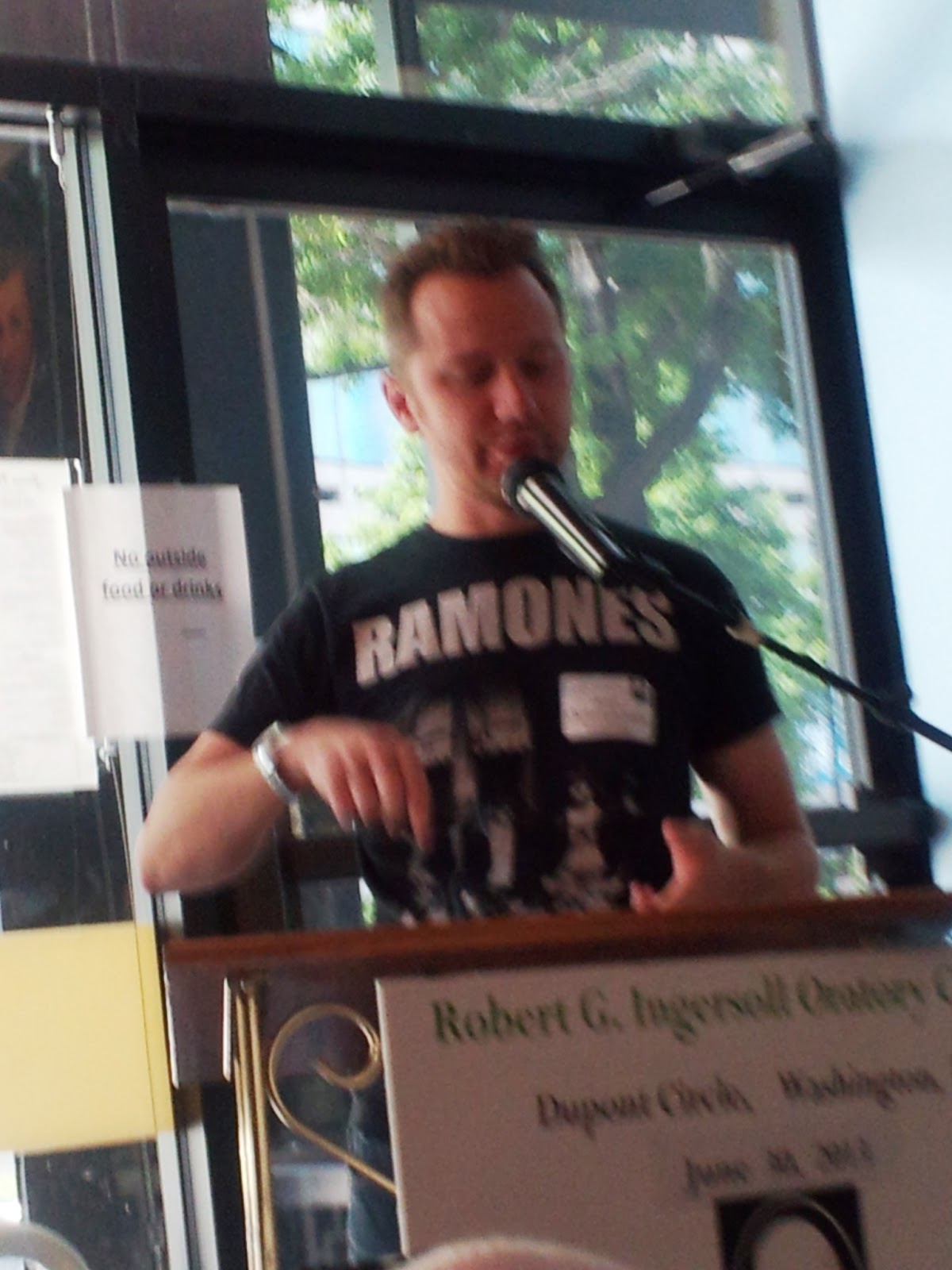
While rain forced a change of venue Sunday (to James Hoban's Restaurant ) we had a very nice event. Eleven contestants, traveling from as far as Florida, Indiana, and Delaware competed for 4 prizes.  Steve Lowe served nobly as Master of Ceremonies with assistance from Beth Kingsley, Brian Magee and Suzanne Perry. Links to photographs and videos will be posted on the Ingersoll Oratory Facebook site and now are available, but a random sample of quotes and images is below.

Carol Ardell kicked off the event by a reciting, from memory, Ingersoll’s Twentieth Anniversary Lotos Club Dinner speech(1890). It begins sagely:


YOU have talked so much of old age and gray hairs and thin locks, so much about the past, that I feel sad. Now, I want to destroy the impression that baldness is a sign of age. The very youngest people I ever saw were bald.
                                                    (These and other quotes from Secular Web)

It goes on:

I am perfectly satisfied that the highest possible philosophy is to enjoy today, not regretting yesterday, and not fearing tomorrow. So, let us suck this orange of life dry, so that when death does come, we can politely say to him, "You are welcome to the peelings. What little there was we have enjoyed."

Terrance Madden followed with a reading from “Thomas Paine (with his name left out the history of liberty cannot be written.)”

At the age of thirty-seven, Thomas Paine left England for
America, with the high hope of being instrumental in the
establishment of a free government. In his own country he could accomplish nothing. Those two vultures Church and State – were ready to tear in pieces and devour the heart of any one who might deny their divine right to enslave the world.


This was followed by Mike Schmidtmann who greeted fellow Humanists before reading “About the Bible” & “The Ten Commandments.” Donald Ardell also recited part of Ingersoll’s About the Holy Bible  which starts:

Somebody ought to tell the truth about the Bible. The preachers dare not, because they would be driven from their pulpits. Professors in colleges dare not, because they would lose their salaries. Politicians dare not. They would be defeated. Editors dare not. They would lose subscribers. Merchants dare not, because they might lose customers. Men of fashion dare not, fearing that they would lose caste. Even clerks  dare not, because they might be discharged. And so I thought I would do it myself."

Speaker selected topical talk including:


Jesse Christopherson, reciting “The Liberty of Man, Woman and Child”, 
"There is no slavery but ignorance. Liberty is the child of intelligence."

Cody Smart heartfully recited, “What is Religion” -  Ingersoll's last public address,delivered before the American Free Religious association, Boston, June 2, 1899.


"For many centuries and by many peoples it was believed that
this God demanded sacrifices; that he was pleased when parents 
shedthe blood of their babes. Afterward it was supposed that he was
satisfied with the blood of oxen, lambs and doves, and that in
exchange for or on  account of these sacrifices, this God gave rain,
sunshine and harvest. It was also believed that if the sacrifices
were not made, this God sent pestilence, famine, flood and
earthquake."
 
 
and Amelia Vogel read some of Ingersoll's beliefs from, “Suicide and Sanity.”

"man is under no obligation to the imaginary gods; that all his 
obligations and duties are to be discharged and done in this world; 
that right and wrong do not depend on the will of an infinite Being, but on the consequences of actions, and that these consequences 
necessarily flow from the nature of things. I believe that the universe 
is natural."


As to what the 3 judges decided:

  1.  Sarah Henry took first place reading from "Improved Man"
  2.   Terence Madden took second place reading from Ingersoll's talk about Thomas Paine.
  3.     
  4. Third place was won by Tya M. Pope who chose from two related speeches: "A Christmas Sermon" and What I Want for Christmas".


 All agreed that the performances were excellent and left us a bit more thoughtful and perhaps wiser:


‘I believe that all actions that tend to the well-being
of sentient beings are virtuous and moral. I believe that real
religion consists in doing good. I do not believe in phantoms. I
believe in the uniformity of nature; that matter will forever
attract matter in proportion to mass and distance;’….

          Partial answer to QUESTION: What is your belief about virtue, morality            and religion? In Suicide N Sanity
 

Images


Taken by Gary Berg-Cross at the Event.
Brian - a helper.