Showing posts with label Obama. Show all posts

Sunday, February 08, 2015

Ideoplogy and Religion Mix at the National Prayer Breakfast

by Gary Berg-Cross

The National Prayer Breakfast often stirs up controversy, although different ones in the secular and religious communities. In the past, for example, we had the context of the  Hobby Lobby Case and we found there was a link to  a somewhat
“secretive group" called "The Family” playng a role of hosting the  National Prayer Breakfast. This was reported on the  MSNBC's Rachel Maddow Show, by author Jeff Sharlet who publicly accused "The Family" of this role.

This year I was at a discussion group after the Breakfast event and the buzz was about Obama’s “crusader” comment:

“And lest we get on our high horse and think this is unique to some other place, remember that during the Crusades and the Inquisition, people committed terrible deeds in the name of Christ. In our home country, slavery and Jim Crow all too often was justified in the name of Christ.”

As the Post noted, “Critics pounce(d) after Obama talks Crusades, slavery at prayer breakfast”
There was lots of ideas and symbols wrapped up in the spaces between the words and suggestive connections to other parts of the speech.  An example is that patriotic, hot button issue of American exceptionalism. Well, as noted, the Greeks think their country i special, too). Then there is the contrast with uncomfortable Bush-era practices such as those interrogation practices, euphemistically called “harsh” for years, but in the Obama era more correctly called  torture that goes along with the invasion of Iraq a tragic, hubristic mistake. Perhaps we should pray for forgiveness for these things as well as our prior heavy hand in Central and South American.

Are these things too sensitive and ideological to discuss at a “prayer” meeting or ask forgiveness for?  Do they downplay ISIS evil too much?   Well conservatives like The Family and Baltimore’s Ben Carson believe so. Any number of outraged Republicans voices could be heard such as former Virginia governor Jim Gilmore who said,

“The president’s comments this morning at the prayer breakfast are the most offensive I’ve ever heard a president make in my lifetime. He has offended every believing Christian in the United States. This goes further to the point that Mr. Obama does not believe in America or the values we all share.”

Well it  seems to some of us as a good use of the Prayer Breakfast pulpit to talk about the moral side of things and for the Religious-American complex to take an historical,  self-reflective stance. It is a timely context seeing something bad done in the name of Religion to humbly note that Faith, and not just one Faith, can be perverted and its name used to justify revenge killing and harm.  It’s about the need for the prayerful to”stand up against those who try to use faith to justify violence, no matter what religion they practice.”

Wednesday, October 08, 2014

Who me? I’m not responsible. Why do those things happen?


by Gary Berg-Cross

Flight from responsibility with its resulting dilemmas is nothing new, but it confronts us in a variety of ways across the country, globe and culture.  It is difficult not to think of the reign of unintended consequences of irresponsibility as we are showered with 21st century news.  This ranges from the responsibility of deaths from police such as in Ferguson, Missouri; to epidemic deaths in Africa; to thousands and millions in conflicts around the globe.  No one thing seems responsible, although you can find attempts to simplify it down to a target cause.  Policemen are only doing their duty and protecting themselves.  They are not responsible if someone gets shot.  Riots break out as unintended consequence of that action.  Are the police, the community of the media responsible for that?  It’s just an unanticipated consequence of a diffuse system where it is difficult to locate one single, intended, responsible cause.  But a multi-causal/many hands explanation might mean that I, as a citizen, share some of the responsibility.  No, not me.  Society says that a crime and such must be intentional.  It's not my intent.  It must be them, or whatever, but not me.

So an easy, religio-cultural defense is that “I didn't intend for this to happen” any more that an anthropomorphic God intended bad things to happen.  Of course, social science suggests that "actions" are generally performed by some human or animal for some purpose.  Certainly we have things discussed in business, law, government, economics that depends on goals or purpose. It’s just that these or a person's model of what will happen based on some intended action may not be what will really happen. Our models are imperfect.  So we have the famous" unintended consequences" and a search for someone/something responsible to blame.  It is a difficult causal analysis and one can understand why we tend to avoid the complex explanation for the simple. Indeed it is a general phenomena that we may recognize which problems are significant, but they are often difficult and so we drift sideways on easier problems and topics that provide more immediate pleasure and conversation.

Fox News is blaming President Obama for being indifferent to the threat of terrorism.  He's an easy target of the focus of who is responsible for all that goes wrong in the Near East.  Who’s responsible for these deaths?  We want a simple answer.  Of course there is a history here and other players with various intentions.  But there is one model to analyze all of this, so as beings with limited analytic ability, we simplify with rules of thumb and biases.  It’s hard for most of us to believe that the President intends things to go wrong, but in politicized times we look for a simple agent explanation.  It’s a very natural way of thinking. But is can be dangerous.  Things happen for a “reason”, but if it is something I don’t like it makes sense to find a cause external to one’s self and group to blame.  And blaming can make enemies of lead to the gridlock of two 6 year olds fighting.

Why are there high divorce rates, the spread of venereal disease, troubles in our schools, and increases in teen suicide, along with alcohol and drug abuse among the poor?  A simple answer is that it’s their culture (see The Poverty of Reason by Glenn C. Loury) .  They are responsible, not the larger society in which poverty is created.  So if "they" rather than "I" are responsible I don't have to do anything about this problem and its unintended (by me at least) consequences.

I can ignore social sciences understanding of dysfunctional behavior patterns adopted by people in poor communities. It’s just too complicated for me to understand and this support broad solutions. 

A worrisome, perhaps central, example of this fight from responsibility is the creeping impact of climate change. Why aren't we taking action? Sure there are scientific warnings about what is happening and why. We  don’t want the anticipated climate changes let along unanticipated ones.  But since they are part of a very complex natural system, coupled with human institutions and power centers beyond my control, it seems to say that “things just happen”. Someone responsible will have to deal with that. 

As passengers on planet earth we can say “I don’t intend that the seas warm and polar bears die off.  My conscience is clear and my moral principles say that I am not to blame.  And thus we drift to unintended consequences unless we see some shared responsibility. As noted in the lead up discussion for the recent UN climate summit:

“...stating that nobody is responsible for climate change leads to paralysis. Second, empirical evidence of public and private initiatives in distant corners of the world ... suggests that both individuals and groups are actively taking responsibility for climate change mitigation.
Climate change can also be approached as a problem of collective moral responsibility. “

Who Has Moral Responsibility for Climate Change?


VANESA CASTAN BROTO, MAR 6 2013

Tuesday, November 12, 2013

A flurry of Anniversaries


By Gary Berg-Cross

This year seems filled with memorable anniversaries.  Some like the first anniversary of SuperStorm Sandy (Oct. 23rd) linger bitterly in recent memory as images of damaged neighborhoods and distraught lives.  A bit more distant is the 8th anniversary of Hurricane Katrina whose horrific damage now throttles the Philippines. Prohibition ended 80 years ago or so, something I guess we will see eventually on TV as part of Boardwalk Empire.

This month (Nov.), of course, marks the very big 50th anniversary of the assassination of President John F. Kennedy, who was shot and killed in Dallas, Texas on Nov. 22, 1963.
Forty years ago in the summer of 1973, the Senate Watergate Committee discovered that Trickster Nixon had a tape-recording system in his offices.  Many of the events come from the civil war era such as the anniversary of the Gettysburg address.

Earlier in the year we had a happier side of  Americana to celebrate like the 50th anniversary of the March on Washington and Martin Luther King's 'I have a dream' speech.
The setting for this was Lincoln Memorial in Washington DC and so it is perhaps fitting to thrown one anniversary onto the pile that involves the very progressive and first Republican President Lincoln and has a setting not far from his hulking memorial. It’s the 150th anniversary celebration the creation of the National Academy of Sciences. On March 3, 1863, President Abraham Lincoln signed the Act creating the National Academy of Sciences.  The act came from Congress with an impetus from American scientists including Coast Survey Alexander Dallas Bache (Ben Franklin’s great grandson!!), naturalist Louis Agassiz, Harvard professor of mathematics and astronomy Benjamin Peirce (father of that great philosopher Charles Sanders Peirce), astronomer Benjamin Gould, and Harvard professor of Greek and Latin Cornelius Felton.  Yes, Republicans once respected Science, reliable knowledge rather than ideology and its promotion in pre-Climate Change days. Indeed Congress was interested in good, scientific advice and saw the Academy as an independent and nonprofit institution charged with providing the government with the scientific advice that it needed. One of the new Academy's first tasks was to determine how magnetic compasses could be made to work properly on board the new "ironclad" battleships being developed for the Civil War.

There’s a year-long celebration, but a special event was held recently October 16-18 called Celebrating Service to the Nation. You can view the Sackler Colloquia's YouTube channel. According to the NAC site 9 videos are available, including the 2013 Sackler Lecture by historian Daniel J. Kevles (Yale University) on The National Academy in the American Democracy. The colloquium program, which lists the moderator and panelists for each of the eight sessions, is available online.

Remarks by President Obama on the NAC are also online.

“For 150 years, you’ve strived to answer big questions, solve tough problems, not for yourselves but for the benefit of the nation.  And that legacy has endured from the Academy’s founding days.  And when you look at our history, you’ve stepped up at times of enormous need and, in some cases, great peril. “

Thursday, December 27, 2012

Looking at Political Rhetoric Ahead with the Aid of a Look Back at Decider Era Language


By Gary Berg-Cross

There are quite a few decisions ahead we face as a nation, but the end of the year is also a time to look back.  Well, at first blush we see in the rear view mirror a very political, ideological and shallow belief driven year.  Looking ahead at some of looming, large conversations it seems that there is plenty to anticipate. But  as a nation we have gone from a 2 year campaign to a permanent campaign mode that makes compromise and balanced decisions difficult.  With ideological belief ridding harshly on pragmatic approaches we are likely to slink into that finger-pointing style for some time. 

That seems a poor environment for decisions so perhaps a look back provides some perspective on what might get when we auto pilot on  politics, ideology and God-given beliefs.  We don’t have to go back too far.  We can look at George W. Bush’s (ghost team written) presidential autobiography Decision Points for some idea of what emerges from such an atmosphere.

When it came out Decision Points  was described by a NYTs review as:

 “a book that is part spin, part mea culpa, part family scrapbook, part self-conscious effort to (re)shape his political legacy…. Certainly it’s the most casual of presidential memoirs: how many works in the genre start as a sort of evangelical, 12-step confession (‘Could I continue to grow closer to the Almighty or was alcohol becoming my god?’),”

Eliot Weinberger’s writing in the London Review of Books pointed out how the book blurred distinction between fiction and non-fiction.

That is to say, the parts that are not outright lies – particularly the accounts of Hurricane Katrina and the lead-up to the Iraq War – are the sunnier halves of half-truths.

Obama is certainly not George W. and likely more thought and data for decisions, but he is dealing in part with neo-con and rigid belief factions that advised us into “problems.”  It is sobering to think about how many Bush legacies, discussed in that book as if Bush was heroically dealing with each one, still have to be dealt with by Obama. The list includes:

  • Recession and debt following the financial crisis of 2008
  • Terrorist attacks,
  • Wars in Iraq and Afghanistan and controlling the military,
  • Middle East conflicts, emerging democracies & aid,
  • drones,
  • Various domestic issues (including Medical reform, Social Security reform, Education and Immigration reform),
  • Federal response to disaster (Sandy etc.) and
  • Political strategy

What ever book Obama writes it will probably provide more insight into these and reflect a different backward glance than W’s last days in office (from Wikipedia):

"I reflected on everything we were facing. Over the past few weeks we had seen the failure of America's two largest mortgage entities, the bankruptcy of a major investment bank, the sale of another, the nationalization of the world's largest insurance company, and now the most drastic intervention in the free market since the presidency of Franklin Roosevelt. At the same time, Russia had invaded and occupied Georgia, Hurricane Ike had hit Texas, and America was fighting a two-front war in Iraq and Afghanistan. This was one ugly way to end the presidency."

Ugly yes, but as Eliot Weinberger wrote in the London Review of Books:

“Bush is the lone hero of every page of Decision Points. We hear very little substantial thinking but are offered instead some detached voice sounding forceful, in command, and often peeved at “the inadequacies of his subordinates”. 

 
Now with a permanent campaign abroad in the land we don’t have to wait for a book to hear spin, combined with mea culpas and self-conscious effort to (shape political legacies (think John Boehner).   So perhaps we can be fore-warned and not have to wait for a future Obama book.  Instead someone else is likely to spin the next few years events to their purpose in a George W decision making style voice:

‘What the hell is happening?’ I asked during an NSC meeting in late April. ‘Why isn’t anybody stopping these looters?’
‘By the time Colin gets to the White House for the meeting, this had better be fixed.’
‘We need to find out what he knows,’ I directed the team. ‘What are our options?’
‘Damn right,’ I said.
‘Where the hell is Ashcroft?’ I asked.
‘Go,’ I said. ‘This is the right thing to do.’
‘We’re going to stay confident and patient, cool and steady,’ I said.
‘Damn it, we can do more than one thing at a time,’ I told the national security team.
As I told my advisers, ‘I didn’t take this job to play small ball.’
‘This is a good start, but it’s not enough,’ I told him. ‘Go back to the drawing board and think even bigger.’
‘We don’t have 24 hours,’ I snapped. ‘We’ve waited too long already.’
‘What the hell is going on?’ I asked Hank. ‘I thought we were going to get a deal.’
‘That’s it?’ I snapped.

It’s complaint and bravado without substance and you can substitute freely to imagine the events that will be reported around the fiscal curb, for example. (“we don’t have 2 hours and what the hell is going on?”)  It’s the new normal and I’m already afraid we’ll be hearing this empty leadership style language in the 2014 campaign. In Texas, noted the NY Times, the 2014 Campaigns  Have Already Begun – “The Campaigns Are Dead, Long Live the Campaigns”. .And the rhetoric has plenty of fodder to throw at us. 

‘That’s it?’ I’ve snapped just thinking about what our political-interest-media hybrid system has become.


Image Credits

 
George P. Bush: http://www.texastribune.org/texas-politics/2014-statewide-elections/what-if-bush-leapfrogged-other-texas-republican

Monday, November 05, 2012

A smidgen of Mixed Judeo-Christian "Values"/Identity and Politics


By Gary Berg-Cross

Religion continues to play a big part in American elections as noted in Ralph Reed Spins a New Faith, Freedom and Conservative Politics Message . A phrase heard often in battleground states is “Souls to the Polls.” Innocent enough. On the Sunday before election in Cleveland Ohio, R&B singer John Legend joined Democratic public officials from around the county on a makeshift stage to  mitigate the angst of waiting on a 4 block long line for early votes (Kent State radio)

On the Republican side it is a bit deeper mix of religion and politics. Fundamentalist Christians are a key part of the right wing base. HufPo, for example, says that:

Most on the Right would describe themselves as religious, predominately Christian-based religious, one is left to extrapolate that their positions … are mandated by their God and doctrine. Abortion is, of course, off-the-charts wrong on every level, at any time, for any reason; birth control ,

For some time the Romney-Ryan strategy has been to bash Obama over ‘Judeo-Christian’ values.  A good bashing seems to have worked in quieting down the base and helping to overcom their uneasiness with Mitt Romney’s Mormonism  (See faith” voters were seen to have begin to rally behind Romney).  

On election eve Paul Ryan warned evangelical Christians that another 4 years of President Obama would threaten "Judeo-Christian values" whatever that is.  Maybe lower tax for money changers? 

According to the NYTs his remarks came in a conference call with the evangelical Christian Faith and Freedom Coalition, a group founded by that new born conservative Christian strategist Ralph Reed.Yes that Ralph Reed.
Mormons and evangelicals are getting comfie.

Ryan stirred the witches pot by describing Obama’s policies this way:

 It’s a dangerous path. It’s a path that grows government, restricts freedom and liberty and compromises those values, those Judeo-Christian, Western civilization values that made us such a great and exceptional nation in the first place.’

He also broadend the base (think Florida) by appealing to a theologically oriented, Judeo-Christian faith voters which include fundamentalist Jews as well as Christians.  

And there has been activity on that front too, thanks to casino mogul and Jewish fundamentalist Sheldon Adelson & wife who has invested heavily in the Presidential campaign with some $20 million for Newt Gingrich’s failed primary campaign,  and at least $10 million for a super PAC supporting GOP presidential candidate Mitt Romney. His rationale? A mix of politics and identity:

"There is now a visceral anti-Israel movement among rank-and-file Democrats, a disturbing development that my parents' generation would not have ignored," he wrote, citing a poll as well as the tumult at the Democratic National Convention this summer over the removal and eventual inclusion of Jerusalem as the capital of Israel in the party platform.” (CNN)

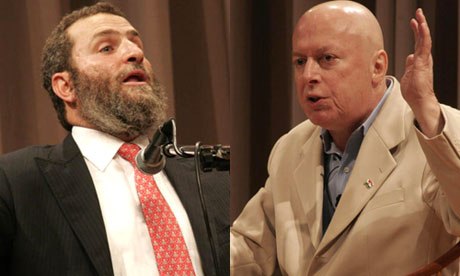
The Adelsons also have heaped largess on one particular New Jersey race. It has a religious connection too. According to reports Adelson, CEO of the Las Vegas Sands empire, along  with wife, Miriam,  have given $500,000 to the Patriot Prosperity PAC, an independent super PAC supporting the Republican Rabbi Shmuley Boteach. Boteach  is a TV celebrity, author of “Kosher Sex,” host of the show “Shalom in the Home,” and former spiritual adviser to pop star Michael Jackson. He  is running against eight-term incumbent Democrat Bill Pascrell, Jr. in a newly redrawn 9th District that includes Paterson.

The Adelsons’ total  support for the Rabbi comes to more than $1 million this year. Pascrell and the Rabbi recently  debated at Temple Sinai in Tenafly NJ. The main topics were an exchange of  views on Israel and the economy. Boteach said taxes were too high under the Democratic administration, crippling job growth.  
We need some religious sponsored trickle down apparently.

Images

  1. Ryan and Reed: http://article.wn.com/view/2012/08/11/Paul_Ryan_firebrand_from_Wisconsin_has_built_reputation_on_f/
  2. Sheldon Adelson: http://politicalticker.blogs.cnn.com/2012/11/05/adelson-makes-his-case-for-backing-gop/
  3. Shmuley faces off with Hitch: http://www.vanityfair.com/online/daily/2010/09/christopher-hitchens-still-doesnt-believe-in-the-afterlife

Thursday, September 13, 2012

A Meaning Too Far: Macaca and Holocaust Moments


By Gary Berg-Cross

Words are used as surrogates to look into what people are thinking about candidates. Below is a partial list of unweighted word counts that people apply to President Obama. These are emotional words and part of sentiment analysis (which was pioneered to see what people thought of car and brand names):

Good/good man/good job 38
Trying/Tried/Tries 30
President 27
Failed/Failure 25
Incompetent 24
http://www.washingtonpost.com/wp-srv/politics/polls/postpewpoll_20120903.html

As you can see it is a mixed list of good and bad, but the good polarity sentiments outnumber the bad.

That’s analysis of what people think. Analysis going the other way looks at how speeches are crafted to make people think a certain way about a candidate or topic. There was a bit of a word storm of analysis after the recent political conventions. Commentators made much of the fact that Romney ignored the Afghan war and hadn’t said the word. But beyond that papers such as the NY Times did detailed analysis on which words were actually used and what we might surmise was the “message” being thrown out.

The graphic below is from the Times and shows that Barack Obama used the word “Health” or the phrase “Middle Class” much more than Romney who used God and Business much more. You can also see a chart of the words used by just Romney and other speakers from the NY Times. Words associated with foreign policy accounted for a small part – but the recent events in Libya have turned that around a bit. Pundits have always discussed campaign wars of words and the stories they tell, but text analysis has gotten incrementally more sophisticated to get closer to understanding the meanings that speech writers try to evoke and the images they cast. Words & phrases like “American Exceptionalism” used this way may have an uncertain alignment with history and external reality.

It has all to do with evoking powerful concepts a person already believes in. The skill is often in getting that fine tuning of moving people just a little way from where they are to where you want them to be. Use a phrase like “American Exceptionalism” often enough and it becomes a tool. You can then wrap your statements in this familiar language with just a hint of evidence (I created jobs) and hope your audience makes the connection you want. You might suggest that Entrepreneurs are part of “American Exceptionalism”. Tell that story and imply that community organizers are less a part of this. They don’t create jobs and are not “Exceptional”– look at the trouble they make.

Of course the story may go wrong if you deviate too widely and seem unfair.

Language requires massive amount of  commonsense knowledge, knowledge
 that a 5 year old has based on experience, but a computer problem doesn’t have. Connecting certain words makes sense and conveys an meaning in normal circumstance. So we may talk about picking up a “blue toy”, but not “burning a blue virtue”. Older kids may even understand a proposition such as “ the far table needs some more soda” even thought tables don’t drink.  We understand that the table includes people who do drink. We buy into the idea being communicated with an interpretation.

But political language can stretch our comprehension system a bit beyond its comfort zone and into interpretations we may find aesthetically disturbing. I’m thinking of the language of politicians like George Allen, Virginia’s 67th Governor, who had a "Macaca” Moment caught on camera. It seemed extreme and racist to label a citizen with an oblique monkey reference this way. It’s a triangle of meaning as I've blogged on before, with words too far from the concepts most of us have. Of course Allen just thought he had chosen the wrong word, but people judged a meaning in the word and perhaps too cheap a political trick to stir the crowd's emotions. More recently Republican Rep. Roscoe Bartlett a 10-term incumbent from Frederick County MD,  had a difficult moment. Bartlett is battling Democratic challenger John Delaney, a financier from Montgomery County in a redrawn district. He was asked during a town hall meeting in Cumberland MD if he favored government-issued student loans. Bartlett replied that such loans are unconstitutional - bad sentiment there. He thought that ignoring the Constitution to do something good (helping students has a good sentiment) can be “a very slippery slope.” What was he trying to connect government loans to? What was the path he saw? He cited the Nazi attempt to exterminate the Jews during World War II as an example of something bad that could happen if we support the federal government’s role in subsidized student loans. Here’s what he said about that slipper slope:


“The Holocaust that occurred in Germany -- how in the heck could that happen? And when you start down the wrong road, it can be a very slippery slope."

He’s apologizing vigorously for this poor choices of words and may be on a slippery slope himself, but what about his concepts? He finds no evidence in the U.S. Constitution that the federal government should be involved with education or that student loans were “a good idea.” This seems so 18th century and what, I guess, some call strict constructionism. Well at least people in parts of MD will have a chance to think about what a simple term like "student loans", "federal government" and "slippery slope" mean to people like Bartlett. The truth is that we often need more than commonsense to interpret political talk which is full of gaps and jumps and historical and cultural reference. There' s a plethora of things not spelled out in the constitution such as privacy rights that slick talk may make seem easy issues, but they are not since they involve more than some obvious meaning in a phrase like "student load" and who is responsible for what as part of that commitment. It's important to inquire into what is really being argued in these seemingly simple statements.


Image Crdits
Sentiment Analysis: http://googlewatch.eweek.com/content/google_search/google_gamed_by_cyber_bullies_needs_sentiment_analysis.html
George Allen: http://www.answers.com/topic/macaca-slur