Showing posts with label charter schools. Show all posts

Friday, January 22, 2016

Shopping at Walmart is equivalent to drinking water from the Flint River

Edd Doer cites Courtland Milloy’s Jan 20 column in the Washington Post: 

“To get approval to build three stores in wealthier parts of the city, Walmart promised to build two in under-served neighborhoods. So they built the three they wanted. Then, last week, Walmart told city officials that it . . . decided not to build them. . . . To make room for the new, Walmart-anchored Skyland Town Center in SE Washington, the city had demolished a tattered but vital neighborhood economy. . .  Some apartments were also demolished, and residents were displaced.”

Walmart, probably the world’s largest retailer, is noted for underpaying its employees, many of whom need food stamps to survive, while exporting American jobs to foreign sweatshops. Walmart’s incredible profits feed the Walmart Family Foundation, which in turn pours tsunamis of tax-free money into massive efforts to undermine public education through vouchers  and charter schools not answerable to taxpayers. On Jan 13 Education Week reported that the Walton Family Foundation will now spend $1 billion on its efforts to sabotage public education.

So the Walton gang is giving the finger to Americans generally, the middle class (what’s left of it) and the poor (whose numbers are growing), and the public schools and teachers serving nearly 90% of American kids.

So shopping at Walmart is equivalent to drinking water from the Flint River or voting for Scott Walker.

 Happy New Year!

Friday, November 13, 2015

Selectivity of NYC charter schools

Edd Doerr notes that this excellent  letter by Martin Brahms was published in the NY Post on 11/13/15. 

Brahms is a NY writer who frequently gets letters published in NY papers. I wish more of us would take advantage of this medium of communication. It is one cheap way of engaging on issues of importance and hopefully influencing opinion. (I have had several thousand letters published in papers and magazines across the country.over the years.) 

Dear Editor
Although the Post may deny it, the selectivity of NYC charter schools is well-established. Their student populations contain a far lower percentage of children with learning disabilities or who cannot speak English than do the regular public schools. Disruptive students are quickly expelled and kids who cannot cut it academically are  routinely "counseled out" to become the responsibility of the "failing" public school system.  It is also no secret that the vaunted charter school "lotteries" draw in kids from stable families who are more committed to their children's education rather than kids from dysfunctional family backgrounds.

Martin Brahms
Brooklyn, N.Y. 

BTW for an earlier comment on one of Marlin's letters see Charter Schools 
See also 

Pauvre, Pauvre NYC Charter Schools?

Monday, October 26, 2015

Charter schools...an underminer of our public system


Edd Doerr, President of Americans for Religious Liberty, published his letter  in the New York Daily News on Oct 16, 2015  ----


“Charters vs  public schools”

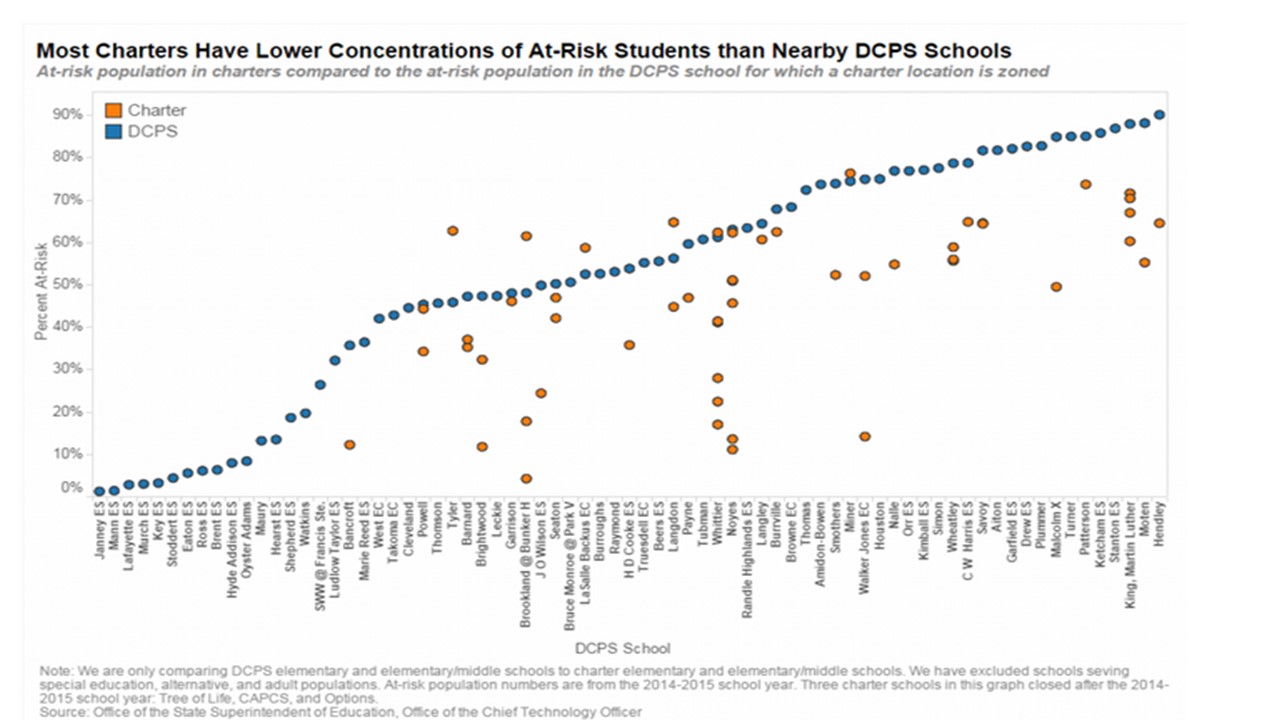
Voicer Martin Brahms’ letter on charter schools was spot-on. Nationally, Washington’s large array of charter schools is considered the best in the US.  But a just-released study of DC charter schools reveals that about 90% of them serve far fewer at-risk kids than nearby regular public schools. Charter schools are part of a national campaign to undermine the public schools that, under- and unevenly funded, have served 90% of our growing population.
See also this Salon article


Friday, October 09, 2015

DC charter schools serve fewer at-risk students than nearby neighborhood [public] schools

Edd Doerr thinks that the  Oct 8 Washington Post online article  by Michael Alison Chandler “DC charter schools serve fewer at-risk students than nearby neighborhood [public] schools” is "Dynamite".

He noted curiously, that the Oct 9 print edition of the paper did not run the story. Here is what Edd posted in the paper online ---

The article details, with maps and charts, how about 90% of DC’s large charter 
school array serve fewer at-risk kids than nearby public schools and are rather selective, which regular public schools cannot be. As the DC charters are regarded as some of the best in the US, what does this say about charters generally? The big question is why did the Post omit this article from its Oct 9 print edition?

There is a strong consensus among educators and others that charter schools – and school voucher plans – are part of an ongoing Republican/conservative campaign to undermine and privatize public education. Diane Ravitch, Mercedes Schneider, and many others, including myself, have been writing about this for a long time.

DC School Vouchers

The Washington Post on Oct 9 did publish this story by Lyndsey Layton, ”8 on [DC] council seek end to private school vouchers.” The story refers to a letter that a majority on the DC City Council sent to a congressional committee on Oct 8 urging no further expansion of the school voucher plan imposed on the District of Columbia by Congress and the George W. Bush administration. You should be able to Google the story. Here is the comment I posted online ---

“Excellent! The Council majority accurately reflects public opinion against vouchers. Remember that in 1981 DC voters voted down a tax-credit voucher plan by 89% to 11%. Remember that DC vouchers are paid for not just by DC taxpayers but by all taxpayers nationwide.
“Let’s note also that the annual Gallup education poll in August showed that Americans nationwide oppose diverting public funds to private schools by 57% to 31%, a supermajority that has held for nearly 50 years and that is reflected in the 28 state referenda from coast to coast from 1966 through 2014.”

Friday, May 15, 2015

Numbing Ideas to Destroy Public Education

A review by Edd Doerr

A Democratic Constitution for Public Education, by Paul T. Hill and Ashley E. Jochim. University of Chicago Press, 2015, 152 pp, $22.50.

This strange book, paradoxically, is at once mind-numbingly simplistic and almost infinitely complex. While purporting to “reform” American K-12 education inside-and-out, top-to-bottom, it actually makes anarchy look well organized by comparison. Fortunately, this vehicle is so Cloud-Nine Twilight-Zone weird that its proposal is unlikely to get off the ground, except maybe in places like Louisiana. One clue to its far-out-ness is its paying respect to such as Chester Finn, Bruno Manno, Milton Friedman, Joel  Klein, and Chubb and Moe while ignoring educators like Diane Ravitch, David Berliner, Mercedes Schneider, and the Lubienskis.

While the book does  not overtly plug vouchers, charters, online teaching for children, and similar bad ideas, Hill is a long time avid promoter of such devices for undermining public education and the teaching profession, while blithely oblivious to state constitutions and well established laws and institutions. He has even gone so far as to propose coalitions of religious groups to start tax-supported schools. Nowhere in this awful opus do the authors demonstrate the slightest concern that their bizarre scheme would do other than fragment our school population and society along religious, ideological, class, ethnic, linguistic, ability level, and other lines; create logistical, financial and traffic nightmares; and siphon public funds to rapacious private pockets while reducing teachers to the level of transient hamburger flippers.

The University of Chicago Press would do well to disown this clunker and avoid further embarrassment.


(Edd Doerr, a former history and Spanish teacher, is president of Americans for Religious Liberty.)

Friday, May 08, 2015

Separation Of Church & State: A Challenged Principle

by
Allan Powell, Professor Emeritus, Philosophy, HCC

Separation Of Church & State: A Challenged Principle

          American political values rest on several fundamental principles clearly stated by the founders of our republic. We do not debate the separation of powers or the supremacy of civilian dominance of military forces. Strangely however, there is an open and active resistance to the concept of a separation of church and state. Yet, this idea should be a most natural policy when it is remembered that most European settlers came here to escape tyrannies where church and state were combined. They were keenly aware of the abuse of power when two of the most conservative social forces conjoin.
          Separation is imperative because of the potential for religion to sanctify evil and claim divine approval for misdeeds. However, while it is important and necessary to keep a constant vigil to block the collusion of church and state, the task is difficult because of public apathy and a shortage of funds.
          There are, nonetheless, a number of religious denominations which are active in supporting the separation principle. They support organizations that monitor the many attempts to breach the wall of separation. It is costly to hire lawyers to bring the cases into court, support the publication of journals and maintain a speaker’s bureau to hold meetings for public education.
          The most durable and powerful source of support are the words of those who wrote the original documents such as James Madison and Thomas Jefferson. Also useful, are the opinions given in Supreme Court decisions. Former President, James Madison declared that, “The number, the industry, and the morality of the Priesthood, and the devotion of the people have been manifestly increased by the total separation of the Church from the State”. This should carry special weight since Madison was regarded as “the Father of the Constitution”.
          Thomas Jefferson made a direct connection between the principle of separation and the Constitution (1st Amendment) in a letter to the Danbury Baptist Church in 1802. Jefferson writes, “Believing with you that religion is a matter which lies solely between man and his God, that he owes account to none other for his faith or his worship, that the legislative powers of government reach actions only and not opinions, I contemplate with sovereign reverence that act of the whole American people which declared that their legislature would make no law respecting an establishment of religion, or prohibiting the free exercise thereof, thus building a wall of separation between church and state”.
          A recent issue of one of these journals gives a list of the kinds of actions they expect from the new members of Congress. It will be evident that there will be no rest for those who struggle to keep a “wall of separation” between church and state. First will be a new effort to advance “voucher schemes” that John Boehner (House) and Mitch McConnell (Senate) call “school choice expansion”. They are actually referring to charter schools. Others (e.g. Ted Cruz), have vouchers in mind. These “schemes” are a way to funnel taxpayer money to sectarian schools.
          Analysts are expecting an increase in what is called “religious freedom exemptions” made possible as a consequence of the Supreme Court decision in Burwell v. Hobby Lobby Stores. It will be recalled, that in this case certain employers could now, on the grounds of religious freedom, make medical decisions effecting employees. It is supposed that the door has been opened for more extensions of religious liberty. It is likely that there will be attempts to expand the teaching of creationism and to restore prayer in public schools.
          There is some concern about the increase in the practice of some churches to abuse their tax exempt status by becoming involved in partisan elections. A study of voting turnout of the 2014 election shows that the religious right had a much larger voter turnout while there was a notable decline in other voter categories. Ralph Reed is reported to have openly stated that his group distributed 20 million voter guides in 117,000 churches. These guides were claimed to have been given to Republican voters.
          On my desk are two journals that I have supported for 30 and 40 years respectively. Both have been reporters of the whole range of issues involving the separation of church and state. It is saddening to conclude that there is little improvement in maintaining the “wall of separation” from abuse. Our efforts appear to be somewhat like those who fight forest fires. After you have struggled painfully and get out that fire, you get word that there are two more up the road.


Allan Powell, Professor Emeritus, Philosophy, HCC