Showing posts with label Susan Jacoby. Show all posts

Tuesday, July 02, 2013

Through Orators Robert Green Ingersoll Speaks

By Gary Berg-Cross

Americans would be wiser and better informed if their reading and education included a good dose of the thoughts of 19th century freethinker Robert Green Ingersoll. It's a point made before in my blog - Hearing the Voice of Freethinking Robert Ingersoll. As Susan Jacoby illustrates in her new book Robert Ingersoll: "The Great Agnostic and American Freethought" Ingersoll is one of the indispensable public figures.  He not only speaks bravely on the issues of the day, but helps protect the historical record and keeps a deeper, alternative version of history alive. In Ingersoll’s case that alternative history included Tom Paine’s forgotten secular history. In the case of issues from Ingersoll's time these included women's rights, immigration, humanistic literature and evolution.  It is worth noting that these retain their divisive potency in our times.  And it is wonderful to report that these and other topics were on display recently at the 3rd Ingersoll Oratory Contest held in DC.

While rain forced a change of venue Sunday (to James Hoban's Restaurant ) we had a very nice event. Eleven contestants, traveling from as far as Florida, Indiana, and Delaware competed for 4 prizes.  Steve Lowe served nobly as Master of Ceremonies with assistance from Beth Kingsley, Brian Magee and Suzanne Perry. Links to photographs and videos will be posted on the Ingersoll Oratory Facebook site and now are available, but a random sample of quotes and images is below.

Carol Ardell kicked off the event by a reciting, from memory, Ingersoll’s Twentieth Anniversary Lotos Club Dinner speech(1890). It begins sagely:


YOU have talked so much of old age and gray hairs and thin locks, so much about the past, that I feel sad. Now, I want to destroy the impression that baldness is a sign of age. The very youngest people I ever saw were bald.
                                                    (These and other quotes from Secular Web)

It goes on:

I am perfectly satisfied that the highest possible philosophy is to enjoy today, not regretting yesterday, and not fearing tomorrow. So, let us suck this orange of life dry, so that when death does come, we can politely say to him, "You are welcome to the peelings. What little there was we have enjoyed."

Terrance Madden followed with a reading from “Thomas Paine (with his name left out the history of liberty cannot be written.)”

At the age of thirty-seven, Thomas Paine left England for
America, with the high hope of being instrumental in the
establishment of a free government. In his own country he could accomplish nothing. Those two vultures Church and State – were ready to tear in pieces and devour the heart of any one who might deny their divine right to enslave the world.


This was followed by Mike Schmidtmann who greeted fellow Humanists before reading “About the Bible” & “The Ten Commandments.” Donald Ardell also recited part of Ingersoll’s About the Holy Bible  which starts:

Somebody ought to tell the truth about the Bible. The preachers dare not, because they would be driven from their pulpits. Professors in colleges dare not, because they would lose their salaries. Politicians dare not. They would be defeated. Editors dare not. They would lose subscribers. Merchants dare not, because they might lose customers. Men of fashion dare not, fearing that they would lose caste. Even clerks  dare not, because they might be discharged. And so I thought I would do it myself."

Speaker selected topical talk including:
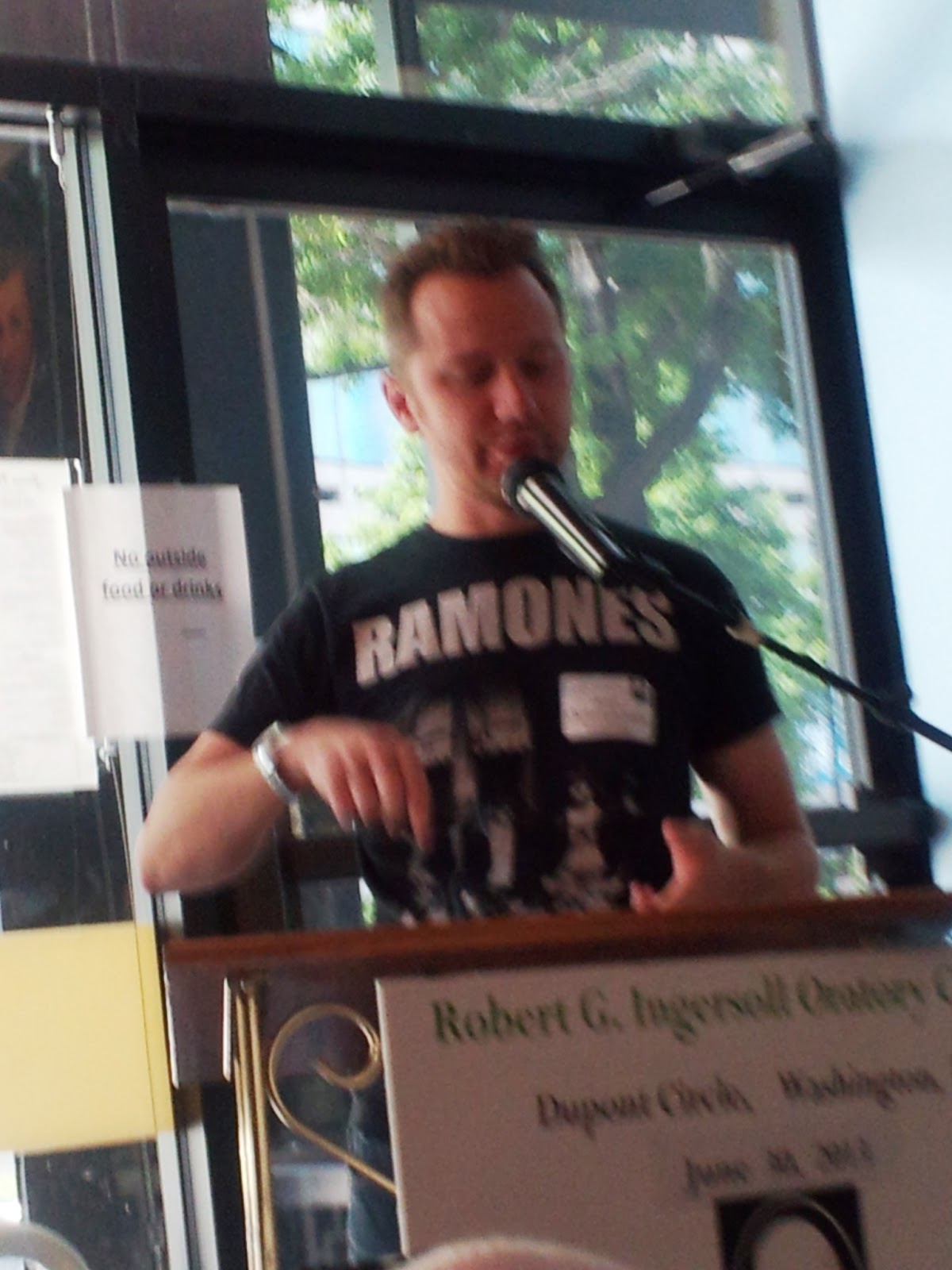

Jesse Christopherson, reciting “The Liberty of Man, Woman and Child”, 
"There is no slavery but ignorance. Liberty is the child of intelligence."

Cody Smart heartfully recited, “What is Religion” -  Ingersoll's last public address,delivered before the American Free Religious association, Boston, June 2, 1899.


"For many centuries and by many peoples it was believed that
this God demanded sacrifices; that he was pleased when parents 
shedthe blood of their babes. Afterward it was supposed that he was
satisfied with the blood of oxen, lambs and doves, and that in
exchange for or on  account of these sacrifices, this God gave rain,
sunshine and harvest. It was also believed that if the sacrifices
were not made, this God sent pestilence, famine, flood and
earthquake."
 
 
and Amelia Vogel read some of Ingersoll's beliefs from, “Suicide and Sanity.”

"man is under no obligation to the imaginary gods; that all his 
obligations and duties are to be discharged and done in this world; 
that right and wrong do not depend on the will of an infinite Being, but on the consequences of actions, and that these consequences 
necessarily flow from the nature of things. I believe that the universe 
is natural."


As to what the 3 judges decided:

  1.  Sarah Henry took first place reading from "Improved Man"
  2.   Terence Madden took second place reading from Ingersoll's talk about Thomas Paine.
  3.     
  4. Third place was won by Tya M. Pope who chose from two related speeches: "A Christmas Sermon" and What I Want for Christmas".


 All agreed that the performances were excellent and left us a bit more thoughtful and perhaps wiser:


‘I believe that all actions that tend to the well-being
of sentient beings are virtuous and moral. I believe that real
religion consists in doing good. I do not believe in phantoms. I
believe in the uniformity of nature; that matter will forever
attract matter in proportion to mass and distance;’….

          Partial answer to QUESTION: What is your belief about virtue, morality            and religion? In Suicide N Sanity
 

Images


Taken by Gary Berg-Cross at the Event.
Brian - a helper.

Tuesday, May 14, 2013

Hearing the Voice of Freethinking Robert Ingersoll


By Gary Berg-Cross

You may have heard that WASH is holding its annual banquet in Lynchburg, VA this year on May 25. All are welcome to come. You don't need to be a WASH member to attend. Details and registration are available at:
http://washbanquet2013.eventbrite.com/

It’s a chance to join other secularists in what many call the "belly" of the fundamentalist beast.  It’s an easy label since Lynchburg is the home of the late Rev. Jerry Falwell's evangelical Liberty University and Thomas Road Baptist Church. WASH will be e serving an excellent buffet with a cash bar and food for thought.  Our speaker will be Dr. J. Anderson Thomson and the topic will be the cognitive science of religious belief.

I’m sure that Robert Ingersoll would attend if he were alive today, but I’m glad to see his ideas and life abroad in the land. Bill Moyers had a show on in March 2013 called Fighting Creeping Creationism. The 2nd part of the show, which you can see via the link above, was a wide-ranging conversation with journalist and historian Susan Jacoby who expounded on the role secularism and intellectual curiosity have played throughout America’s history from its founders on.


This is a topic explored in her new book, The Great Agnostic: Robert Ingersoll and American Freethought. Jacoby is the perfect person to play the role of bringing Ingersoll,  “mover and shaker” of the early Republican Party, back into mainstream discussion.  Seven score years ago Ingersoll did the same secular resurrection for Tom Paine.

For most of us Ingersoll, like Paine is largely forgotten today although earlier he was listened to on topics of the separation of church and state, Darwin’s theory of evolution,  women's rights and much more.
His Centennial Oration gives one a feeling about the timely relevance of his thought:

THE Declaration of Independence is the grandest, the bravest, and the profoundest political document that was ever signed by the representatives of a people. It is the embodiment of physical and moral courage and of political wisdom....

Such things had occasionally been said by some political enthusiast in the olden time, but, for the first time in the history of the world, the representatives of a nation, the representatives of a real, living, breathing, hoping people, declared that all men are created equal. With one blow, with one stroke of the pen, they struck down all the cruel, heartless barriers that aristocracy, that priestcraft, that king-craft had raised between man and man. They struck down with one immortal blow that infamous spirit of caste that makes a God almost a beast, and a beast almost a god. With one word, with one blow, they wiped away and utterly destroyed, all that had been done by centuries of war — centuries of hypocrisy — centuries of injustice.

What more did they do? They then declared that each man has a right to live. And what does that mean? It means that he has the right to make his living. It means that he has the right to breathe the air, to work the land, that he stands the equal of every other human being beneath the shining stars; entitled to the product of his labor — the labor of his hand and of his brain.

What more? That every man has the right to pursue his own happiness in his own way. Grander words than. these have never been spoken by man.”
 
If you would like to hear more about Ingersoll’s “controversial” ideas come to the  Ingersoll Oratory contest in Dupont Circle starting at noon June 30th, 2013. There’s a lot of great oratory to chose from, the great Ingersoll  delivered more than 1,200 speeches to packed houses across the country in the late 1800s. His arguments were usually succinct, thought provoking, insightful and still speaks to contemporary issues.
Fifteen speakers will select their favorite pieces to orate some of these ideas.  Susan Jacoby will be there as one of the judges making it a great event for secular DC.

Also of note, WASH board member Steven Lowe offers walking tours of Ingersoll’s life in DC. Upcoming are morning walks June 20th and 29th.
 

Sunday, June 23, 10 am: short version** - meet at SW corner 13th & E St. NW

Saturday, June 29, 9:30 am: long version* - meet at 450 F St. NW

*Long Version: a 1.5 mile walk lasting 2 hours, visiting 11 locations.
- Meet at 450 F Street NW.( the Building Museum/Judiciary Square METRO street level)


These take you through the oldest parts of Washington, D.C., to visit the sites where Ingersoll lived, worked, or spoke.

Images


Friday, July 20, 2012

Battles Discussing the Elites -America Lite & Twilight of the Elites


by Gary Berg-Cross
In this book-crowded summer of contentious reads David Gelernter has added to the pile with his America-Lite: How Imperial Academia Dismantled Our Culture (and Ushered in the Obamacrats). One may agree with some of the broad statements: "The nation is filling inexorably with Airheads, nominally educated yet ignorant; trained and groomed like prize puppies. " But wait a minute who does he say are the puppies? Good liberals. Oh, I had some other airheads in mind. Did Gelernter follow the Republican primary?
 
The book's already the object of battling reviews. The National Review cautiously likes it and talks about it's argument of Dismantling of a Culture - "America’s elites now disdain the rest of America." 

They interviewed a disgruntled Gelenter, who was happy to add to his earlier arguments from Americanism:The Fourth Great Western Religion.
In that earlier work Gelenter asked what it means to “believe” in America? Why do we always speak of our country as having a mission or purpose that is higher than other nations? I think our founders gave us some hope for this with things like separation of church and state.  But David argues that modern liberals have "invested a great deal in the notion that America was founded as a secular state, with religion relegated to the private sphere." So to Gelernter, America is not secular at all, but a powerful religious idea—that males its sort of a religion in its own right. What kind you ask? Gelernter says that what we have come to call “Americanism” (as in American Exceptionalism) is in fact a secular version of Zionism. This is scary language to some since Zionism has produced a conservative state based on religion. And it attitude towards the use of the military option and settling disputes with neighbors leaves something to be desired.

His new book takes off from there to continue the attack on intellectual elites, a topic I've blogged on earlier.

"In a piddling few decades, the world’s most powerful, influential cultural establishment happened to get demolished and rebuilt from the ground up. What had been basically a Christian, patriotic, family-loving, politically moderate part of society became contemptuous of biblical religion, of patriotism, of the family, of American greatness. The American cultural elite used to resemble (more or less) the rest of America. Today it disdains the rest of America. That’s a revolution."

A good counter arguement to Gelenter's is offered in Russell Jacoby's review of the book in an article called Dreaming of a World With No Intellectuals.

As he notes Gelernter highlights the role of American Jews as a way to trace the enormous cultural change and its consequences in higher education. But Gelenter's argument seems to be one of selective data and does not live up to comparative analysis as suggested in the quote below from Jacoby's review which includes quotes from the book.
"Up through the 60s, the WASP establishment excluded Jews from elite universities. But by 1970, Jews had pushed their way into student bodies, faculties, and administrations. The consequences? Again, easy. Jews are both leftist and aggressive. "Naturally, we would expect that an increasing Jewish presence at top colleges" would imprint the schools with those qualities. "And this is just what happened." Colleges and universities became more leftist as well as more "thrusting" and "belligerent."...
"Gelernter is Jewish, and it is not likely that a non-Jew would airily argue that obnoxious leftist Jews have taken over elite higher education. But Gelernter does so with enthusiasm untempered by facts. Aside from quoting Jewish neoconservatives such as Norman Podhoretz as sources, Gelernter does not offer a single example of what he is writing about. Who are these belligerent leftist Jewish professors? Anthony Grafton? Steven Pinker? Richard Posner? Martha Nussbaum? Perhaps Alan Dershowitz?
Moreover, the entire formulation remains vague. What does it mean that colleges have acquired "a more thrusting, belligerent tone"? The whole college? The administration? The students? One might imagine that Brandeis University, founded in 1948 by Jews, would be a perfect example to verify Gelernter's argument. Is it loud and leftist? Gelernter does not mention it."

Chris Hayes has also written a book this summer on called Twilight of the Elites. In Hayes' view the problem is less ideological of left and right and more of elite self interest which detracts from solving problems. "Part of the problem is that this kind of elite solidarity, this self-protection impulse, it stretches across the public and private sector, and it stretches across, in some way, ideological lines," (More on Hayes book, perhaps in a later post.)

It would be great to get Chris and Gelernter to debate this point and one might hope we could see this on Chris's weekend show Up with Chris Hayes. If he invites Susan Jacoby to the discussion it should be world class. She was great when the Up show discussed the Reason Rally this Spring. He could also invite Janine R. Wedel who could discuss her idea of Shadow Elite - see
The Scandal of Anti-Intellectualism and Elites.


Picture/Image Credits

America Lite:http://www.writersreps.com/America-Lite
American Zionism: http://www.fourwinds10.net/siterun_data/history/zionism/news.php?q=1341887958
Twilight of the Elites: America After Meritocracy : http://www.insidehighered.com/views/2012/07/11/review-christopher-hayes-twilight-elites-america-after-meritocracy
Why Are Jews Liberals?:http://www.toqonline.com/blog/sailer-on-podhoretz/

Sunday, March 25, 2012

Up With Chris Hayes discusses Atheism and the Reason Rally

by Gary Berg-Cross
Sunday morning had a great media follow up to the Reason Rally. The Up With Chris Hayes show on MSNC had a fabulous panel of Susan Jacoby, Steven Pinker, (Cognitive Psychologist), Jamila Bey (Evangelical Atheist from WAPO), Progressive voice on Citizen RadioJamie Kilstein and Robert Wright (Evolution of God). "An unprecedented look at atheism in America."

They discussed the place of atheism in their life, the history of religious freedom in the US, war, the atheism and morals of Ayn Rand, the Political Right, Libertarianism and how political-religion coalitions and how they influence each other.


Tuesday, August 23, 2011

Critical Thinking in a Time of Political Truthiness


By Gary Berg-Cross
You can tell from just a few campaign snippets that a form of cultural mania approaches. Conservative politicians who oppose tax increases un-reflectively and inconsistently oppose keeping the payroll tax cut. Rick Perry & friends espouse some very scary thoughts in the name of religion with little discussion of the consequences. There’s talk of dismantling Social Security as FDR's safety net legacies are described as affronts to the Constitution. There’s nary a line of historical validity or facts in the frayed debates. And the assault of principled thinking and honest debate goes on. Truthiness boldly rides  forth, as reason, clear thinking and real problem solving is shoved back a few steps and the popular mind is numbed. There’s little real analyze of arguments and/or assumptions. On the rare occasion that challenge questions are asked, non-stick talking points are ejected without the structure of a reasonable argument.

 It’s yet another phenomena supporting Susan Jacoby’s theory explored in The Age of American Unreason that America has immatured into an anti-intellectual culture filled with junk thought.
The tone of discussion already takes me back to a moment in 2004 when George W. was running for re-election. I happened to walk by a college’s Humanities' office. Some professor has posted a description of a course on Critical Thinking. It was full of good sense and the search for truth, but seemed like something from an earlier age when liberal education was in vogue and before the ascendency of a vocational brand of higher education. Looking at the course description I could see an enlightened view of education that fosters some skill in reading, reflection, and interpretation. 

 These are needed and should be highly prized in any culture, but they seem to be drifting out of the reach for many people. This is part of the argument made by Richard Arum and Josipa Roksa in their Academically Adrift (2011), which summarizes the findings of their analysis of the efforts and expectations of a large sample of American undergraduates. An example of findings is that 45 percent of students "did not demonstrate any significant improvement in learning" during the first two years of college and 36 percent of students "did not demonstrate any significant improvement in learning" over four years of college.
As I walked on I imagined how a person teaching critical thinking might feel during an election campaign. There might be so much to talk about, but they might also feel like a salmon jumping barriers and swimming upstream. It’s what I felt in 2004 and I feel it again as we approach the full campaign of 2012. The distance between political posturing and a real examination of issues is disappointing. There’s an unreality to it, at least from the rational part of the mind.
One legacy of the Bush administration is a disdain for reality as we understand it from a critical standpoint. Exhibit 1 of this was reported by The New York Times correspondent Ron Suskind during Bush’s 2004 re-election campaign. Suskind described a meeting with a senior Bush aide who put down journalist’s as members of a “reality-based community”. This he defined as one which is based on the belief that “solutions emerge from a judicious study of discernible reality.” Seems reasonable to me, but the aide argued at the time that this was old thinking and no longer practical. In this he echoed VP Cheney who preferred his theories of reality (remember not only weapons of mass destruction but also “deficits don’t matter) to any validated reality. His preference was for what seems to me a Napoleonic, action-oriented take on the new reality, which Bush’s aide explained this way:
“That’s not the way the world works anymore…when we act, we create our own reality. And while you’re studying that reality—judiciously, as you will—we’ll act again, creating other new realities, which you can study too…all of you, will be left to just study what we do.”
As I listen to some economic arguments this philosophy of artificial, reactively created “reality” seems to be riding forth again. At least this is the way the idea of cutting stimulus efforts in an attempt to reduce the deficit strikes me. This again reminds me how frustrating it must be to teach critical thinking when the culture abounds in uncritical thinking on so many levels. In a season with the media filled with talking points and sound bites (or bytes), I have that feeling again that we under-value skepticism, challenging questions and reality testing. Maybe it is the new normal. But we still have time to heed Ernest Hemingway's paraphrased advice that writers (all of us) need a built-in baloney detector.

What we should insist on is that any pols' explanations on subjects like the economy, unemployment, the role of stimulus to reduce unemployment, and the value of tax cutting be treated critically. These should be treated as theories or testable hypotheses. As a theory they make claims about what is true and real of the world. How do we know they are valid or even plausible? We test them critically to winnow the good from the bad, the real from the fake. For one thing theories must be consistent with observations. These include historical as well as contemporary observations, so what happened to the economy and employment under FDR should be part of the discussion. The rise of deficits under Reagan and George W. Bush are more recent observations. No observation can contradict a true theory. But many observations may be irrelevant to a theory that is true about some limited aspect of the world. And that is what we often get in political debates. People get away with it because social theories are complex and because critical analysis is hard. They require disciplined reasoning and command of the facts. They also require careful clarifications supported by credible & reliable judgments about sources of information and the quality of observations.It's all part of a good conversation about a topic.


(Picture above  from http://www.mindmapart.com/critical-thinking-mind-map-adam-sicinski/)

But these are all hard things to do in an anti-intellectual stew of mis-information.  What we need to understand and agree on is that they are worth the effort and needed in a Democracy.

 It’s an educational imperative as Jefferson noted -the time to start teaching the process of critical thinking is as early as possible so it becomes a habit and natural.