
By Gary Berg-Cross
Philosophy probably has had an equal number of word creations if not more. Among them are concepts like consciousness, self, spirit, will and free will. Is there a reality to them? Some like spirit, that have been pulled into religion and laden down with dogma, no longer seem viable as causal philosophical concepts. Others like consciousness seem fair game for a joint cognitive science-philosophy effort.
The Free-Will versus Det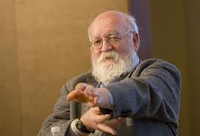 erminism argument has been raging for quite a while and very now and then every now and then some thinker takes a whack at it. This usually stirs the pot anew. Philosophers with a good grounding in modern science have provided some new perspective on the topic using neuroscience and an evolutionary perspective. For example Daniel Dennett’s in his Consciousness Explained (1991) approached the issue something like an update to David Hume’s ideas in the light of our neo-synthesis of Darwin's theory of evolution. Dennett calls the idea that we live in the here and now, moving steadily into the future an illusion. Instead cognitive "real time" is a spider web process of zigzagging through memories as we assess our progress on goals, hopes, plans and regrets! Indeed,in his view the Self like Consciousness is a type of internal reification. It is a constructed web of tales spun by us to make sense of experience. To Dennett our human consciousness, along with our narrative self-hood, is a product of experience not their source. This makes sense for several reasons including the fact that as children are learning language they see others as objects and so it is easy to identify oneself as a similar object. This concept of a conscious self serves a role of a unified agent who we can speak about in simple words. During this period we may pick up a term like "soul" and make a simple connection to a concrete concept so that the term comes becomes part of an unverified system of belief.
 erminism argument has been raging for quite a while and very now and then every now and then some thinker takes a whack at it. This usually stirs the pot anew. Philosophers with a good grounding in modern science have provided some new perspective on the topic using neuroscience and an evolutionary perspective. For example Daniel Dennett’s in his Consciousness Explained (1991) approached the issue something like an update to David Hume’s ideas in the light of our neo-synthesis of Darwin's theory of evolution. Dennett calls the idea that we live in the here and now, moving steadily into the future an illusion. Instead cognitive "real time" is a spider web process of zigzagging through memories as we assess our progress on goals, hopes, plans and regrets! Indeed,in his view the Self like Consciousness is a type of internal reification. It is a constructed web of tales spun by us to make sense of experience. To Dennett our human consciousness, along with our narrative self-hood, is a product of experience not their source. This makes sense for several reasons including the fact that as children are learning language they see others as objects and so it is easy to identify oneself as a similar object. This concept of a conscious self serves a role of a unified agent who we can speak about in simple words. During this period we may pick up a term like "soul" and make a simple connection to a concrete concept so that the term comes becomes part of an unverified system of belief.
More recently Dennett took on the issue of whether there can be freedom and free will in a deterministic  world in his Freedom Evolves. Surprisingly he frames his conclusion in the other direction considering the idea that as cognitive agents we can avoid some things we foresee. Our ability to understand some things mitigates the idea of inevitability.
"Some things we can avoid. We are free to avoid some things such as ducking to avoid a tree branch. Very useful, but it doesn’t work so easily with a Tsunami. So some parts of the future is inevitable and others not within a deterministic world. So some concept of freedom is not an illusion but an adaptive, objective phenomenon that is distinct from other biological conditions and found in only humans through evolution. We are less instinctual, automated creatures and can even chose to be non-adaptive to prove a point."
 world in his Freedom Evolves. Surprisingly he frames his conclusion in the other direction considering the idea that as cognitive agents we can avoid some things we foresee. Our ability to understand some things mitigates the idea of inevitability.
"Some things we can avoid. We are free to avoid some things such as ducking to avoid a tree branch. Very useful, but it doesn’t work so easily with a Tsunami. So some parts of the future is inevitable and others not within a deterministic world. So some concept of freedom is not an illusion but an adaptive, objective phenomenon that is distinct from other biological conditions and found in only humans through evolution. We are less instinctual, automated creatures and can even chose to be non-adaptive to prove a point."
See http://dontdontoperate.wordpress.com/2011/05/29/free-will-religion-without-god-dennetts-compatibilism/ for Dilbert's view on Free Will.
Even more recently Sam Harris has had a go at the issue in his The Moral Landscape (pp. 102-110), which has further stirred the pot. To Harris, unlike Dennett, the problem with free will is that no account of causality leaves room for it. All our internal life of thoughts, moods, and emotions effect of us in ways that are: “from a subjective point of view, perfectly inscrutable.”
Harris asks why he might have used the term “inscrutable” in the above sentence and answers for us that he has no idea. It is not clear that he was free or constrained to do this and even the meaning of the claim is inscrutable or opaque.
Harris’ stance mixes philosophy and cognitive-neuroscience observing that only a small fraction of momentary information that our brains process becomes conscious. This requires attention which we have in small amount. You can actually experience how limited this is in the selective attention video on YouTube.
The essential message is that human evolution has given us a cognitive system that allows us to note only important changes in our environment. It has not produced an all knowing or even totally rational system. We use simplifying models to helps us make sense of a complex world. While we are aware of some our inner life of thoughts and emotions, we are personally unaware of the neural events that produce these changes. Thus we generate models of the world of ourselves and of other people explain why things happen. These such as concepts of a unified self are simplifications, but pretty good ones to start with. It’s just that Science has moved us along and is helping us un-muddle the words used for concepts that are not simple “things” but processes.
Perhaps somewhere between Dennett and Harris’ views is Schopenhauer's summary statement pushing the issue a bit farther back to cognitive primitives:
'Man can indeed do what he wants, but he cannot want what he wants'.
It seems to capture an important aspect of the argument.


